

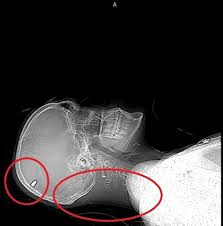
The exact prevalence of retained bullet fragments among survivors of firearm violence is unknown. In a single-center study of 298 patients admitted with a nonfatal gunshot injury, 225 (75.5%) had 1 or more retained bullet fragment and 202 (89.8%) were discharged from the hospital without fragment removal. Surgical removal may be limited by difficulty accessing the retained bullet, fragmentation of the ballistic, and proximity to critical anatomic structures such as the aorta and spinal cord.
Most bullets fired by and at civilians in the US are made of a lead alloy or have a lead core. Therefore, patients with retained bullet fragments may be at risk of lead toxicity. Elevated blood lead levels (BLLs), defined as more than 5 µg/dL, may cause irritability, headache, memory loss, weakness, abdominal pain, and joint pain. BLLs of 10 µg/dL or higher are associated with increased rates of hypertension and essential tremor.
In a meta-analysis that included 462 patients with retained bullet fragments, 11 of 12 studies reported an association between elevated BLLs and retained bullet fragments. The median BLL for retained ballistics was 9.01 µg/dL, which was 5.47 µg/dL higher than in controls. Accompanying fractures and multiple ballistic fragments were independent predictors for elevated BLL.
Patients with retained bullet fragments should undergo BLL testing every 90 days for the first year after injury and, if technically feasible, removal of bullet fragments if BLL is greater than or equal to 5 µg/dL.
References
Strong BL, et al. Sequelae and Care after Firearm Injury, JAMA 2025;334(8):726-727.
Nee N, et al. Retained bullet fragments after nonfatal gunshot wounds: epidemiology and outcomes. J Trauma Acute Care Surgery. 2012;90(6):973-976.
Apte A, et al. Lead toxicity from retained bullet fragments: a systematic review and meta-analysis. J Trauma Acute Care Surgery. 2019;87(3):707-716.



 How to resolve AdBlock issue?