

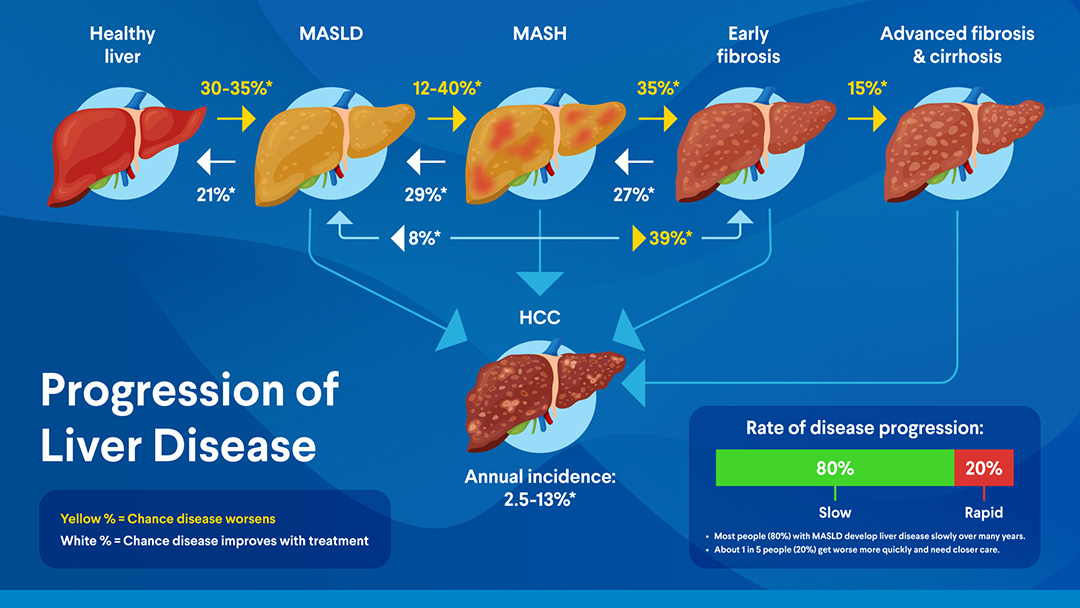
Metabolic dysfunction–associated steatotic liver disease(MASLD) was formerly called nonalcoholic fatty liver disease (NAFLD) and nonalcoholic associated steatohepatitis (NASH). MASLD is the most common chronic liver disease worldwide, affecting 30% to 40% of the general adult population globally. MASLD is present in 60% to 70% of individuals with type 2 diabetes and approximately 70% to 80% of those with obesity. The severity of MASLD can range from isolated steatosis to metabolic dysfunction associated steatohepatitis (MASH), which involves fat accumulation and inflammation in the liver. Left untreated, 13% to 18% of individuals with MASLD will develop hepatic fibrosis, cirrhosis, or hepatocellular carcinoma. MASLD also heightens the risk of developing cardiovascular disease, and extra-hepatic cancers such as gastrointestinal, breast, and gynecologic.
The diagnosis of MASLD is based on detecting hepatic steatosis usually with ultrasonography in combination with the presence of at least 1 of 5 clinical features of the metabolic syndrome: overweight or obesity, prediabetes or type 2 diabetes, hypertension, elevated plasma triglycerides, and low HDL-cholesterol.
Patients with MASLD can be further evaluated for fibrosis using vibration-controlled transient elastography and either the Fibrosis-4 index (FIB-4) or the enhanced liver fibrosis (ELF) test. Vibration-controlled transient elastography measures liver stiffness. The FIB-4 index provides an estimate of the risk of advanced liver fibrosis. The index includes age, plasma ALT level, plasma AST level, and platelet count. When the liver becomes inflamed, plasma transaminases increase. When the liver develops fibrosis, platelets become trapped in the spleen and the platelet count decreases. For patients younger than 65 years, an index of less than 1.30 is low, 1.30-2.67 is indeterminate, and a score of 2.67 or higher is high. A low index of less than 1.30 has a negative predictive value of 85% to 90% for detecting advanced liver fibrosis. Conversely, an index of greater than 3.25 has a positive predictive value of 80% for diagnosing advanced liver fibrosis.
The ELF test uses 3 plasma biomarkers of fibrosis: tissue inhibitor of metalloproteinase 1, type III procollagen amino terminal peptide, and hyaluronic acid. ELF has a sensitivity of approximately 98% for detecting liver fibrosis.
Agile 3+ score is another noninvasive test. It uses a combination of vibration-controlled transient elastography and the AST/ALT ratio, platelet count, diabetes status, sex, and age. Agile 3+ has been shown to better identify advanced liver fibrosis than the measure of liver stiffness or FIB-4 index alone.
Guidelines from the American Association for the Study of Liver Diseases, the European Association for the Study of the Liver, the European Association for the Study of Obesity, and the American Diabetes Association do not recommend universal screening for MASLD. Instead, they recommend a 2-tier testing approach in high-risk populations for MASLD. The first step involves calculation of the FIB-4 index. Patients with an FIB-4 index greater than 1.3 should undergo either vibration-controlled transient elastography or the ELF test. Patients with a liver stiffness measurement of greater than 8.0 kPa or an ELF test score greater than 9.8 should be referred to a hepatologist for further evaluation.
References
Tamaki N, et al, Non-invasive methods of imaging hepatic steatosis and their clinical significance in NAFLD. Nat Rev Endocrinol. 2022;18(1):55-66.
Younossi ZM, et al, Performance of the enhanced liver fibrosis test to estimate advanced fibrosis among patients with nonalcoholic fatty liver disease. JAMA Netw Open. 2021;4(9):e2123923.
Dalbeni, A et al, Diagnostic accuracy of AGILE 3+ score for advanced fibrosis among patients with NAFLD: a systematic review and meta-analysis. Hepatology. 2024;79(5):1107-1116.
European Association for the Study of the Liver (EASL); European Association for the Study of Diabetes (EASD); European Association for the Study of Obesity (EASO). EASL-EASD-EASO clinical practice guidelines on the management of metabolic dysfunction-associated steatotic liver disease (MASLD). J Hepatol. 2024;81(3):492-542.
Rinella ME, et al. AASLD practice guidance on the clinical assessment and management of nonalcoholic fatty liver disease.Hepatology.2023;77(5):1797-1835.
Tilg H, et al. Metabolic Dysfunction-Associated Steatotic Liver Disease in Adults: A Review, JAMA, published online November 10, 2025, doi:10.1001/jama.2025.19615.
Krintus M, Panteghini M, Detection of Advanced Liver Fibrosis Using Blood Noninvasive Tests: A Laboratory Medicine Perspective. Clin Chem 2026;00.0;1-10.



 How to resolve AdBlock issue?