

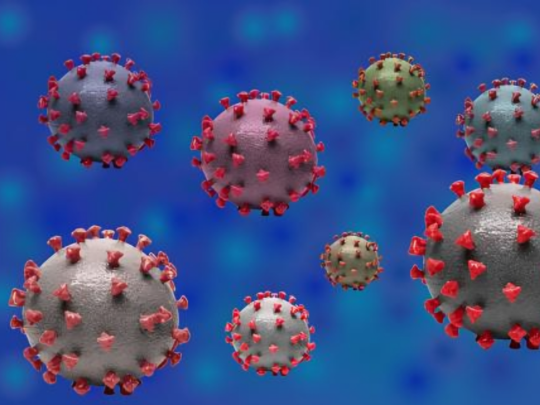
Since the COVID-19 pandemic began in late 2019, new SARS-CoV-2 variants with mutations in the spike protein have continued to emerge, generating antigenic diversity and immune escape characteristics that necessitate periodic reevaluation and reformulation of the COVID-19 vaccine composition. The spike protein is the primary target of neutralizing antibodies generated from a previous infection or COVID-19 vaccination, and mutations in this protein can affect transmissibility and immune evasion.
During December 2021, the B.1.1.529 (Omicron) variant, with approximately 32 spike mutations, began replacing pre-Omicron strains, evading neutralizing antibodies induced by previous infection or vaccination and resulting in a surge in COVID-19 cases and hospitalizations. Subsequently, the XBB (2022) and BA.2.86 (2023) variants emerged, prompting updates to COVID-19 vaccines to include these new lineages.
The Omicron BA.2.86 lineage variant, first detected in 2023, had approximately 30 mutations in the spike protein relative to its predecessor, BA.2. Despite low-level circulation, BA.2.86 had the potential to accumulate immune evasion mutations. Subsequent acquisition of the L455S substitution in the BA.2.86 lineage likely conferred a selective advantage, leading to the emergence of JN.1, which then replaced the previously predominant XBB lineage viruses. This strain replacement event was the third observed in the United States; the first occurred during Omicron’s emergence during late 2021 and early 2022, and the second corresponded to the replacement of BA.4/5 by XBB lineages during late 2022 and early 2023. A strain replacement event has not been observed during 2024–25 or 2025–26.
BA.3.2 represents a new lineage of SARS-CoV-2, genetically distinct from the JN.1 lineages, including LP.8.1 and XFG. It was first identified in South Africa on November 22, 2024. BA.3.2 has approximately 70–75 substitutions and deletions in the gene sequence of the spike protein relative to JN.1 and its descendant, LP.8.1, the antigens used in the 2025–26 COVID-19 vaccines. BA.3.2 has been nicknamed the cicada variant because it has largely remained undetected, or underground, like its namesake.
The first U.S. BA.3.2 detection in the United States occurred at San Francisco International Airport on June 27, 2025. The CDC’s Traveler-Based Genomic Surveillance program detected the variant in a person traveling to the United States from the Netherlands. The first U.S. detection of BA.3.2 in a clinical specimen collected from a patient was reported on January 5, 2026. As of February 11, 2026, BA.3.2 had been detected in voluntarily self-collected nasal swabs from four U.S. travelers, clinical samples from five patients, three airplane wastewater samples, and 132 wastewater surveillance samples from 25 states.
BA.3.2 has been reported by at least 23 countries but has not rapidly overtaken other strains. It has co-circulated with other JN.1 descendent lineages at 10% to 40% prevalence. BA.3.2 mutations in the spike protein have the potential to reduce protection from a previous infection or from vaccination with the most current COVID-19 vaccines.
The 2025–2026 LP.8.1-adapted mRNA COVID-19 vaccine demonstrates protection against currently predominant JN.1 strains but had the lowest antibody neutralization against BA.3.2 in a laboratory study of seven variants, potentially affecting vaccine-conferred protection. The observed increases in BA.3.2 detections might be driven by substantial antibody evasion enabling infection of previously immune persons among populations in which previous variants circulated. However, BA.3.2 has not rapidly overtaken other variants, but has co-circulated with various JN.1 descendant lineages. One reason might be that BA.3.2.1 and BA.3.2.2 have substantially reduced angiotensin-converting enzyme 2 (ACE2) binding and lung cell entry compared with XFG and NB.1.8.1.
Reference
Shakya M, et al. Early Detection and Surveillance of the SARS-CoV-2 Variant BA.3.2 — Worldwide, November 2024–February 2026. MMWR Morb Mortal Wkly Rep 2026;75:130–137.



 How to resolve AdBlock issue?