

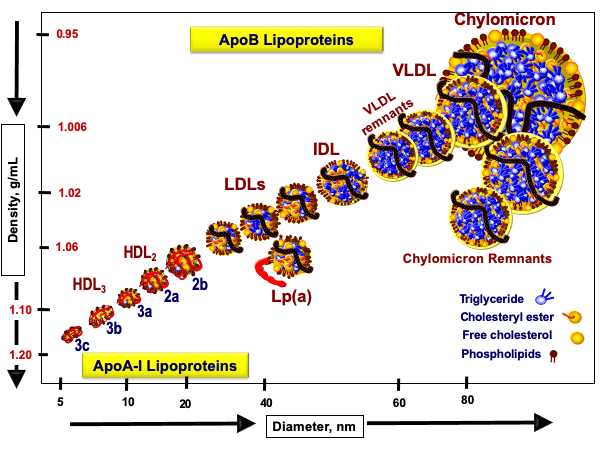
Cholesterol and triglycerides are the major lipids that are transported in plasma by lipoproteins. The liver combines a single apolipoprotein B molecule, triglycerides and cholesterol into an apoB lipoprotein particle (apoB). Plasma concentrations of apolipoprotein B (apoB)–containing lipoproteins are the primary causal determinants of atherosclerotic cardiovascular disease (ASCVD) events. These lipoproteins include low-density lipoprotein cholesterol (LDL-C), remnants, very LDL-C, intermediate-density lipoprotein cholesterol, and lipoprotein a. They contain a variable amount of cholesterol but only one apoB lipoprotein.
Because apoB is contained is contained in LDL cholesterol and all other atherogenic lipoproteins, it is a better predictor of cardiovascular risk than LDL cholesterol (LDL-C). Patients with acceptable non-high-density lipoprotein cholesterol (non-HDL-C) or LDL-C but elevated ApoB remain at higher risk of developing CVD. Conversely, patients with acceptably low ApoB but moderate non-HDL-C or LDL-C elevations are at a reduced risk for CVD.
According to the Expert Clinical Consensus from the National Lipid Association, measurement of apoB may be helpful in the following situations:
- Patients with borderline atherosclerotic cardiovascular disease risk who prefer not to start statin therapy. If apoB suggests low risk, then statin therapy could be withheld.
- Patients with obesity and insulin resistance have smaller cholesterol-depleted LDL particles that result in lower LDL-C levels. Elevated apoB levels may drive the decision to treat with a statin.
- Patients on statin therapy who are under consideration for therapeutic intensification. If the LDL-C is at goal and apoB is above threshold, treatment intensification may be considered.
ApoB can be measured by a turbidimetric immunoassay. Specimen requirement is a red top tube containing gel.
The adult desirable range for apoB is less than 90 mg/dL. Higher levels are associated with increased risk of ASCVD.
|
apoB (mg/dL) |
Interpretation |
|
<90 |
Desirable |
|
90-99 |
Borderline High |
|
100-130 |
High |
|
>130 |
Very High |
ApoB and LDL-C concentrations tend to parallel each other, but can diverge following statin therapy. When LDL-C decreases to the treatment threshold, but apoB remains elevated, apoB is the better predictor of future cardiovascular outcomes. The therapeutic target for apoB varies by ASCVD risk. According to the consensus statement, the treatment thresholds for LDL-C and apoB are:
|
ASCVD Risk Category |
LDL-C Threshold (mg/dL) |
ApoB Threshold (mg/dL) |
|
Borderline to Intermediate Risk |
100 |
90 |
|
High Risk |
70 |
70 |
|
Very High Risk |
55 |
60 |
In summary, measurement of apoB can be helpful for further risk stratification in patients with borderline or intermediate LDL-C levels, and for deciding whether further intensification of lipid-lowering therapy may be warranted when the LDL threshold has been reached.
The consensus statement does not state that apoB should be measured in all patients or that it is the standard of care. The use of apoB to assess the effectiveness of lipid lowering therapies remains a matter of clinical judgement.
References
Soffer et al, Role of apolipoprotein B in the clinical management of cardiovascular risk in adults: An expert clinical consensus from the national lipid association, Journal of Clinical Lipidology, https://doi.org/10.1016/j.jacl.2024.08.013
De Oliveira-Gomes D, et al, Apolipoprotein B: Bridging the Gap Between Evidence and Practice, Circulation, 2024;150(1):62-79.
Glavinovic T, et al. Physiological bases for the superiority of apolipoprotein B over low-density lipoprotein cholesterol and non-high-density lipoprotein cholesterol as a marker of cardiovascular risk. J Am Heart Assoc. 2022;11:e025858.
Sniderman AD, et al. Apolipoprotein B particles and cardiovascular disease: a narrative review. JAMA Cardiol. 2019;4:1287–1295.
Pencina MJ, et al. Apolipoprotein B improves risk assessment of future coronary heart disease in the Framingham Heart Study beyond LDL-C and non-HDL-C. Eur J Prev Cardiol. 2015;22(10):1321-7.



 How to resolve AdBlock issue?