

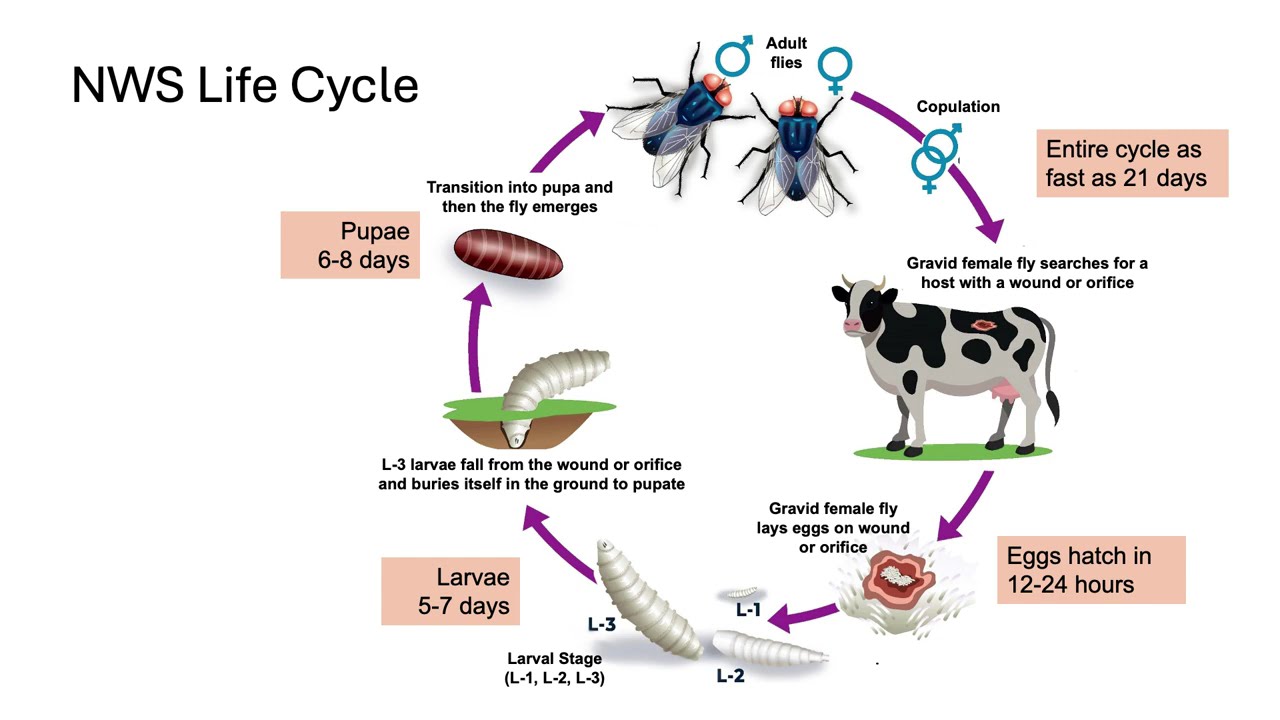
New World screwworm (NWS) is a parasitic blowfly that lays eggs in the open wounds or mucous membranes (nose, ears, eyes, or mouth) of warm-blooded animals. Wounds as small as tick bites can attract flies. The odor of a wound or body cavity attracts female flies. A single female lays 200 to 300 eggs per clutch every 3 to 7 days and may lay up to 3,000 eggs during her 10 to 30 day lifespan. Eggs hatch within 24 hours. When the eggs hatch, NWS larvae (maggots) burrow into living flesh. After about 7 days of feeding, larvae drop to the ground, burrow into the soil, and pupate. The adult screwworm fly emerges from the soil after 7 to 54 days depending on temperature and humidity. Female flies mate only once in their lifespan.
The name screwworm refers to the feeding behavior of the larvae as they burrow (screw) into healthy tissue. The larvae’s Latin name, Cochliomyia hominivorax, literally means man-eater. The sharp mouth hooks of the maggots cause extensive tissue damage, called myiasis. Wounds can become larger and deeper as more larvae hatch and feed on tissue. Bacterial superinfection of these wounds can also occur.
NWS was fully eradicated from the U.S. in 1966. Starting in the late 1950s, scientists used the Sterile Insect Technique (SIT): mass-producing sterile males and releasing them to outcompete wild males, collapsing the fly population. It worked because female flies mate only once.
Over a 50-year period, screwworm was pushed back from the United States through Mexico, through Central America, to the Panama-Colombia border. The U.S. and Panama maintained a binational barrier there, dropping roughly 20 million sterilized flies across six flights per week. For decades, it held.
NWS is endemic in the American tropics and subtropics which includes the countries of South America, Cuba, Haiti, and the Dominican Republic. For decades NWS had been contained in Panama. Starting in 2023, NWS began moving northward. On January 20, 2026, the CDC issued a Health Alert Network (HAN) advisory on recent animal cases of NWS in the Mexican state of Tamaulipas, which borders Texas. Since 2024, Mexico has documented 27,449 cases in animals, with as many as 2,000 cases currently active. Mexico has confirmed 141cases in humans. As of June 26, there have been 25 confirmed cases in the US; 24 in Texas and 1 in New Mexico. Most NWS cases have involved cattle, but goats, sheep, and dogs have also been infected.
The resurgence of NWS has occurred because of a combination of factors.
- Cattle smuggling. NWS detections in Panama spiked from 25 cases per year to more than 6,500 in 2023, driven largely by cattle movement outside sterile fly zones.
- U.S. federal funding cuts. In early 2025, roughly 15,000 United States Department of Agriculture (USDA) positions were eliminated. USDA’s Animal and Plant Health Inspection Service lost more than 2,100 employees.
- Loss of expertise. In many countries, veteran veterinary entomologists have retired without replacements, taking decades of specialized knowledge with them.
The best way to stop this outbreak is to reintroduce SIT. Mexico Mexico is refurbishing retired rearing facilities to resume sterile fly production by summer 2026. The USDA has allocated $1.3 billion for a NWS response. This funding includes a $750 million Texas plant to produce and release 300 million sterile flies per week. However, experts estimate 400 to 500 million will be needed for full eradication. Ramping to capacity could take 18 months to two years. In the meantime, Panama is sending SIT males to the U.S.
The biggest concern is the the welfare of cattle. A 1976 Texas outbreak, a spillover from Mexico, affected 1.8 million livestock. Stray dogs and wildlife in agricultural areas are also at risk of infection.
Human cases are rare. The most recent U.S. case was a traveler who returned from El Salvador in 2025 and recovered. People at highest risk for NWS infestation are those living in rural areas of endemic countries who frequently work with livestock.
NWS infestations of humans causes very painful wounds. Larvae may be visible in open wounds, surgical sites, or mucus membranes. Egg masses may be around or in the wound; larvae may be visible by the third day of infestation.
The CDC recommends considering a diagnosis of NWS in people who present with visible egg masses in wounds or orifices and who have recently traveled to an area where NWS is present.
Human cases of NWS are treatable when caught early. Treatment consists of removal of all eggs and larvae. Surgical extraction might be necessary if larvae have become deeply embedded into tissues. No specific medication has been found effective for treatment of NWS.
All suspected NWS larvae should be placed into a leak-proof container with 70% (or higher) ethanol. The volume should be sufficient to fully submerge larvae, which will kill and preserve them for confirmatory diagnostic examination. If 70% ethanol is unavailable, 70% (or greater) isopropanol or 5% to 10% formalin are acceptable alternatives, although not preferred.
Identification of the genus or species involves comparing certain morphological structures on the larvae, including the anterior and posterior spiracles, mouthparts, cephalopharyngeal skeleton, and cuticular spines. Travel history can also be helpful for genus or species-level identification.
On June 11, 2026, the FDA issued an emergency use authorization (EUA) for a generic drug, Nitenpyram, to treat NWS in dogs and cats who weight at least 2 pounds and are at least 4 weeks old. Nitenpyram kills NWS larvae within hours of the first dose. A second dose should be administered 6 hours later. After treatment, a veterinarian may still need to remove any remaining dead or live larvae.
References
CDC, Clinical Overview of New World Screwworm Myiasis, https://www.cdc.gov/myiasis/hcp/clinical-overview/index.html
Jetelina K, Screwworm is here. Your Local Epidemiologist, June 9, 2026,
Soucheray S, New World screwworm confirmed in dog in New Mexico as Texas reports 3 new cases, CIDRAP, June 9, 2026.



 How to resolve AdBlock issue?