

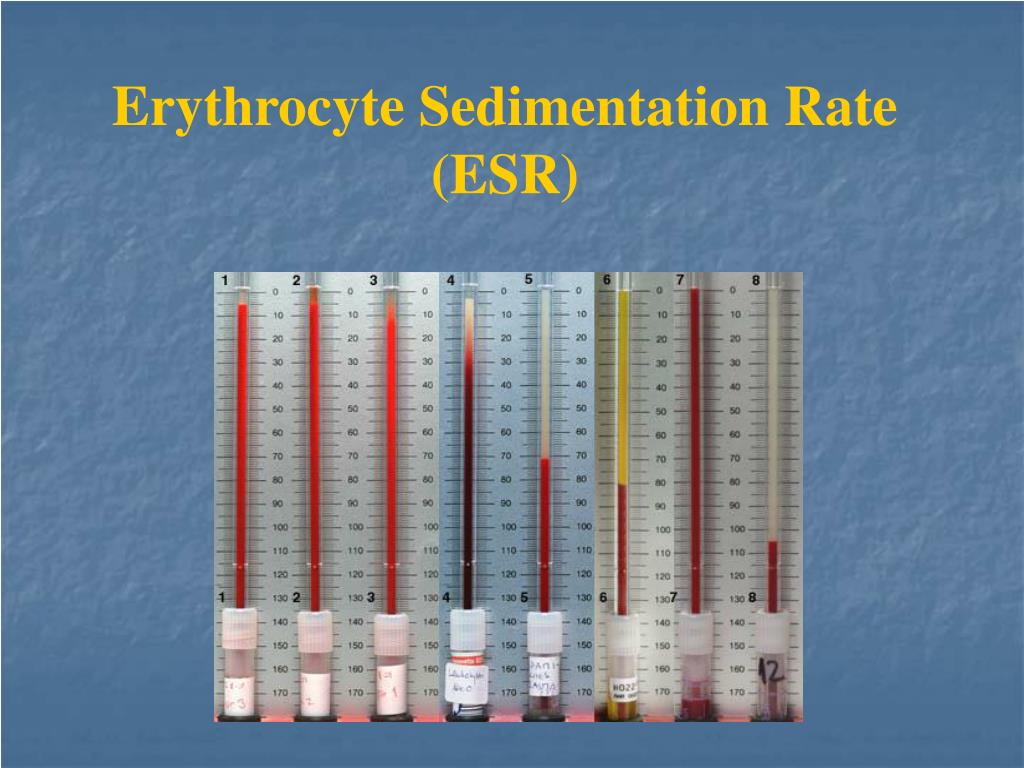
Erythrocyte sedimentation rate (ESR) is one of oldest laboratory tests in use. When anticoagulated whole blood is allowed to stand, red blood cells settle out. The rate at which they fall is known as the erythrocyte sedimentation rate and is a rough measure of abnormal concentrations of acute phase proteins and immunoglobulins. This property makes ESR a sensitive, but nonspecific, indicator of tissue damage and inflammation.
The acute phase proteins that affect ESR are fibrinogen, C-reactive protein, alpha-1 antitrypsin, and haptoglobin. Fibrinogen is a large positively charged protein and is the most abundant acute phase reactant. Acute phase proteins increase with acute tissue damage and inflammation such as occurs in myocardial infarction, collagen vascular disease, malignancy and chronic infection. Elevated immunoglobulins, including monoclonal gammopathy, also increase ESR.
Elevated ESR is an important diagnostic criterion for polymyalgia rheumatica and temporal arteritis, because these two diseases have few laboratory markers other than ESR elevation. ESR may be helpful in detecting occult disease. The most common causes of an elevated ESR in outpatients are infection, malignancy, and renal disease. The most common causes of an extremely elevated ESR (>100 mm/hr) are endocarditis, osteomyelitis, connective tissue disease, metastatic cancer, and monoclonal gammopathies. ESR can be measured serially to monitor the course of a disease such as systemic lupus erythematosus or rheumatoid arthritis. ESR usually decreases within a few days after initiating corticosteroid therapy, but remains above normal, even when the patient’s clinical status has dramatically improved.
Measurement of C-reactive protein is another general marker of inflammation that begins to increase within 4 to 6 hours after tissue injury. Even though both ESR and CRP levels reflect similar pathologies, discordance between ESR and CRP has been documented and is thought to depend, in part, on serum albumin concentration, renal insufficiency, anemia and non-infectious inflammatory disorders. ESR is more likely to be elevated in patients with bone and joint disease and colon disease.
ESR may be helpful in the diagnosis of coexisting iron deficiency in patients with the anemia of chronic disease. Serum iron and transferrin saturation often cannot distinguish between these two conditions. In healthy people, ferritin is a sensitive measure of tissue iron stores. A value less than 15 ng/mL usually indicates iron deficiency. However, ferritin is an acute phase reactant and levels can rise above 15 ng/mL in patients with iron deficiency and inflammation. In this situation, ESR can be used to correct ferritin levels for the degree of inflammation present. When serum ferritin is >80 ng/mL, iron deficiency is unlikely, regardless of the ESR. When ferritin falls between 15 and 80 ng/mL, the likelihood of iron deficiency can be determined from a nomogram that plots ferritin levels against ESR (Amer J Clin Pathol 1988; 90:85-87).
Other factors may also affect ESR. Red cell changes are especially prone to affect ESR. If hematocrit is reduced, red cell aggregates sediment faster. The more severe the anemia the higher the ESR. Macrocytes settle more rapidly than normal red blood cells, while microcytes settle more slowly. Sickle cells interfere with rouleaux formation and retard sedimentation. Extreme leukocytosis impedes the downward flow of red cells.
|
Factors Increasing ESR |
Factors Decreasing ESR |
|
Anemia |
Polycythemia |
|
Macrocytosis |
Microcytosis (Hb C) |
|
Female gender |
Sickle cells, spherocytes |
|
Age >50 years |
Anti-inflammatory medications |
|
Obesity |
Hypogammaglobulinemia |
|
Pregnancy |
Hypofibrinogenemia (DIC) |
|
Hypercholesterolemia |
Extreme leukocytosis |
|
Hypoalbuminemia |
Hyperviscosity |
Sex and age may influence ESR. Women are noted to have higher ESR values than men. Elderly people tend to have slightly higher ESR.
Reference ranges vary with the device being used to measure ESR. Typical reference ranges are:
|
Newborn infants |
0-3 mm/hour |
|
Children |
0-10 mm/hour |
|
Women <50 Y |
0-20 mm/hour |
|
Women 50-64Y |
0-30 mm/hour |
|
Women 65-79 |
0-53 mm/hour |
|
Men <50Y |
0-15 mm/hour |
|
Men >50Y |
0-20 mm/hour |
|
Men 65-79Y |
0-30 mm/hour |
A general rule of thumb is that the upper limit of normal for women is one half their age and in men it is one half their age minus 10. For example, the upper limit of normal in an 40 year old woman is 20 mm/hr.
Specimen requirement is a 5 mL lavender top (EDTA) tube of blood.
References
Bedell SE and Bush BT. Erythrocyte sedimentation rate: from folklore to facts. Am J Med. 1985;78:1001-1009.
Fincher RM. Clinical significance of extreme elevation of the erythrocyte sedimentation rate. Arch Intern Med. 1986;146:1581-83.
Hale, AJ, et al. Evaluating the Erythrocyte Sedimentation Rate. JAMA published online March 19, 2019, E1-E2.
Jurado RL. Why shouldn’t we determine the erythrocyte sedimentation rate? Clin Infect Dis. 2001;33:548-549.
C-Reactive Protein and Erythrocyte Sedimentation Rate: Continuing role for ESR. SINGH G. Adv Biol Chem: 2014; 4:5-9; DOI:10.4236/abc.2014.41002



 How to resolve AdBlock issue?