

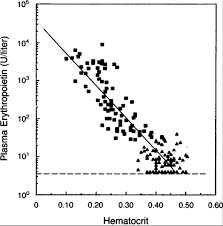
Erythropoietin (EPO) is a large glycoprotein hormone that regulates red blood cell production. More than 90% of circulating EPO is produced by the kidney and 10% by the liver. Normally, EPO levels vary inversely with hemoglobin or hematocrit. Hypoxia stimulates EPO release, which, in turn, stimulates bone marrow erythropoiesis. Elevated levels of RBC, hemoglobin, hematocrit ,or oxygen suppress the release of EPO.
Patients with uncomplicated EPO-independent anemia have elevated concentrations of EPO that are appropriate for the level of anemia. Examples include iron deficiency, aplastic anemia, sickle cell anemia, thalassemia, megaloblastic anemia, and myelodysplastic syndromes.
Chronic renal failure may result in decreased renal EPO synthesis and, subsequently, anemia. In addition to renal failure, other conditions such as chronic infections (e.g. AIDS), chronic inflammation (e.g. rheumatoid arthritis & inflammatory bowel disease) malignancies (e.g. solid tumors, multiple myeloma & lymphoma) and prematurity are associated with anemia and deficient serum EPO levels. Patients suffering from EPO-deficient anemias have erythropoietin levels that are inappropriately low for the degree of anemia. These patients may benefit from therapy with recombinant EPO.
Polycythemia vera is a neoplastic clonal blood disorder with autonomous proliferation of red blood cells. Increased red blood cells result in a negative feedback suppression of EPO. Patients with polycythemia vera have extremely elevated hemoglobin or hematocrit and decreased serum erythropoietin level.
Secondary polycythemia is associated with disorders that cause tissue hypoxia such as living at high altitude, chronic obstructive pulmonary disease, cyanotic heart disease, sleep apnea, high affinity hemoglobinopathy, smoking, or localized renal hypoxia. In secondary polycythemia, EPO production is increased in an attempt to increase oxygen delivery to tissues by increasing the number of oxygen carrying red blood cells. Patients with secondary polycythemia have elevated hemoglobin or hematocrit and higher than normal serum EPO level.
Some tumors secrete EPO or EPO-like proteins and cause erythrocytosis. Examples include renal cell carcinoma, Wilm’s tumor, hepatoma, cerebellar hemangioblastoma, adrenal tumors, and leiomyoma.
In the work up of polycythemia, an EPO assay is indicated if the hemoglobin level is greater than 18.5 g/dL in men or 16.5 g/dL in women, or if there is a lesser degree of hemoglobin elevation associated with polycythemia vera-related features. A low serum EPO level indicates that polycythemia vera is very likely. If the EPO level is elevated, the diagnosis is probably secondary erythrocytosis.
Erythropoietin is measured by a chemiluminescent enzyme immunoassay. Reference range is 2.6-18.5 mIU/mL. Specimen requirement is a plain red top or SST tube of blood.
Recombinant erythropoietin, such as darbepoetin alpha, is administered to treat some forms of anemia. These drugs may cross-react with the assay for endogenous erythropoietin.
References
Erslev AJ, Erythropoietin, New Engl J Med 1991;324:1339-1344.
Goonough LT, Skikne B, Brugnara C, Erythropoietin, iron, and erythropoiesis, Blood, 2000;96(3):823-833.
Bunn HF. Erythropoietin. Cold Spring Harb Perspect Med. 2013 Mar 1;3(3):a011619.



 How to resolve AdBlock issue?