

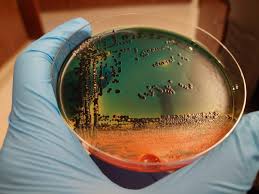
Diarrhea may be caused by bacteria, viruses, and parasites. Stool culture can determine whether diarrhea is being caused by an enteric bacterial pathogen. Stool culture can detect Aeromona, Campylobacter, Salmonella, Shigella, and Yersinia.
Stool culture is indicated for patients who develop community acquired diarrhea that persist for 7 days or longer. It is also helpful in determining the cause of travel-related diarrhea. Stool culture is usually not indicated for patients who develop diarrhea after being hospitalized for more than 3 days.
Feces is inoculated onto selective media that inhibits the growth of normal flora. Selective media include: sheep blood agar, Hektoen enteric agar, eosin-methylene blue agar, Campylobacter agar, cefsulodin-irgasan-novobiocin (CIN) agar, and the enrichment broth, selenite F. Following incubation, suspect colonies are identified using one or more of the following techniques: matrix-assisted laser desorption/ionization time of flight mass spectrometry (MALDI-TOF), biochemical tests, carbon source utilization, serology, or nucleic acid sequencing of the 16S ribosomal RNA gene.
Acceptable specimens for stool culture include a fecal swab or feces preserved in culture and sensitivity stool transport media, such as Cary-Blair or Para-Pak C and S.
If stool cultures are negative and diarrhea persists, it may be necessary to additional tests such as: Gastrointestinal Pathogen Panel, Ova and Parasite examination, Clostridium difficile toxin, Giardia antigen, Cryptosporidium antigen, and Microsporidia PCR.
Shiga toxin antigen STx1 and STx2 can be detected by enzyme-linked immunosorbent assays or polymerase chain reaction (PCR). Clostridium difficile toxin can be detected by enzyme-linked immunosorbent assay (ELISA) or by polymerase chain reaction.
The BioFire FilmArray Gastrointestinal Profile is a multiplex polymerase chain reaction (PCR) test that can detect the DNA or RNA of 22 common GI pathogens including viruses, bacteria, and parasites that cause infectious diarrhea. The FilmArray panel can detect infections caused by Campylobacter species, Clostridioides difficile, Plesiomonas, shigelloides, Salmonella species, Vibrio species, Vibrio cholerae, Yersinia species, enteroaggregative Escherichia coli, enteropathogenic E coli, enterotoxigenic E coli, Shiga toxin-producing E. coli, E. coli O157, Shigella/Enteroinvasive E coli, Cryptosporidium species, Cyclospora cayetanensis, Entamoeba histolytica, Giardia lamblia, adenovirus F 40/41, astrovirus, norovirus, rotavirus, and sapovirus.
Specimen requirement for the pathogen panel is one gram of fresh feces submitted in Cary-Blair transport medium or Para-Pak C and S transport medium.
References
DuPont HL. Persistent diarrhea: A clinical review. JAMA. 2016;315(24):2712-2723.
York MK, et al. Fecal culture for aerobic pathogens of gastroenteritis. In: Clinical Microbiology Procedures Handbook. 3rd ed. ASM Press; 2010:Section 3.8.1.
Procop GW, et al, eds. Koneman's Color Atlas and Textbook of Diagnostic Microbiology. 7th ed. Lippincott Williams and Wilkins; 2017.
Khare R, et al. Comparative evaluation of two commercial multiplex panels for detection of gastrointestinal pathogens by use of clinical stool specimens. J Clin Microbiol. 2014;52(10):3667-3673.



 How to resolve AdBlock issue?