

Stenotrophomonas maltophilia is the only member of the genus Stenotrophomonas, and was originally classed with the Pseudomonads. It is a nonsporulating aerobic gram-negative rod, found in a wide variety of environments and geographical regions. Nosocomial sources most often include wet areas, such as shower heads and faucets, but also blood-sampling tubes, central venous pressure monitors, dialysis machines and inhalation therapy equipment. The organism is frequently present as a colonizer, but may cause true infection. Risk factors for acquisition include chronic lung disease, neoplastic lesions, cystic fibrosis, mechanical ventilation and hospitalization in an intensive care unit.
The most common site of S. maltophilia in hospitalized patients is the respiratory tract, accounting for 56-69% of isolates, although the majority of patients are colonized rather than infected at this site. S. maltophilia is reported to cause 5% of nosocomial pneumonias, which are associated with mechanical ventilation, tracheostomy, previous exposure to broad-spectrum antibiotics, and the use of respiratory therapy equipment such as nebulizers. Many patients also have preexisting lung conditions such as chronic obstructive pulmonary disease, bronchiectasis, kyphoscoliosis, or endobronchial obstruction. True respiratory tract infection with S. maltophilia is associated with significantly increased mortality.
Bacteremia is a common manifestation of S. maltophilia infection, and appears to be increasing frequency. Bacteremia may be secondary to a pulmonary, urinary or gastrointestinal source, although often the initial site of infection is not apparent. S. maltophilia septicemia may be complicated by disseminated intravascular coagulation (DIC), purpura fulminans and ecthyma gangrenosum. There have been several reports of S. maltophilia endocarditis, with most cases occurring in IV drug abusers or as a complication of prosthetic valve surgery. Other reported sites of S. maltophilia infection include urinary tract, skin and soft tissue, bone and joint, central nervous system, and ocular including corneal ulcers in contact lens users.
Infections caused by S. maltophilia are particularly difficult to manage because of resistance to many antimicrobial agents, including imipenem, most other B-lactams, and aminoglycosides. Variable activity has been reported with fluoroquinolones, tetracyclines, ticarcillin/clavulanate, and trimethoprim/ sulfamethoxazole. Methodological problems associated with susceptibility testing limit the ability to predict susceptibility and ultimate therapeutic efficacy.
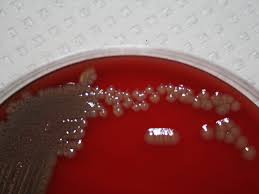
S. maltophilia easily grows on standard culture media. Colonies are typically yellow-green in color on nutrient agar. They are non-hemolytic with a faint lavender color and an ammonia odor on blood agar. The are colorless on MacConkey plates since it is non-lactose fermenting.
S. maltophilia is a strict aerobe that is usually oxidase negative. However, up to 20% of isolates show positive oxidase activity. It is also catalase-positive, DNase-positive, lysine decarboxylase positive, indole negative, HS negative, and urease negative.
Colonies can be identified by matrix-assisted laser desorption ionization, time of flight (MALDI-TOF) mass spectrometry and by 23S rRNA-directed polymerase chain reaction (PCR).
References
Johnson AP, Duckworth GJ. The emergence of Stenotrophomonas maltophilia. BMJ. 2008;336(7657):1322.
Looney WJ, Narita M, Mühlemann K. Stenotrophomonas maltophilia: an emerging opportunist human pathogen. Lancet Infect Dis. 2009;9(5):312-23.
Senol E. Stenotrophomonas maltophilia: the significance and role as a nosocomial pathogen. J Hosp Infect. 2004;57(1):1-7.
Whitby PW, et al. Identification and detection of Stenotrophomonas maltophilia by rRNA-directed PCR. J Clin Microbiol. 2000;38(12):4305-4309.
Clark AE, Kaleta EJ, Arora A, Wolk DM. Matrix-assisted laser desorption ionization-time of flight mass spectrometry: a fundamental shift in the routine practice of clinical microbiology. Clin Microbiol Rev. 2013;26(3):547-603.



 How to resolve AdBlock issue?