

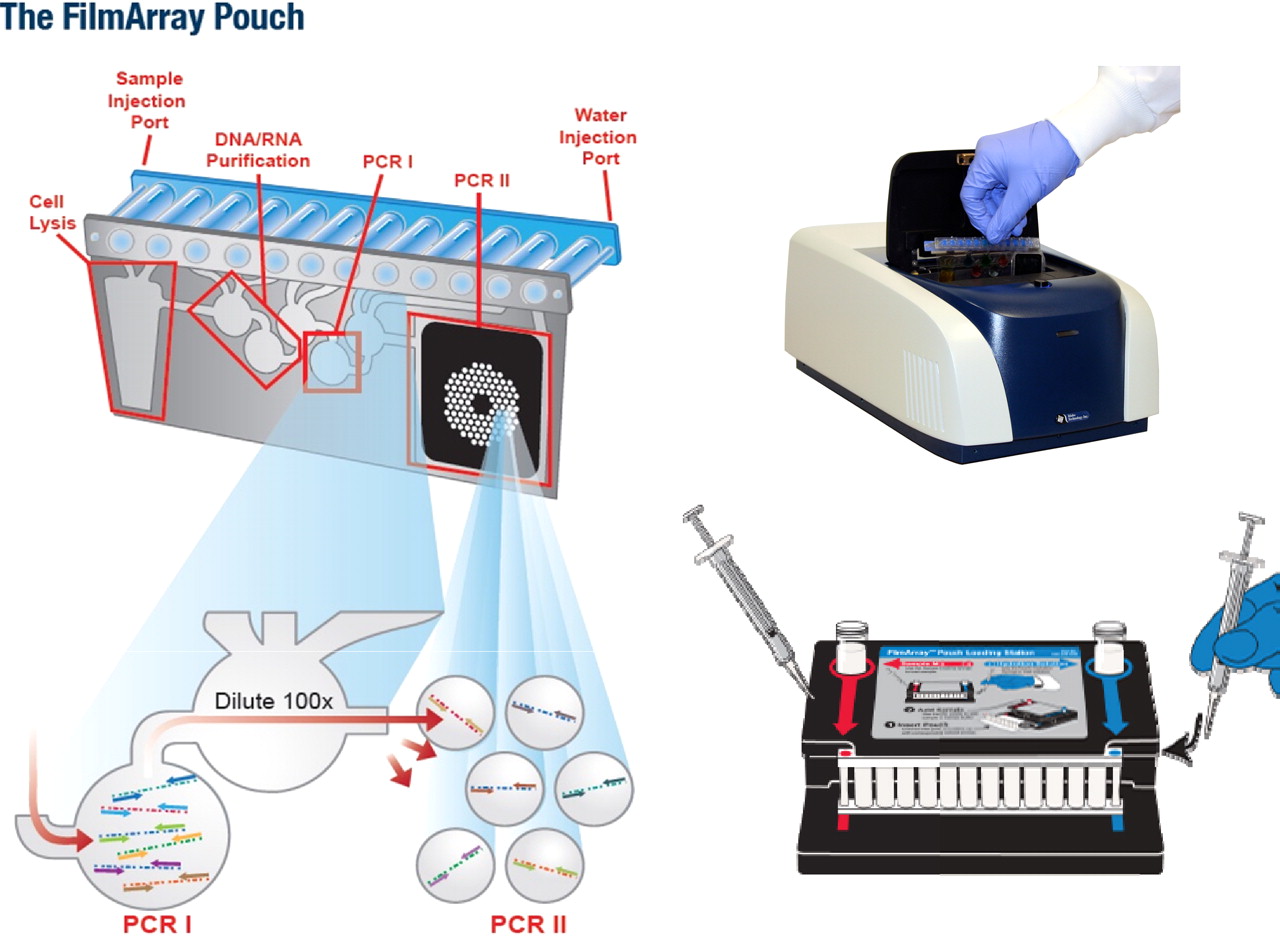
Respiratory viruses cause significant morbidity and mortality, particularly among the elderly, children, and immunocompromised individuals. There are an estimated 200,000 hospitalizations due to influenza and 125,000 RSV-related hospitalizations in the U.S. annually. Parainfluenzas, human metapneumovirus and adenoviruses can cause respiratory disease that is clinically indistinguishable from illness caused by influenza and RSV. Bacterial atypical pneumonia pathogens include Mycoplasma pneumoniae and Chlamydophila pneumoniae. M. pneumoniae typically infects younger age groups, while C. pneumoniae has a higher incidence in the elderly. Long-lasting immunity does not occur following infection with either organism.
Traditional methods for detection of respiratory pathogens include rapid antigen detection tests, direct fluorescent antibody (DFA) staining, culture, and serology. None of these methods is ideal for diagnostic purposes. Rapid antigen testing is widely available but limited to detecting a few microorganisms. Its sensitivity ranges from 50-90%. DFA testing has excellent sensitivity for most viruses, but is technically cumbersome to perform. Virus isolation by culture requires 2-10 days, so results are generally not available within a timeframe that is helpful for patient management. Additionally, sensitivity of culture for respiratory viruses can be as low as 60%, and varies considerably depending on specimen collection and handling. Serologic testing for respiratory pathogens usually requires acute and convalescent samples and is usually not effective for early diagnosis.
Testing for respiratory pathogens by nucleic acid amplification tests (NAAT) has become the gold standard for detection of respiratory pathogens. Several NAAT methodologies exist for nucleic acids detection of viruses including loop-mediated isothermal nucleic acid amplification (LAMP), transcription-mediated amplification (TMA), and real time polymerase chain reaction (PCR).
The FilmArray Respiratory Panel (bioMerieux) combines PCR and gene array technology to detect: adenovirus, coronarvirus, SARS-CoV-2, human metapneumovirus, human rhinovirus/enterovirus, influenza A subtypes (H1, H3, and H5), influenza B, parainfluenza serotypes 1-4, respiratory syncytial virus, Bordetella pertussis Bordetella parapertussis, Chlamydia pneumoniae, and Mycoplasma pneumoniae.
The sensitivity for detecting each pathogen ranges from 95 to 100% and specificity is 99%. Of note, mixed viral infections are detected in up to 30% of respiratory specimens tested by PCR.
Rogers, et. al. published an important article that compared the outcomes of children three months or older who were admitted to the hospital with an acute respiratory infection before and after implementing FilmArray Respiratory Panel. The results showed that implementing the rapid respiratory panel reduced the mean time to test result and increased the percentage of patients who received a result while in the emergency room. Duration of antibiotic use was shorter if results were reported within four hours after ordering. Length of stay and time in isolation were both reduced. Introduction of FilmArray Respiratory Panel significantly improved patient outcomes.
Testing can be performed on nasopharyngeal swabs, nasal washes, and bronchoscopy specimens.
References
Berry GJ, et al, ADLM Guidance Document on Laboratory Diagnosis of Respiratory Viruses, J Appl Lab Med, 2024; 9(3):599-628.
Dashler N, Dlein E, Mostafa H, The utility of syndromic respiratory pathogen panels: the premise of flexible and customizable approaches, J Clin Microbiol, 2025;63(7):e0031325.
Ramanan P, Bryson AL, Binnicker MJ, Pritt BS, Patel R. Syndromic panel-based testing in clinical microbiology. Clin Microbiol Rev. 2017;31(1):e00024-17.
Rogers BB, Shankar P, Jerris RC, et al. Impact of a rapid respiratory panel test on patient outcomes. Arch Pathol Lab Med. 2015;139:636–641.



 How to resolve AdBlock issue?