

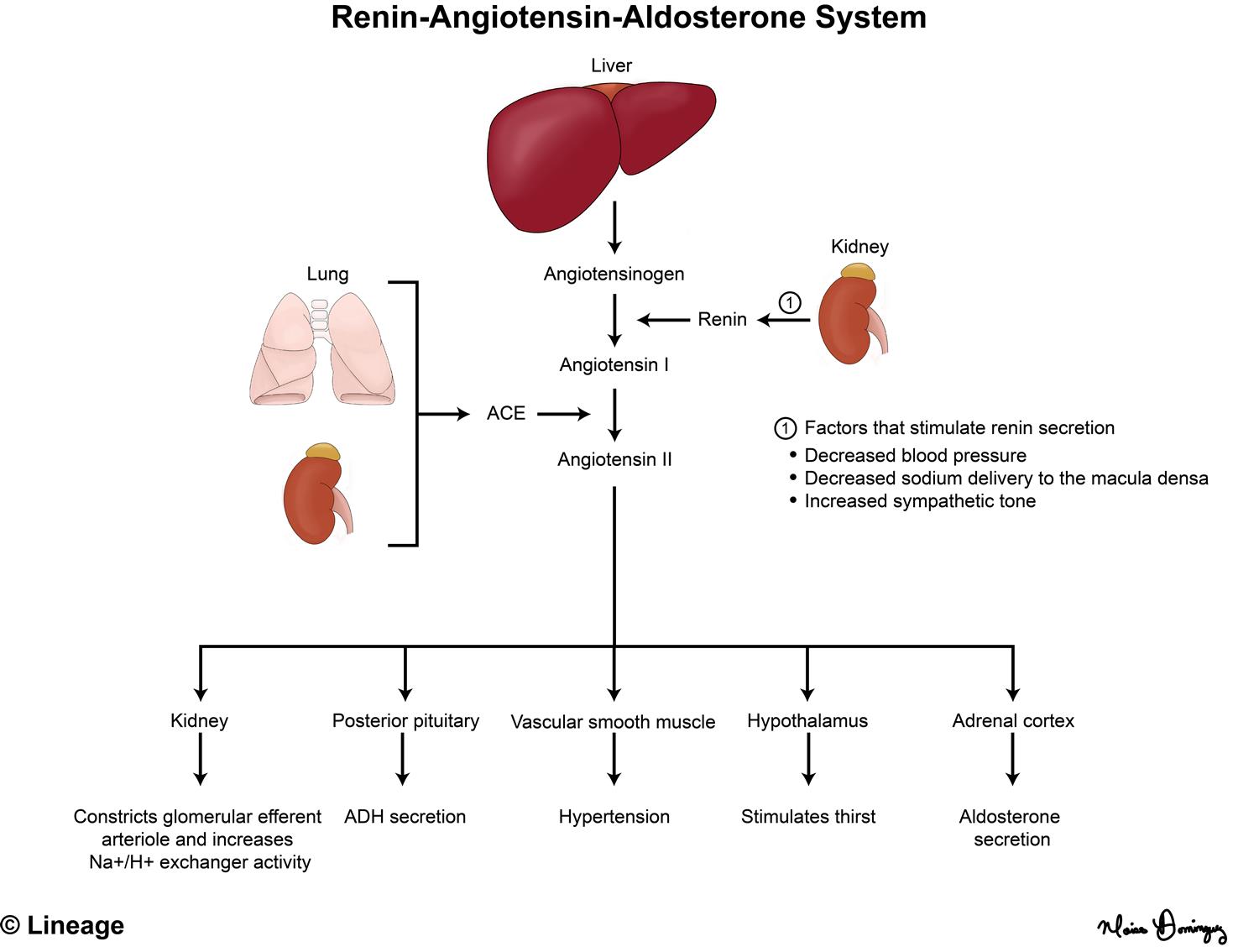
Renin is synthesized by the juxtaglomerular cells of the kidneys as prorenin and stored in granules as prorenin and renin. Prorenin is proteolytically cleaved to renin which is secreted into the circulation in response to physiological stimuli such as decreased blood volume, decreased blood pressure or sodium depletion. A fraction of prorenin escapes proteolytic cleavage and is released directly into the circulation. Prorenin secretion does not appear to be tightly regulated, whereas renin secretion is strictly controlled. Blood concentration of prorenin is approximately ten-fold greater than renin.
Renin catalyzes the formation of angiotensin I by proteolytic cleavage of angiotensinogen, a glycoprotein synthesized in the liver. Angiotensinogen concentration is the limiting factor in angiotensin II production. Increased levels of thyroid hormone, estrogen and glucocorticoids increase angiotensinogen. Angiotensin-converting enzyme (ACE) converts angiotensin I to angiotensin II, which regulates renal blood flow and glomerular filtration. Increased concentration of angiotensin II promotes aldosterone release and inhibits renin secretion by a negative feedback mechanism. Renin secretion increases in response to decreased renal artery perfusion, reduction in distal tubular resorption of sodium ions, hypokalemia or stimulation of β-adrenergic receptors. The renin-angiotensin-aldosterone system (RAAS) plays an important role in water homeostasis, electrolyte balance, and regulation of arterial pressure. Measurement of both plasma renin and aldosterone concentrations is used to assess the RAAS function.
Primary aldosteronism is a group of adrenal disorders characterized by autonomous production of aldosterone independent of angiotensin II stimulation. Idiopathic adrenal hyperplasia is the most common cause followed by aldosterone secreting adenomas (Conn syndrome). Primary aldosteronism accounts for approximately 10% of the cases of hypertension. Classical primary aldosteronism is characterized by hypertension, hypokalemia, elevated aldosterone and undetectable renin.
Isolated measurement of plasma aldosterone concentration lacks sensitivity for primary aldosteronism since many patients fall within the wide reference range and the accompanying hypokalemia often lowers aldosterone concentration. Anti-hypertensive drugs such as ACE inhibitors and angiotensin receptor blockers also lower aldosterone. A low renin level is highly sensitive but lacks specificity since it can occur in patients with a high salt diet, advancing age, chronic renal impairment and treatment with beta blockers, clonidine, alpha methlydopa or nonsteroidal anti-inflammatory agents. Renin is also reduced in other causes of hypertension such as Cushing syndrome and Liddle syndrome.
The aldosterone to renin ratio (ARR) is considered to be the best screening test for hypertensive patients with a suspicion of primary aldosteronism. ARR is determined by measuring both aldosterone and renin concentrations. Renin concentrations may be determined by measuring direct renin concentrations or renin activity.
At least 4 weeks prior to blood collection, patients should stop taking medications that affect the ARR. These include triamterene, amiloride, eplerenone, spironolactone, and potassium-wasting diuretics. If measuring renin activity, collect midmorning after patient has been out of bed for at least 2 hours and after they have been seated for 5 to15 minutes. If measuring direct renin, blood should be collected midmorning (7-10 a.m.) after the patient has been out of bed for at least 30 minutes; For an upright sample, the patient should be seated for 5 to 15 minutes. For a supine sample, the patient should be in the supine position for at least 30 minutes.
The aldosterone to renin activity ratio is measured using a quantitative chemiluminescent immunoassay. The aldosterone to renin direct ratio is measured using a qualitative chemiluminescent immunoassay. Reference range at ARUP laboratories for their direct renin assay is 2.5-45.7 pg/mL. Reference range for aldosterone to direct renin ratio is 0.1-3.7 and the reference range for aldosterone to renin activity ratio is 25 or less. Higher ratios are suggestive of primary aldosteronism.
Analytical measurement range of the Diasorin Liaison assay is 2.1 to 300 pg/mL. No High dose hook effect was observed for renin concentrations up to 300 pg/mL.
Medications that significantly affect the ARR should be withdrawn for at least four weeks before testing. Blood collection should be scheduled during midmorning after the patient has been ambulatory for at least 2 hours. The patient should be seated for 15 minutes before drawing blood into a tube containing EDTA as anticoagulant. Tubes should be collected and processed at room temperature to prevent conversion of prorenin to renin. Plasma should be separated from cells as soon as possible and then frozen if it will not be tested immediately.
References
Young Jr. WF, Calhoun DA, Lenders JWM, Stowasser M, Textor SC. Screening for endocrine hypertension: An Endocrine Society scientific statement. Endocr Rev. 2017;38(2):103-122.
Funder JW, Carey RM, Mantero F, et al. aldosteronism: case detection, diagnosis, and treatment: an Endocrine Society clinical practice guideline, J Clin Endocrinol Metab, 2016;101(5):1889-1916.



 How to resolve AdBlock issue?