

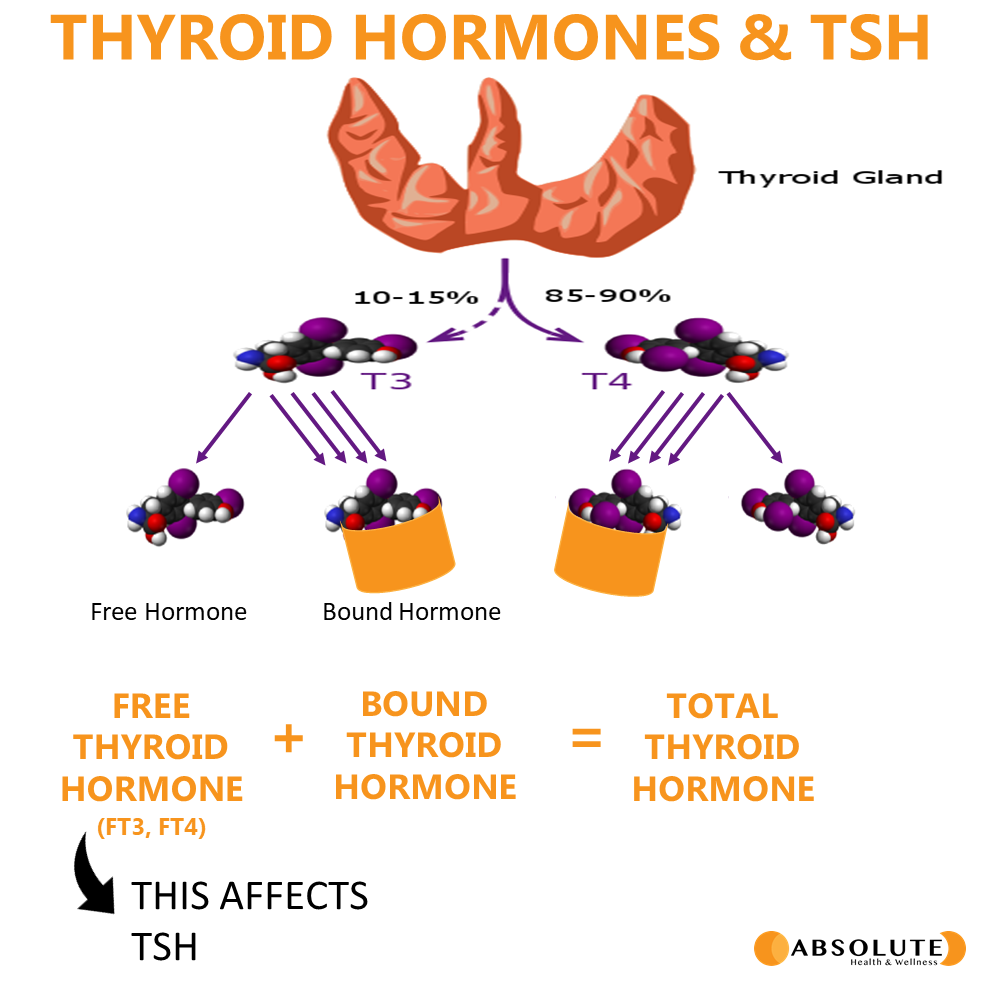
Thyrotropin releasing hormone (TRH), a hypothalamic peptide, stimulates the anterior pituitary to synthesize and secrete thyroid stimulating hormone (TSH). TSH stimulates the release of triiodothyronine (T3) and thyroxine (T4) from thyroglobulin and their secretion by the thyroid. T4 and T3 are secreted in a ratio of 10:1. Most circulating T4 and T3 are protein bound. Only the free fraction is metabolically active. In peripheral tissues, T4 is converted to T3, which is the active hormone that migrates into the target cell nuclei and binds to DNA.
Primary hypothyroidism is the most common thyroid disorder. In this condition, the thyroid fails to respond to TSH. The pituitary secretes more TSH in response to decreasing circulating T4 concentrations. The failing thyroid gland partially compensates by increasing the ratio of secreted T3 to T4. If this last attempt to restore homeostasis fails, the patient’s metabolic rate falls. At this stage of hypothyroidism, TSH is elevated and T4 and free T4 are decreased.
The opposite condition, hyperthyroidism or thyrotoxicosis, is caused by too much circulating T4. Graves’s disease, an autoimmune disorder caused by antibody to TSH receptors, leads to uncontrolled release of T4 and T3, which suppress circulating TSH. Serum T4, FT4, T3, and FT3 concentrations are elevated two to three times above the upper limit of normal and TSH is undetectable.
Traditionally, at least two thyroid function tests, thyroxine (T4) and T3 uptake (T3U), were ordered on each patient. The product of these tests was reported as the free thyroxine index (FTI) or T7. This index was an attempt to estimate free thyroxine (FT4). T7 is calculated by multiplying T4 by T3U and dividing the product by 100.
T7= (T4 x T3-Uptake)/100
T7 is usually be elevated in patients with hyperthyroidism and decreased with hypothyroidism. It may be low in patients with nonthyroid illness.
|
Disorder |
Total T4 |
T3 Uptake |
T7 |
|
Primary hypothyroid |
Decreased |
Decreased |
Decreased |
|
Secondary hypothyroid |
Decreased |
Decreased |
Decreased |
|
Hyperthyroid |
Increased |
Increased |
Increased |
|
T3 Toxicosis |
Normal |
Normal |
Normal |
Adult reference range is 4.8-12.7 ug/dL.
Specimen requirement is one red-top gel barrier tube of blood.
Most clinical laboratories no longer recommend ordering FTI or T7. Newer methods for direct measurement of free T4 has eliminated the need to estimate free hormone levels with T3U and FTI. Thyroid stimulating hormone (TSH) and free thyroxine (Free T4) are preferred for thyroid disorder screening.
References
Gruhn JG, Barsano CP, Kumar Y. The development of tests of thyroid function. Arch Pathol Lab Med. 1987 Jan; 111(1):84-100.
Ross DS, et al. 2016 American Thyroid Association Guidelines for Diagnosis and Management of Hyperthyroidism and Other Causes of Thyrotoxicosis. Thyroid. 2016;26(10):1343-1421.
Salvatore D, Cohen R, Kopp PA, Larsen PR. Thyroid pathophysiology and diagnostic evaluation. In: Melmed S, Auchus RJ, Golfine AB, Koenig RJ, Rosen CJ, eds. Williams Textbook of Endocrinology. 14th ed. Philadelphia, PA: Elsevier; 2020:chap 11.



 How to resolve AdBlock issue?