

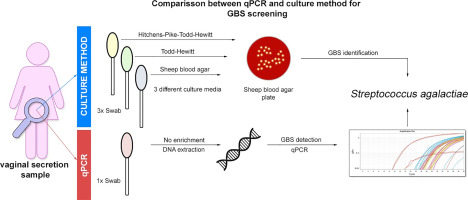
Group B Streptococcus (GBS), also known as Streptococcus agalactiae, is the leading cause of newborn infection. Up to one-third of healthy women are colonized with GBS. During childbirth, GBS can be transmitted to newborns, leading to life-threatening infections such as sepsis, meningitis, and pneumonia.
The American College of Obstetricians and Gynecologists (ACOG), the American Academy of Pediatrics (AAP), and the American Society for Microbiology (ASM) recommend universal screening of all pregnant women for colonization with GBS at 36 to 37 weeks of gestation.
ASM recommends screening with a single swab of the lower vagina and then rectum. Swab specimens are incubated in selective enrichment broth before testing by agar culture or nucleic acid amplification tests (NAAT).
Culture is the most common laboratory method for the identification of GBS. When grown on blood agar, they appear as small colorless colonies that cause beta-hemolysis or complete hemolysis. Gram stain shows gram-positive cocci that occur in pairs and chains.
However, culture has a long turnaround time and may not be helpful when results are needed quickly, such as during preterm birth. NAAT has a faster turnaround time and is useful in these situations. NAAT should be performed on specimens after incubation in enrichment broth to maximize sensitivity and specificity.
Because penicillin is the preferred agent for intrapartum prophylaxis, antimicrobial susceptibility testing should be performed on all GBS isolates from pregnant individuals with a severe penicillin allergy to assist in the selection of an alternative antibiotic..
References
Prevention of group B streptococcal early-onset disease in newborns: ACOG committee opinion, no. 797 [published correction appears in Obstet Gynecol. 2020;135(4):978-979]. Obstet Gynecol. 2020;135(2):e51-e72.
Centers for Disease Control and Prevention. Clinical overview of group B strep disease. Last updated Jan 2024; accessed Jun 2024.
Puopolo KM, Lynfield R, Cummings JJ, et al. Management of infants at risk for group B streptococcal disease [published correction appears in Pediatrics. 2019;144(4)]. Pediatrics. 2019;144(2):e20191881.
Filkins L, et al. American Society for Microbiology provides 2020 guidelines for detection and identification of group B Streptococcus. J Clin Microbiol. 2020;59(1):e01230-20.



 How to resolve AdBlock issue?