

Streptococcal pharyngitis (strep throat) is a bacterial infection of the throat and tonsils that is caused by Group A beta hemolytic Streptococcus. Group A Streptococcus includes Streptococcus pyogenes, S. anginosus, and S. dysgalactiae, but S. Pyogenes is the most common cause of pharyngitis. It is the cause of pharyngitis in up to 30% of children and 15% of adults.
Children between the ages of 5 and 15 years are most commonly infected. Streptococcal pharyngitis occurs year-round, but the incidence peaks in the winter and spring months. Streptococcal infections are spread from person to person via inhalation of respiratory droplets containing S. pyogenes. The most common risk factor is close contact with another person with strep throat. Some individuals, particularly school-age children, carry S. Pyogenes without exhibiting signs of illness. The incubation period between infection and symptoms is 2 to 5 days.
Common symptoms include fever, chills, sore throat, pain when swallowing, swollen tonsils coated with grayish-white exudate, enlarged lymph nodes, and petechiae on the roof of the mouth. Left untreated, S. Pyogenes may progress to complications such as peritonsillar abscesses, otitis media, sinus infections, post-streptococcal glomerulonephritis, and rheumatic fever.
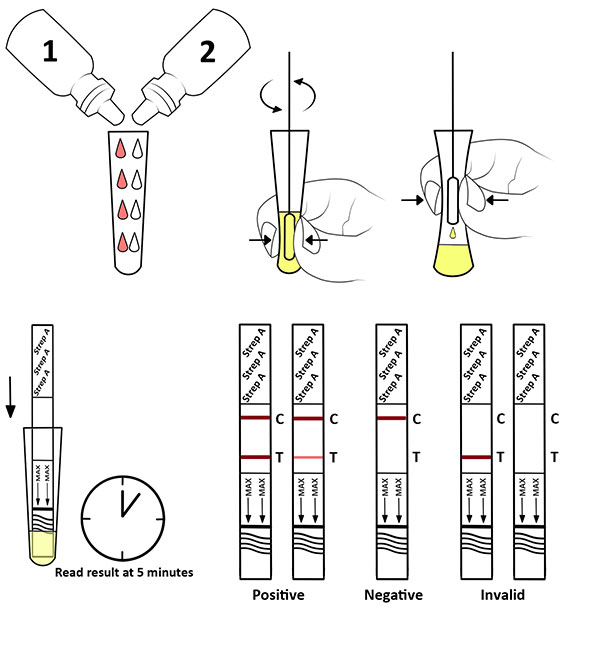
Rapid antigen detection tests (RADT) for group A Streptococcal pharyngitis are available for the diagnosis of strep throat. The major advantage of rapid diagnosis is that a patient can be diagnosed and treated at the same time. Early treatment is beneficial because it promptly relieves symptoms, decreases the likelihood of serious sequelae, and limits the spread of infection to others.
There are three principal types of RADT: latex agglutination, enzyme immunoassay (EIA), and optical immunoassay (OIA). All RADT require a throat swab. The swab is then immersed in acid to solubilize the cell wall carbohydrate. An immunological reaction then detects the presence or absence of the Lancefield group A carbohydrate, which is a specific antigen in the cell wall of Group A beta hemolytic streptococci.
The sensitivities of these techniques depend not only on the methodology used but also on the numbers of streptococci present in the sample. Different clinical studies have reported sensitivities that range from 71% to 87% and specificities from 60% to 92%.
False negative results may occur with any test method if the specimen contains small numbers of streptococci. Therefore, a good throat swab is crucial. All specimens that test negative should be confirmed by culture or polymerase chain reaction (PCR).
Specimen requirement is a throat swab collected with a calcium alginate swab and placed in transport media.
Reference range is negative for group A Streptococcus by antigen detection.
References
Linder JA, et al, 2025 Clinical Practice Guideline Update by the Infectious Diseases Society of America on Group A Streptococcal (GAS) Pharyngitis: Risk assessment using clinical scoring systems in children and adults, https://www.idsociety.org/practice-guideline/streptococcal-pharyngitis2/
Cohen JF et al, (2013). Effect of clinical spectrum, inoculum size and physician characteristics on sensitivity of a rapid antigen detection test for group A streptococcal pharyngitis. Eur. J. Clin. Microbiol. Infect. Dis, 2013;32 (6):787–793.
Cohen J. F., Pauchard J. Y., Hjelm N., Cohen R., Chalumeau M. Efficacy and safety of rapid tests to guide antibiotic prescriptions for sore throat. Cochrane Database Syst. Rev, 2020;6,CD012431. doi: 10.1002/14651858.CD012431.pub2
Hamilton JL, McCrea L, Streptococcal Pharyngitis: Rapid Evidence Review, Am Fam Physician, 2024;109(4):343-349.



 How to resolve AdBlock issue?