

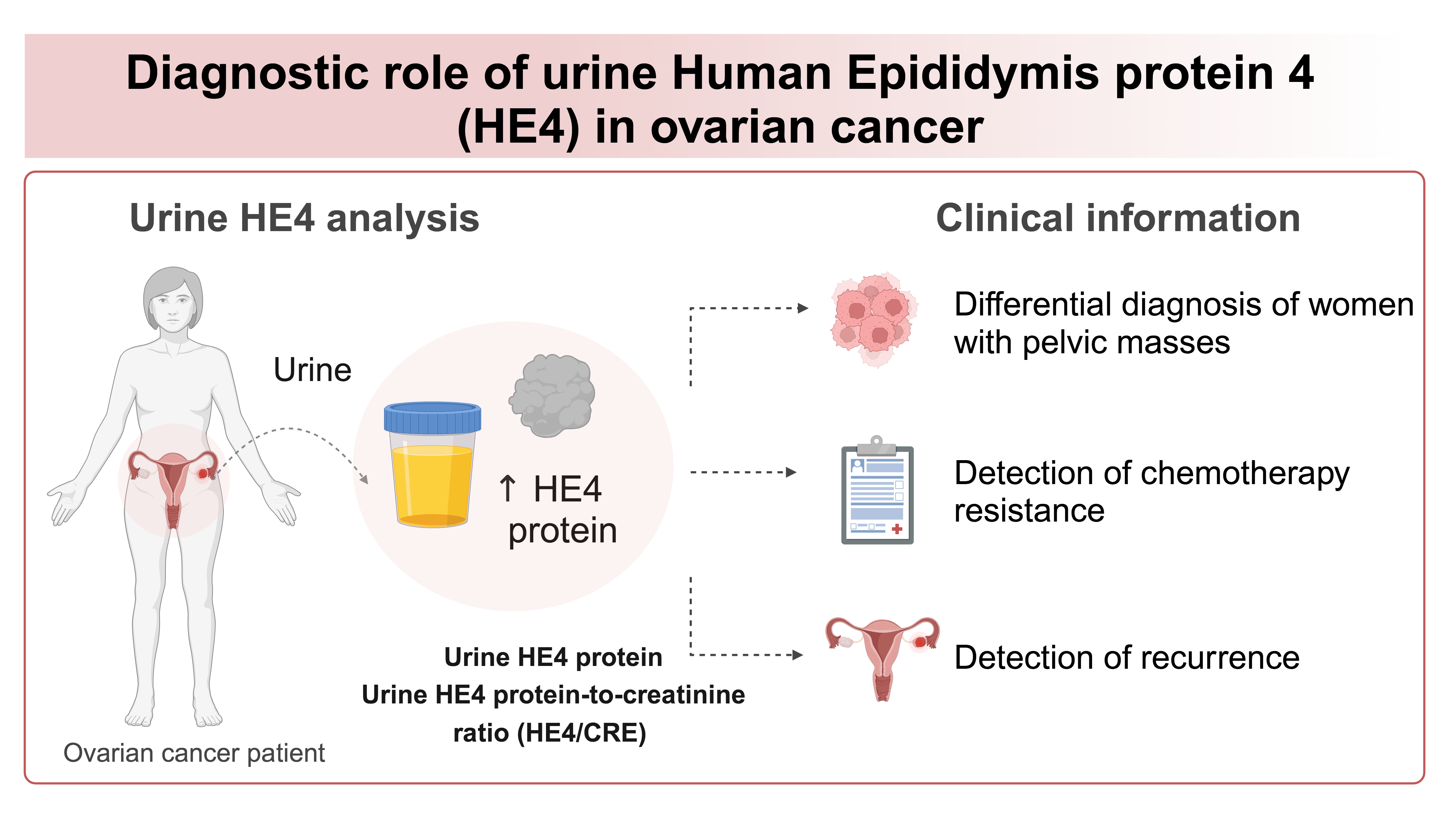
CA-125 is the most commonly used serum marker to monitor therapeutic response and detect disease recurrence in patients treated for epithelial ovarian cancer. The National Comprehensive Cancer Network recommends CA-125 measurement before each treatment cycle and at each follow-up evaluation for women with elevated pretreatment concentrations. However, CA 125 is not elevated in all patients with epithelial ovarian cancer and is not specific for ovarian cancer. For this reason, physicians measure Human Epididymis Protein 4 (HE4) in addition to CA 125.3
HE4 was first identified in the epithelium of the distal epididymis. Its biological function has not been determined. It is expressed in the epithelia of respiratory and reproductive tissues. The WFDC2 gene codes for HE4. This gene is overexpressed in patients with ovarian carcinoma. In 2003, HE4 was found to be elevated in the plasma of patients with ovarian carcinoma. Subsequent studies demonstrated that HE4 is elevated in 93% of serous, 100% of endometrioid epithelial, and 50% of clear cell ovarian carcinomas. Mucinous and germ-cell tumors of the ovary rarely express HE4. Therefore, HE4 is not recommended for monitoring of patients with these types of ovarian cancer. Most non-ovarian carcinomas do not produce HE4 protein.
HE4 is used to monitor recurrence of progressive disease in patients with epithelial ovarian cancer. Serial measurement HE4 can be used in conjunction with CA-125 and other clinical methods to monitor patients with known ovarian cancer for disease progression or therapeutic response. HE4 increases by 25 percent or greater in 60 percent of women with ovarian cancer relapse or progression. A decrease of this magnitude suggests therapeutic response. HE4 remains constant in 75 percent of women without disease progression.
An elevated HE4 concentration is not specific for ovarian cancer. HE4 may be elevated in some benign gynecologic conditions such as ovarian cysts, cystadenomas, leiomyomas, fibromas, and endometriosis. It should not be used to screen for ovarian cancer in asymptomatic women.
In patients with ovarian carcinoma, an increase in HE4 suggests recurrence or disease progression, while a decrease suggests therapeutic response. A change in HE4 concentration of 20% or greater should be considered clinically significant.
Reference range is 0-150 pmol/L using the HE4 enzyme immunometric assay from Fujirebio Diagnostics, Inc. Values obtained with different immunoassay methods should not be compared. Specimen requirement is a plain red or serum separator tube.
References
Galgano MT, Hampton GM, Frierson HF Jr. Comprehensive analysis of HE4 expression In normal and malignant human tissues. Mod Pathol. 2006; 19(6):847-853.
Hellström I, Raycraft J, Hayden-Ledbetter M, et al. The HE4 (WFDC2) protein is a biomarker for ovarian carcinoma. Cancer Res. 2003; 63(13):3695-3700.
Huhtinen K, Suvitie P, Hiissa J, et al. Serum HE4 concentrations differentiates malignant ovarian tumours from ovarian endometriotic cysts. Br J Cancer. 2009; 21:100(8):1315-1319.
Dochez V, et al. Biomarkers and algorithms for diagnosis of ovarian cancer: CA125, HE4, RMI and ROMA, a review. J Ovarian Res. 2019;12(1):28.



 How to resolve AdBlock issue?