

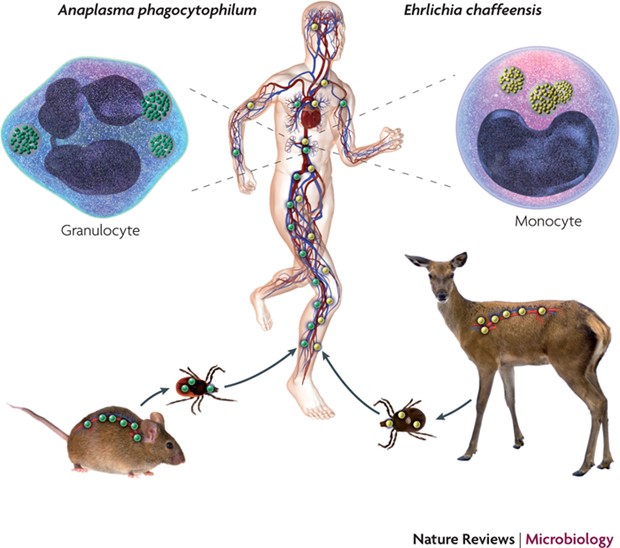
Ehrlichiosis is the generic name for infections caused by both the Ehrlichia and Anaplasma genera, which are small gram-negative obligate intracellular bacteria. In the US, infections are most commonly caused by Anaplasma phagocytophilum, which causes human granulocytic anaplasmosis. Human granulocytic ehrlichiosis is now known as anaplasmosis. See article entitled “Anaplasma phagocytophilum” for more information.
Ehrlichia chaffeensis causes human monocytic ehrlichiosis (HME). E chaffeensis is transmitted to humans by the Lone Star tick (Amblyomma americanum). It is most commonly found in south-central, southeastern and mid-Atlantic regions of the U.S. White tail deer are the primary reservoir for E chaffeensis.
After an incubation period of 5 to 21 days after transmission, HME typically presents as a febrile illness with nonspecific symptoms such as chills, sweats, myalgia, headache, malaise, and cough. Gastrointestinal distress, arthralgia, and photophobia may also occur. Approximately one-third of patients develop rash. Some patients progress to meningitis, acute respiratory distress, and disseminated intravascular coagulopathy.
Laboratory tests may reveal leukopenia, lymphopenia, thrombocytopenia, and elevated transaminases. Anemia and hyponatremia may also be present.
Ehrlichia chaffeensis infects monocytic cells in HME. Examination of a Wright- or Giemsa-stained peripheral blood smear may detect instinctive cytoplasmic inclusions or bacteria within monocytes, that are called morulae. However, they are only seen in about 20% of cases during the first week of infection.
The diagnostic tests of choice are serology and polymerase chain reaction (PCR). Serology includes testing for IgM and IgG antibodies against E chaffeensis. Neither antibody may be detectable during the first 7 to 14 days of illness. Therefore PCR is recommended for suspected acute disease. A positive PCR result is consistent with acute infection. After the first 1 to 2 weeks, the infection rapidly wanes, limiting the efficacy of PCR. Therefore, a negative PCR result obtained after 2 weeks does not necessarily rule out HME. The sensitivity of PCR ranges from 60 to 80% depending on the number of days since infection occurred.
An immunofluorescence assay (IFA) for IgG antibody to E chaffeensis is the most frequently used confirmatory test . Reference value is a titer of <1:64. Since antibody is not usually present in the first week of illness when patients typically present, a diagnosis is made by collecting paired sera 2 to 6 weeks apart. A 4-fold difference in titers or an IgG titer of least 1:256 is indicative of infection with E chaffeensis. Because there is a high rate of cross-reactivity between antibodies to A. phagocytophilum and those to E. chaffeensis, serologic testing for both pathogens should be performed simultaneously. If the titer is much higher for one organism than the other, the one with the higher titer should be considered the likely causative agent. IgG antibodies may remain elevated for months to years after infection.
Specimen requirement for IFA serology is one plain red-top tube or one SST tube of blood.
Specimen requirement for PCR is one lavender-top (EDTA) tube of blood.
References
Eickhoff C, Blaylock J, Tickborne disease other than Lyme in the United States, Cleve Clin J Med, 2017;84(7):555-567.
Masison-Antnucci S, et al. Emerging Tick-Borne Diseases, Clinical Microbiol Rev, 2020;33(2):1-34.



 How to resolve AdBlock issue?