

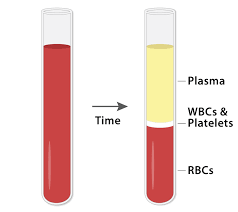
Hematocrit is the relative volume of packed red blood cells to whole blood, expressed as a percentage. Hematocrit is also known as packed cell volume. Hematocrit is used to identify anemia and polycythemia along with RBC count and hemoglobin concentration.
Adult males have a higher hematocrit compared to adult females. Reference range is 40-50% in males and 36-45% in females. Hematocrit values less than 15% and greater than 60% are considered critical values.
Pregnant patients have a lower hematocrit due to hemodilution. People living at high altitudes had a higher hematocrit due to hypoxia. Newborns have a high hematocrit, which gradually decreases during the neonatal period. Values >70% are considered critical in neonates.
Smokers and chronic obstructive pulmonary disease patients also have high hematocrit due to chronic hypoxia. The increase in hematocrit increases the viscosity of the blood, and so does the peripheral resistance. Hence, patients with higher hematocrit may have higher blood pressure.
Hematocrit can be performed manually by centrifuging blood in a capillary tube and determining the percentage of the volume of whole blood that is red blood cells.
Today, most hematocrit results are reported by automated hematology analyzers. Hematology analyzers calculate hematocrit by multiplying the number of red blood cells x the mean cell volume (MCV). Manual hematocrits have some plasma trapped between RBCs and give 2-3% higher values than an automated hematology instrument.
The Rule of 3 states that the hematocrit should match the Hb x 3 +/-3. Patient samples that do not comply with this rule should be evaluated by morphologic examination. Disagreement is seen in patients who have abnormal RBC morphology, cyroglobulinemia, lipemia, giant platelets, or high WBC counts.
The source of the blood sample may affect hematocrit results. Fingerstick hematocrits are often higher than venous hematocrits and venous hematocrits are higher than arterial. Hemoglobin is a more accurate parameter than hematocrit.
Specimen requirement is one 5 mL lavender top (EDTA) tube of blood.
References
Young PC, et al. Evaluation of the capillary microhematocrit as a screening test for anemia in pediatric office practice. Pediatrics. 1986;78(2):206-9.
Yang ZW, et al. Comparison of blood counts in venous, fingertip and arterial blood and their measurement variation. Clin Lab Haematol. 2001;23(3):155-9.
Peng L, Wang W, Bai L. Performance evaluation of the Z2 coulter counter for WBC and RBC counting. Int J Lab Hematol. 2007;29(5):361-8.
Billett HH. Hemoglobin and Hematocrit. In: Walker HK, Hall WD, Hurst JW, editors. Clinical Methods: The History, Physical, and Laboratory Examinations. 3rd ed. Butterworths; Boston: 1990



 How to resolve AdBlock issue?