

Each hemoglobin molecule is composed of four globin chains and a heme molecule. Each globin chain is linked to one heme group, with the heme groups at the surface of each molecule, thereby having the ability to combine reversibly with oxygen. The heme groups contain an iron molecule bound within a porphyrin ring and is identical in all hemoglobins.
Hemoglobin A (HbA) is the major normal adult hemoglobin (~97% of total normal hemoglobin). It consists of two identical alpha globin chains and two identical beta chains. HbA and thus is designated α2β2 . In addition to Hb A, adult red cells also contain small quantities of Hb A2 (α2δ2,1.5-3.5%) and Hb F (α2γ2; < 2%)
Hemoglobinopathies are among the most common genetic diseases in the world. Approximately 700 structural variants of the hemoglobin molecule have been described. Many of these have been discovered incidentally and are not of clinical significance. About 200 variants hemoglobin variants are clinically significant and may cause microcytosis, anemia, jaundice, erythrocytosis or cyanosis. Hemoglobinopathies are caused by either a qualitative (structural) or quantitative abnormality of one or more of the globin chains causes a hemoglobinopathy.
Several laboratory methods are available to evaluate hemoglobin composition, including electrophoresis (acid and alkaline), high performance liquid chromatography (HPLC), capillary electrophoresis, isoelectric focusing, and amino acid/DNA sequencing. With the exception of DNA sequencing, these methods generally rely on differential charge of various hemoglobin types to identify abnormalities.
The clinical indications for ordering hemoglobin electrophoresis include:
- Unexplained hemolytic anemia
- Positive sickle cell or solubility test
- Microcytic anemia not explained by iron deficiency, lead toxicity, or chronic disease
- A blood smear with abnormal erythrocyte morphology such as sickle cells or target cells
- Positive neonatal screen
- Positive family history of a hemoglobinopathy
Hemoglobin Electrophoresis
Hemoglobin electrophoresis is generally performed at both alkaline and acid pH. Using cellulose acetate or agar at an alkaline pH of 8.6, hemoglobins are negatively charged and will move on the gel towards the positive electrode (anode). Hemoglobins containing an amino acid substitution that changes the overall charge of the molecule will have differing mobility from Hb A. Alkaline electrophoresis is quite useful; however, many hemoglobin variants will migrate in a similar position. For example, hemoglobins S, D, and G migrate in the same location, as do hemoglobins C, E, O, and A2. Acid electrophoresis, run at a pH of 6.2, complements information obtained from alkaline electrophoresis. By this method, the most common abnormal hemoglobins, Hb S and Hb C, are effectively separated from Hb A, as well as most others that migrate in similar locations by alkaline electrophoresis. Unfortunately, many of the other abnormal hemoglobins migrate in a pattern similar to Hb A, and thus, acid electrophoresis is often not useful for characterization of other abnormal hemoglobins.
Isoelectric Focusing
Isoelectric focusing is an additional electrophoretic method in which a pH gradient from approximately 6-8 is established within the gel. This differential pH gradient allows hemoglobins to migrate within the gel to their isoelectric point, the point at which they contain zero charge. Isoelectric focusing allows better discrimination of hemoglobins that migrate in similar locations on alkaline electrophoresis. Isoelectric focusing has largely been replaced by high performance liquid chromatography (HPLC) as a method of hemoglobin analysis.
High Performance Liquid Chromatography (HPLC)
HPLC instruments utilize a weak cation exchange column to which hemoglobins bind. As the ionic strength of the eluting liquid phase increases, hemoglobin variants will come off the column at a specific retention time, thus allowing identification of the hemoglobin variant based on the overall charge characteristics of the protein. The pattern seen by alkaline electrophoresis demonstrates some correlation with retention time by HPLC since both methods are dependent on the charge of the hemoglobin molecule; although the specific retention time by HPLC is dependent on the column and eluting solution used in the instrument. In general terms, amino acid substitutions leading to more overall negative charge will result in faster migration by alkaline electrophoresis and a shorter retention time on the column by HPLC. One advantage of this method is that Hb C does not migrate with Hb A2 as it does on alkaline electrophoresis, thus allowing measurement of Hb A2 in a patient with heterozygous or homozygous Hb C. Unfortunately, Hb E does elute with Hb A2 by this method, precluding accurate measurement of Hb A2 when Hb E is present.
Capillary Electrophoresis
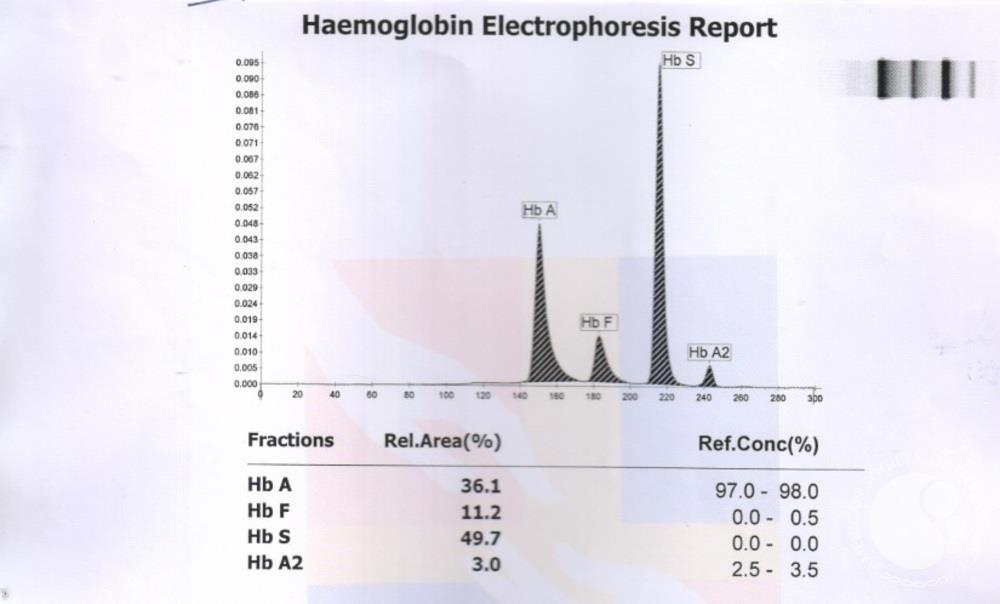
Most recently, automated capillary electrophoresis (CE) instruments have been making their way in to the clinical laboratory for hemoglobin analysis. By this method, electrophoresis is performed by adding patient sample to a thin capillary tube containing a buffer, most often an alkaline buffer. Voltage is applied to allow separation of hemoglobins based on their charge, similar to the traditional gel electrophoresis methods mentioned above. This method has the advantage over HPLC of allowing accurate quantitation of Hb A2 in the presence of Hb E; although on some CE instruments adequate separation of Hb A2 from Hb C to allow accurate quantitation may not be possible in all cases.
DNA Sequencing
While most common hemoglobin variants can be identified by other methods, some uncommon variants require DNA sequencing for further identification. In particular, sequencing may be required for some clinically important variants, including unstable hemoglobins, low or high oxygen affinity hemoglobins, and M-hemoglobins, that fail to separate from Hb A by other methods, often due to their neutral charges. Generally, polymerase chain reactions (PCR) are performed to amplify the exons of the ß and/or α-globin genes. Then these PCR products are put through a sequencing reaction that determines the nucleotide sequence of these genes. The nucleotide substition that results in the abnormal amino acid sequence is usually easily identified, and can be compared to known sequences for identification. In addition to its use in hemoglobinopathies, DNA sequencing can also be useful to identify nucleotide substitutions associated with ß-thalassemia, a group of disorders resulting in decreased production of a normal ß-globin chain.
A clinical pathologist interprets the results of these tests after reviewing in consideration of the patient’s age, transfusion history, complete blood count, and peripheral blood smear.
Hemoglobin reference range is 96-99% Hb A, 0-3.5% Hb A2, and 0-2% Hb F with no hemoglobinopathy detected.
Specimen requirement is one lavender top (EDTA) tube of blood for adults or 2 lavender top microtainer tubes for children.
Reference
Association of Public Health Laboratories and the Centers for Disease Control and Prevention, Hemoglobinopathies: Current Practices for Screening, Confirmation and Follow-up, December 2015.
Keren DF, Unraveling Hemoglobinopathies with Capillary Electrophoresis
Ching-Nan Ou, Rognerud CL, Diagnosis of hemoglobinopathies: electrophoresis vs. HPLC, Clin Chim Acta, 2001;313 (1-2):187-194.
Schneider RG, Identification of Hemoglobins by Electrophoresis, CRC Crit Rev Clin Lab Sci, 2008;5(1):41-44.



 How to resolve AdBlock issue?