

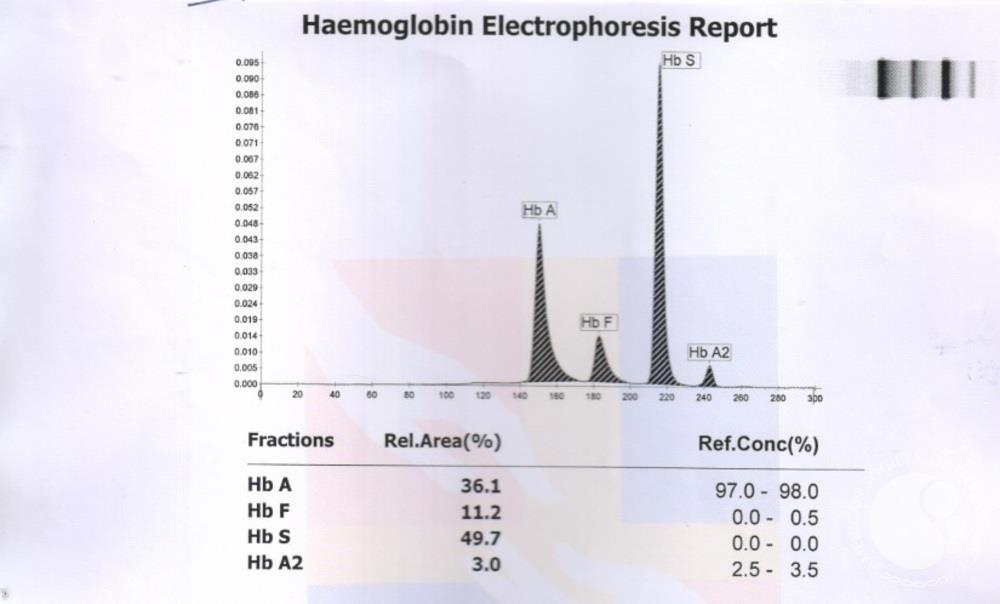
Fetal hemoglobin (hemoglobin F, Hb F) consists of two alpha and two gamma chains. It is the major hemoglobin of the fetus and newborn, comprising 60 to 90% of total hemoglobin. By 24 months of age, Hb F levels decrease to adult levels of 0-2% of the total hemoglobin. However, a few individuals may have slightly higher levels (5%) for several years.
Fetal hemoglobin may be elevated in beta thalassemia, hereditary persistence of fetal hemoglobin (HPFH), and several hemoglobinopathies including sickle cell anemia. In heterozygous beta thalassemia, Hb F may be slightly increased to 2.1-5.0%, and in homozygous beta thalassemia is elevated to between 10 and 90%. In homozygous HPFH, the Hb F level is 100% and in heterozygous HPFH (in Blacks) is usually between 15 and 35%. Elevated Hb F levels may also be seen in acquired disorders such as megaloblastic anemia, myelofibrosis, leukemias and pregnancy.
Hb F is measured by hemoglobin electrophoresis. Reference range in adults is 0-2%.
Specimen requirement is one lavender top (EDTA) tube of blood.
The detection of Hb F is also useful in the workup of suspected fetomaternal bleeding (see Kleihauer Bettke Test).
Reference
Mosca A et al, The relevance of hemoglobin F measurement in the diagnosis of thalassemias and related hemoglobinopathies, Clin Biochem, 2009;42(18):1797-1801.



 How to resolve AdBlock issue?