

Hepatitis B virus (HBV) is a small double stranded DNA virus composed of an outer envelope containing hepatitis B surface antigen (HBsAg) and an inner nucleocapsid consisting of hepatitis B envelope antigen (HBeAg) and hepatitis B core antigen (HBcAg). The viral core also contains a double stranded DNA genome and DNA polymerase.
Hepatitis B virus (HBV) is transmitted through contact with infected blood or body fluids which may occur during pregnancy or delivery, sexual activity, or injection drug use. An estimated 1.6 to 2.4 million persons are infected with HBV in the United States and two thirds might be unaware of their infection. HBV infection can result in both acute and chronic hepatitis. Approximately 90% of adults who are infected will resolve the infection without permanent organ damage, while 10% become carriers and 6% progress to chronic disease. Infected newborns and children have a much worse outcome. Chronic infection occurs in 90% of infants infected at birth and in 30% of children infected between ages 1 and 5 years. Persons with chronic HBV infection are at increased risk for premature death from cirrhosis and hepatocellular carcinoma as well as liver failure from HBV reactivation when receiving immunosuppressive therapy or hepatitis C therapy.
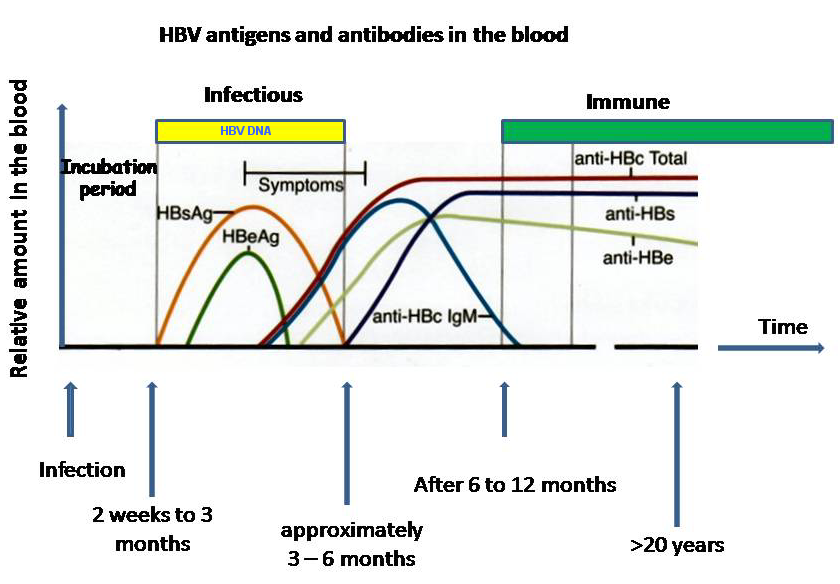
After exposure to HBV, there is an incubation period ranging from 1 to 4 months, during which the patient may not exhibit symptoms or positive serologic results. Symptoms, if they appear, usually occur within 4 to 6 weeks after exposure. The most common symptoms include nausea, anorexia, malaise and jaundice. The stage of the infection can be monitored with tests for HBV antigens and antibodies.
Although there is no cure for chronic hepatitis B, most deaths can be prevented with disease monitoring, antiviral therapy, and liver imaging for hepatocellular carcinoma surveillance. Hepatitis B (HepB) vaccination is highly effective in preventing HBV infection but 70% of adults in the United States were unvaccinated as of 2018.
In CDC’s 2023 Hepatitis B Virus recommendations, “screening” refers to serologic testing of asymptomatic persons not known to be at increased risk for exposure to HBV and “testing” refers to serologic testing of persons with symptoms or who are identified to be at increased risk for exposure to HBV.
Screening is recommended for the following persons:
- All adults aged ≥18 years at least once during a lifetime (new recommendation).
- All pregnant persons* during each pregnancy, preferably in the first trimester, regardless of vaccination status or history of testing
Testing is recommended for the following persons:
- Everyone with a history of risk for HBV infection, regardless of age. Susceptible persons include those who have never been infected with HBV and either did not complete a HepB vaccine series or who are known vaccine nonresponders.
- Susceptible persons with ongoing risk should be tested periodically, while risk persists.
- Anyone who requests HBV testing regardless of disclosure of risk, because they might be reluctant to disclose stigmatizing risks (new recommendation).
- Persons who have an increased risk for acquiring HBV infection, including the following:
- Infants born to HBsAg-positive pregnant persons
- Persons born in regions with HBV infection prevalence of ≥2%
- U.S.-born persons not vaccinated as infants whose parents were born in regions with HBV infection prevalence of ≥8%
- Persons who have a history of injection drug use
- Persons incarcerated or formerly incarcerated in a jail, prison, or other detention setting (new recommendation)
- Persons with HIV infection
- Persons with HCV infection or a past HCV infection (new recommendation)
- Men who have sex with men
- Persons with STIs or past STIs or multiple sex partners (new recommendation)
- Household contacts or former household contacts of persons with known HBV infection
- Needle-sharing or sexual contacts of persons with known HBV infection
- Persons on maintenance dialysis, including in-center or home hemodialysis and peritoneal dialysis
- Persons with elevated ALT or AST levels of unknown origin
CDC’s new recommendation for universal hepatitis B screening of adults complements the 2022 ACIP recommendation for universal hepatitis B vaccination of adults aged 19 to 59 years, in addition to adults >59 years with risk factors for HBV infection or who request vaccination.
In 2019, The United States Preventive Services Task Force USPSTF reaffirmed its support for universal HBV screening of pregnant mothers. In 2020, USPSTF reaffirmed its recommendation for screening for HBV infection in non-pregnant adolescents and adults who are increased risk of HBV infection. The groups at increased risk of HBV infection who are recommended to undergo screening include:
- Persons born in a country with an HBV prevalence of 2% or greater
- Persons born in the US who were not vaccinated as infants and whose parents were from a country with HBV prevalence of 8%or greater
- Household contacts and sex partners of persons with chronic HBV infection
- Past or current users of injected drugs and needle-sharing contacts
- Men who have sex with men, and persons with HIV
Furthermore, the updated recommendations affirmed the reliability of serologic tests for hepatitis B screening and the lack of evidence of harm in screening.
HBV infection can be detected by reliable and inexpensive screening tests before the development of chronic liver disease. A panel of three serologic tests including Hepatitis B surface antigen (HBsAg), antibody to hepatitis B surface antigen (anti-HBs), and total antibody to hepatitis B core antigen (anti-HBc). HBsAg can identify people with an active infection, anti-HBsAg can identify people who are immune, and anti-HBc can identify people who have a re- solved infection but may be susceptible to reactivation. People with negative results for all 3 tests are susceptible to HBV infection and need vaccination.
HBsAg is the first serologic marker, developing between 1- and 10-weeks following infection and 2 to 8 weeks prior to the onset of symptoms. Presence of HBsAg in serum may indicate acute HBV infection, chronic HBV infection, or asymptomatic carrier state. In acute infection, HBsAg typically becomes undetectable within 1 to 3 months after symptom onset. Persistence of HBsAg for more than 6 months is consistent with the development of chronic hepatitis B.
A negative HBsAg test result rules out acute hepatitis B infection, except during the window period, which is the time typically between 100 and 160 days after symptom onset when HBsAg disappears and before anti-HBs becomes detectable. During this time, total and IgM hepatitis B core antibodies (anti-HBc) are the only serologic markers present.
The significance of a positive test for HBsAg is determined by evaluating it in relationship to the presence or absence of the other HBV markers and the clinical presentation and history of the patient.
Antibody to HBsAg (Anti-HBs) becomes detectable several weeks after HBsAg has disappeared. As mentioned above, the interval between disappearance of HBsAg and appearance of anti-HBs is known as the window period. Detection of anti-HBs usually indicates clinical recovery and subsequent immunity to HBV. Anti-HBs may persist after resolution of the infection. Therefore, the detection of anti-HBs does not discriminate between current or previous infection. Anti-HBs may fall below detectable levels with time.
Successful vaccination results in detectable anti-HBs. Levels of 10 mIU/mL or greater indicate protection against HBV infection. Anti-HBs quantitation is a useful tool to monitor vaccinees who are likely to have a blunted response including:
- Individuals >30 years of age at the time of first vaccination
- Immunocompromised patients
- Obese individuals
- Patients undergoing dialysis
- Patients with protein losing nephropathies
- Individuals working in high-risk endemic areas.
Hepatitis B e antigen (HBeAg) is the soluble portion of the core antigen of HBV. HBeAg develops one week after HBsAg is detectable, but before symptoms appear. The presence of HBeAg correlates active HBV replication, greater infectivity, and higher serum levels of HBV DNA. Persistence of HBeAg beyond 12 weeks usually indicates progression to a chronic carrier state. Pregnant women who are positive for HBeAg have a high risk (90%) of HBV transmission to the fetus.
Antibody to HBeAg (anti-HBe) is usually detectable between 12 and 16 weeks, when HBeAg disappears. When a patient is positive for HBsAg and anti-HBe, but negative for HBeAg, there is reduced infectivity and a probable likelihood of resolving the infection. Anti-HBe may be detectable in a chronic carrier. The presence of anti-HBe does not imply immunity to HBV.
Antibody to hepatitis B core antigen (anti-HBc) appears during the first few weeks after infection, shortly after the onset of symptoms and rises to high levels during convalescence. IgM anti-HBc develops in the acute phase of HBV infection, indicating an infection in the past 3 to 6 months. It is detectable during prodromal, acute, and early convalescent phases. IgM anti-HBc may be the only antibody detectable during the window period when HBsAg has disappeared and before anti-HBs becomes detectable. In this situation, it is a reliable indicator of ongoing infection. Prenatally acquired anti-HBc gradually disappears in the first 2 to 4 months of life.
IgG anti-HBc develops in the late acute phase of infection. It is measured as part of total anti-HBc and may be the only serologic marker remaining following recovery from infection. It is an accurate serological marker of previous HBV infection, as it appears in all patients infected with the hepatitis B virus and may persist in individuals at low titer long after HBV exposure. In some cases, total anti-HBc titers may fall into the undetectable range along with total anti-HBs.
In subclinical asymptomatic hepatitis B virus infection, HBsAg and HBeAg are present for a brief period or may not be detectable and are followed by the appearance of anti-HBc and anti-HBs. In these patients, detection of total anti-HBc and total anti-HBs must be relied on as evidence of previous HBV infection.
Chronic infection is defined as persistence of HBsAg for more than 6 months. In chronic hepatitis B infection, HBsAg appears during the incubation phase of the disease and may persist for years and possibly for life. Additional test for HBV replication, including HBeAg and HBV DNA should be performed in those with chronic hepatitis B. All HBsAg-positive persons are considered infectious.
In the chronic hepatitis B, HBsAg can be absent in patients infected with HBV containing S-escape gene variants. The prevalence of occult chronic hepatitis B is approximately 0.11% in highly endemic areas.
The presence of HBV DNA in the plasma is an accurate indicator of viral replication. HBV DNA levels that persist longer than 8 weeks may indicate progression to chronic HBV infection.
The following table summarizes the interpretation of hepatitis B serological patterns.
|
HBsAg |
Anti-HBs |
Anti-HBc Total |
Anti-HBc IgM |
HBeAg |
Anti-HBe |
Interpretation |
|
Reactive |
Nonreactive |
Nonreactive |
|
|
|
Early HBV asymptomatic |
|
Nonreactive |
Nonreactive |
Reactive |
Reactive |
|
|
Early HBV, core window |
|
Reactive |
Nonreactive |
Reactive |
Reactive |
|
|
Acute HBV hepatitis |
|
Reactive |
Nonreactive |
Reactive |
Nonreactive |
Nonreactive |
Reactive |
Chronic HBV nonreplicating |
|
Reactive |
Nonreactive |
Reactive |
Nonreactive |
Reactive |
Nonreactive |
Chronic HBV replicating |
|
Nonreactive |
Reactive or Nonreactive |
Reactive |
Nonreactive |
|
|
HBV exposure with recovery/immunity |
|
Nonreactive |
Reactive |
Nonreactive |
Nonreactive |
|
|
Immune to HBV |
References
Screening for Hepatitis B Virus Infection in Pregnant Women US Preventive Services Task Force Reaffirmation Recommendation Statement, JAMA 2019;322:349
Screening for Hepatitis B Virus Infection in Adolescents and Adults US Preventive Services Task Force Recommendation Statement, JAMA 2020, 324:2415
Hwant, JP and Lok AS, USPSTF 2020 Hepatitis B Screening Recommendation
Evidence to Broaden Screening and Strengthen Linkage to Care, JAMA 2020;324: 2380.
Conners EE, Panagiotakopoulos L, Hofmeister MG, et al. Screening and Testing for Hepatitis B Virus Infection: CDC Recommendations — United States, 2023. MMWR Recomm Rep 2023;72(No. RR-1):1–25. DOI: http://dx.doi.org/10.15585/mmwr.rr7201a1
So S, Terrault N, Conners EE. Universal Adult Hepatitis B Screening and Vaccination as the Path to Elimination. JAMA Published Online: March 10, 2023. doi:10.1001/jama.2023.2806



 How to resolve AdBlock issue?