

Kaposi Sarcoma Herpesvirus (KSHV), also called Human Herpesvirus-8 (HHV-8), belongs to the family of DNA viruses named Herpeseviridae. KSHV is a double-stranded DNA virus that is subclassified as a gammaherpesvirus. Gammaherpesviruses are lymphotropic viruses. Seroprevalence of HHV-8 varies worldwide, with a prevalence of greater than 90% in Africa, 20 to 30% in the Mediterranean region, and less than 10% in the United States, northern Europe, and Asia.
KSHV DNA has been detected in semen and female genital tract samples, but is present in much higher concentrations in saliva. KSHV is primarily transmitted through saliva but can be acquired through receptive anal sex and, rarely organ transplant or blood transfusion. After initial infection, KSHV enters a latent state, primarily in B lymphocytes and monocytes. Viral reactivation may be precipitated by factors such as HIV infection, malaria infection, and immunosuppression.
KSHV is the cause of Kaposi sarcoma, Castleman disease, primary effusion lymphoma, and Kaposi sarcoma-associated herpesvirus inflammatory cytokine storm (KICS). Kaposi sarcoma is classified into 4 clinical variants. Classic Kaposi sarcoma affects males without HIV infection who are typically older than 70 years. Endemic Kaposi sarcoma occurs in children and adults who are from endemic areas, such as sub-Saharan Africa. Iatrogenic Kaposi sarcoma affects patients treated with immunosuppressant medications. Epidemic Kaposi sarcoma is associated with HIV-induced immunosuppression.
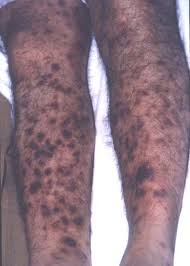
Kaposi sarcoma typically presents with distal lower extremity skin findings, including violaceous, dark brown, or reddish-blue macules, plaques, or nodules. These may be exophytic, ulcerative, or hemorrhagic. Patients with severe Kaposi sarcoma may have lesions involving the oral cavity, throat, visceral organs, and lymph nodes.
The differential diagnosis of Kaposi sarcoma includes nodular melanoma, Merkel cell carcinoma, pyogenic granuloma, angiosarcoma, bacillary angiomatosis, and acroangiodermatitis of Mali, a reactive angiodysplasia associated with chronic venous insufficiency.
Iatrogenic Kaposi sarcoma typically occurs in patients undergoing treatment with immunosuppressants after organ transplant or for immune-mediated diseases. A study of US patients who received solid organ transplants from 1987 to 2014 and had no history of Kaposi sarcoma or HIV infection found that 163 of 244 ,964 (0.07%) developed Kaposi sarcoma.
As of February 2026, post-transplantation KSHV has been identified among 74 transplant recipients in the US. Sixty one percent of these recipients developed Kaposi sarcoma, 14% developed Kaposi sarcoma and Castleman disease, 8% developed KICS; 5% developed a lymphoproliferative disorder alone and 1% developed KICS alone. Most of the donors were not infected with HIV, but non-medical drug use was common.
Iatrogenic Kaposi sarcoma has also been reported in patients taking long-term daily systemic corticosteroids to treat rheumatoid arthritis, polymyalgia rheumatica, myasthenia gravis, nephrotic syndrome, and bullous pemphigoid.
The diagnosis of KSHV associated malignancies is based on the clinical presentation and tissue or lymph node biopsy for histology. Immunofluorescent staining for KSHV-LANA is very specific for Kaposi sarcoma.
PCR tests for KSHV have been developed that amplify the ORF-73 gene. The minimum virus level that gives a positive result in 95% of replicates is 500 copies per mL. This test has not been approved by the FDA.
Multiple research immunoassays have been developed to detect antibodies to multiple KSHV antigens. However, poor agreement has been documented among and between laboratories, particularly when testing low-risk populations.
References
Wen KW, Damania B. Kaposi sarcoma-associated herpesvirus (KSHV): molecular biology and oncogenesis. Cancer Lett. 2010 Mar 28;289(2):140-50.
Dittmer DP, Damania B. Kaposi sarcoma-associated herpesvirus: immunobiology, oncogenesis, and therapy. J Clin Invest. 2016 Sep 01;126(9):3165-75.
Kracalik I, et al. Kaposi Sarcoma–Associated Herpesvirus Infection and Complications Among Solid Organ Transplant Recipients — United States, January 2021–September 2025. MMWR Morb Mortal Wkly Rep 2026;75:99–105.
Knights SM, et al. High seroprevalence of Kaposi sarcoma–associated herpesvirus in men who have sex with men with HIV in the southern United States. Open Forum Infect Dis 2023;10:ofad160.
Albrecht D, et al. Epidemiology of HHV-8 infection in HIV-positive patients with and without Kaposi sarcoma: diagnostic relevance of serology and PCR. J Clin Virol 2004;30:145–9.
Polizzotto MN, et al. Clinical features and outcomes of patients with symptomatic Kaposi sarcoma herpesvirus (KSHV)–associated inflammation: prospective characterization of KSHV inflammatory cytokine syndrome (KICS). Clin Infect Dis 2016;62:730–8.



 How to resolve AdBlock issue?