

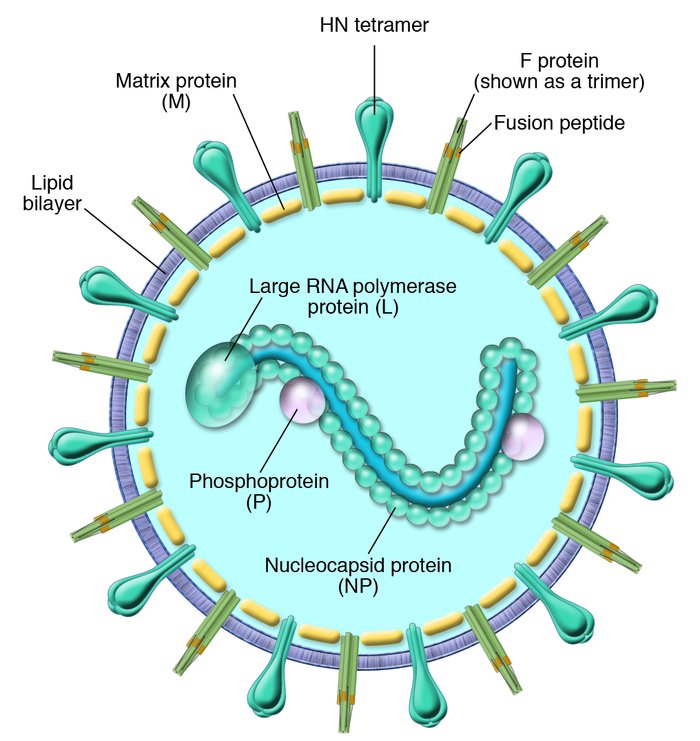
Despite the name, human parainfluenza viruses (HPIVs) are not closely related to influenza viruses. They are enveloped RNA viruses that belong to the Paramyxoviridae family. There are four types (1-4) and two subtypes (4a and 4b). The clinical and epidemiological features for each subtype can vary.
- HPIV-1 infections often cause croup in children. They can cause upper and lower respiratory illness and cold-like symptoms. There are usually more cases in the fall.
- HPIV-2 infections can also cause croup in children. They can cause upper and lower respiratory illness and cold-like symptoms. HPIV-2 infections are more common in the fall. They are less frequently detected than HPIV-1 and HPIV-3.
- HPIV-3 infections are more often associated with bronchiolitis and pneumonia. They usually occur in spring and early summer months. However, HPIV-3 infections can occur throughout the year, particularly when HPIV-1 and HPIV-2 are not in season.
- HPIV-4 (subtypes 4a and 4b) infections are diagnosed less often because of infrequent testing. They may cause mild to severe respiratory tract illness, including bronchiolitis and pneumonia. Seasonal patterns are not as well characterized but seem to occur in fall and winter each year.
HPIV transmission usually occurs by direct contact with infectious droplets when an infected person breathes, coughs, or sneezes. They can also become infected by direct contact with contaminated surfaces. HPIV remain infectious in expelled droplets and surfaces for more than one hour.
The incubation time, from infection to symptom onset, is 2 to 6 days. HPIVs typically cause symptoms similar to other respiratory viruses including: cough, sneezing, sore throat, congestion, and fever. Severe disease is more common in young children, who can develop croup, bronchiolitis, bronchitis, or pneumonia. HPIV infections may exacerbate underlying lung conditions such as asthma. Symptoms of more serious illness in children can include a barking cough, hoarseness, stridor, and wheezing.
Symptoms in adults include fever, runny nose, cough, and sore throat. Bronchitis or pneumonia may occur in older adults or those with weakened immune systems.
Children are generally infected at a young age. Most children ages 5 years and older have antibodies against HPIV-3, and approximately 75% have antibodies against HPIV-1 and HPIV-2. However, people can get multiple HPIV infections throughout their lifetime. Reinfections usually cause mild upper respiratory tract illness with cold-like symptoms.
HPIV serotypes 1-4 can be detected by the BioFire FilmArray Respiratory Panel. Specimen requirement is a nasopharyngeal swab placed in 1 mL of transport media.
References
Elboukari H, Ashraf M. Parainfluenza Virus. [Updated 2023 Jul 17]. In: StatPearls [Internet].
Branche AR, Falsey AR. Parainfluenza Virus Infection. Semin Respir Crit Care Med. 2016 Aug;37(4):538-54.
DeGroote NP,et al. Human parainfluenza virus circulation, United States, 2011-2019. J Clin Virol. 2020 Mar;124:104261



 How to resolve AdBlock issue?