

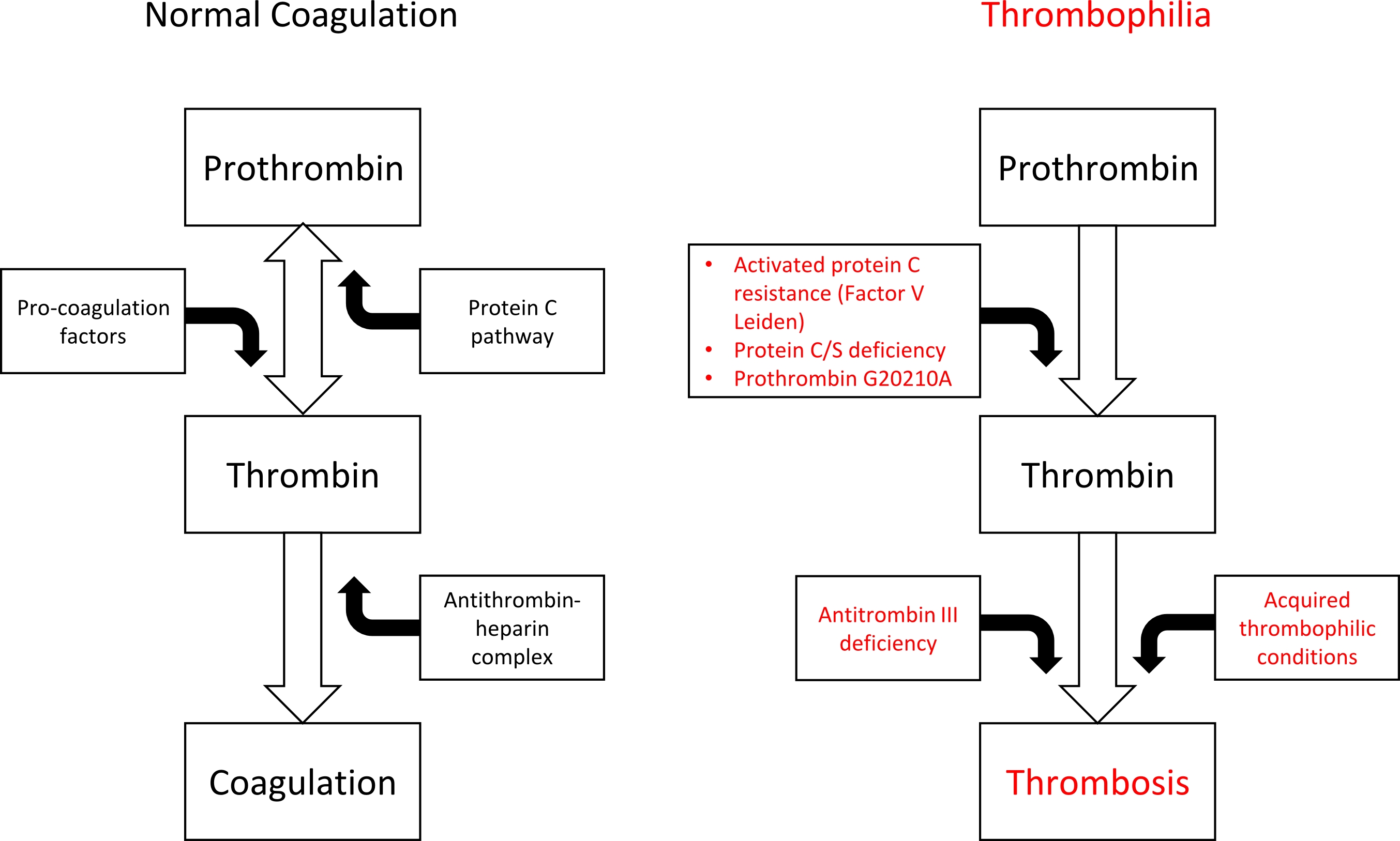
Approximately 2 million people in the United States die each year from an arterial or venous thrombosis. Effective prophylaxis and treatment for venous thrombosis are available, but are often not administered because testing for hypercoagulable disorders is not routinely performed and risk factors are not fully understood. Known acquired and hereditary thrombotic risk factors are summarized below.
Acquired thrombotic risk factors
- Surgery or trauma
- Immobilization
- Malignancy
- Pregnancy
- Oral Contraceptives
- Estrogen replacement therapy
- Lupus anticoagulant
- IgG anticardiolipin antibody
- Obesity
- Nephrotic syndrome
- Polycythemia vera
- Smoking
Hereditary thrombotic risk factors
- Activated protein C resistance (Factor V Leiden mutation)
- Prothrombin G20210A mutation
- Hyperhomocysteinemia (can also be acquired)
- Protein C deficiency
- Protein S deficiency
- Antithrombin deficiency
|
Hereditary Risk Factor |
Prevalence in Caucasian Population |
Prevalence in Patients with DVT |
Relative Risk |
|
Factor V Leiden |
5% |
20% |
8 |
|
Prothrombin |
2% |
6% |
3 |
|
Homocysteinemia |
5% |
10% |
2.5 |
|
Protein C |
0.3% |
3% |
10 |
|
Protein S |
0.3% |
2% |
10 |
|
Antithrombin |
0.02% |
1% |
10-50 |
According to the “second hit” theory for initiation of thrombosis, the presence of more than one risk factor is needed to manifest thrombosis in most patients. For example, one hereditary risk factor plus one acquired risk factor results in thrombosis. A patient with the factor V Leiden mutation (1st hit) who uses oral contraceptives (2nd hit) greatly increases their risk of thrombosis by combining the 2 risk factors.
The clinical relevance of the various inherited and acquired prothrombotic risk factors and the strength of their interactions are only partially understood. In some instances it is not known whether patients with inherited thrombophilia should be treated differently from those without these disorders, particularly with regard to duration of oral anticoagulant therapy following a thrombotic episode. In general, patients with a history of VTE may be stratified into three risk categories for recurrent thrombosis.
1. Low-risk category:
Patients with a single episode of VTE that occurred in the presence of one or more transient risk factors (such as surgery, immobilization, pregnancy, the puerperium, oral contraceptive or hormone replacement therapy). In general, these patients receive relatively short-term anticoagulation (3-6 months).
2. High-risk category:
Patients with the most severe forms of thrombophilia such as:
- Antithrombin deficiency
- Antiphospholipid antibodies
- Homozygous factor V Leiden
- Multiple thrombophilic defects
- Malignancy
- Recurrent VTE.
Longer-term anticoagulation is usually recommended for these patients (12 months to indefinite).
3. Intermediate category
- Patients with relatively mild thrombophilia
- Heterozygous protein C and protein S deficiency
- Heterozygous factor V Leiden
- Heterozygous prothrombin gene mutation
- Patients with thrombosis in a life-endangering location such as portal, mesenteric or cerebral vein, or massive pulmonary embolism.
Indications for laboratory testing include:
- A history of venous or arterial thrombosis with one or more of the following features:
- Idiopathic / unexplained
- Recurrent
- Family history of thrombotic tendency
- Unusually young age
- Unusual site e.g. subclavian or mesenteric vessels
- Resistant to conventional anticoagulant therapy
- Associated with pregnancy or oral contraceptive therapy
- A history of one of the following complications of pregnancy:
- Second trimester pregnancy loss
- Intrauterine growth restriction
- Severe or recurrent preeclampsia
For ordering convenience, some laboratories offer hypercoagulability panels. For example, an antiphospholipid I panel includes coagulation tests for diagnosis of lupus anticoagulant. Ordering indications for this panel include investigation of an unexplained APTT prolongation, or follow-up of a previously diagnosed or borderline lupus anticoagulant. Tests might include APTT, PT, mixing studies, hexagonal phase phospholipid test, dilute Russell viper venom time, thrombin time, anticardiolipin IgG and IgM antibodies, and anti-beta-2-glycoprotein I IgG and IgM antibodies.
A venous thrombosis panel might include all of the laboratory tests needed to diagnose the most common hereditary and acquired hypercoagulable disorders. It might include all of the tests in the antiphospholipid panel plus activated protein C (APC) resistance, factor V Leiden (if APC resistance is abnormal), prothrombin gene mutation, homocysteine, Protein C, Protein S, and antithrombin.
Acquired deficiencies of the naturally occurring anticoagulants, protein C, protein S, and antithrombin, are very common in various pathological and physiological conditions, as shown in the following table.
|
Condition |
Protein C |
Protein S |
Antithrombin |
|
Acute thrombosis |
↓ |
↓ |
↓ |
|
Liver disease |
↓ |
↓ |
↓ |
|
DIC |
↓ |
↓ |
↓ |
|
Coumadin |
↓ |
↓ |
- |
|
Vitamin K deficiency |
↓ |
↓ |
- |
|
Acute phase reaction |
↓ |
↓(free) |
- |
|
Pregnancy |
- |
↓ |
↓ |
|
Oral contraceptives |
|
↓ |
↓ |
|
Estrogen therapy |
|
↓ |
↓ |
|
Nephrotic syndrome |
- |
↓(free) |
↓ |
|
Heparin |
- |
- |
↓ |
A panel of tests for hypercoagulability is often ordered for inpatients with deep vein thrombosis, pulmonary embolism or arterial thrombosis. However, the value of this testing during hospitalization is questionable for the following reasons. Acute thrombosis transiently decreases protein C, protein S and antithrombin. Factor VIII and fibrinogen often increase, because they are acute phase reactants. Heparin therapy can lower antithrombin levels and impair interpretation of clot-based assays for lupus anticoagulants and proteins C and S if the level of heparin is above the therapeutic range. Warfarin therapy decreases protein C and protein S levels because they are vitamin K dependent proteins. If a low value is obtained for any of these proteins during an acute event, testing must be repeated once the patient has fully recovered and is off of anticoagulants.
Genetic testing for Factor V Leiden and prothrombin gene mutations is not affected by medical acuity or anticoagulants, but the activated protein C resistance test, which is a screening test for Factor V Leiden, is decreased by acute thrombosis.
Some studies have concluded that testing of inpatients for mutations that cause inherited thrombophilia is not clinically useful, cost effective, or reliable in the setting of venous thromboembolism (VTE). The result of such testing does not affect management of acute primary or recurrent VTE. Testing should only be considered using an individualized approach in the outpatient setting with appropriate genetic counseling.
The optimal time to order thrombophilia testing is when a patient is asymptomatic and no longer on anticoagulant therapy. In general, testing should be performed 4 to 6 weeks after discontinuing warfarin, direct thrombin inhibitors or fibrinolytic agents. This time interval is also necessary to allow acute-phase reactant proteins to return to baseline.
During pregnancy there is a significant acquired decrease in protein S levels (total and free). If there has been a recent acute event (including thrombosis), it is advisable to defer testing for 4 to 6 weeks.
References
Petrilli CM et al. Inpatient Inherited Thrombophilia Testing. J Hospital Medicine 2016;11:801-804.
Connors JM, Thrombophilia Testing and Venous Thrombosis, New Engl J Med, 2017;377:1777-1787.
Khan F et al, Venous thromboembolism, The Lancet,2021;398:64-77.
Tritschler T et al, Venous Thromboembolism: Advances in Diagnosis and Treatment, JAMA,2018(320):1583-1594.



 How to resolve AdBlock issue?