

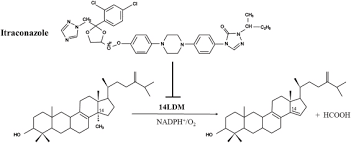
Itraconazole is an oral anti-fungal medication that can be used to treat candidia, cryptococcus, aspergillosis, histoplasmosis, and severe presentations of sporotrichosis. The major anti-fungal mechanism of itraconazole is inhibition of ergosterol synthesis, which is a major component of fungal cell membranes. Itraconazole is metabolized by CYP3A4 to hydroxyitraconazole, which has comparable activity to the parent drug.
Most patients do not require routine monitoring of itraconazole concentrations. Patients with, impaired absorption or possible drug interactions may benefit from therapeutic drug monitoring. Initially, bioassays were used to measure drug activity, but they could not distinguish parent drug activity from metabolite activity. More recently, laboratories have introduced liquid chromatography-tandem mass spectrometry (LC-MS/MS) which can measure itraconazole and hydroxyitraconazole independently.
Target therapeutic values are assay-dependent. Results of bioassays typically run 2 to10 times higher than HPLC results. Reference ranges for bioassays and HPLC assays are not interchangeable.
Trough itraconazole concentrations by HPLC should be greater than 0.5 mcg/mL for localized infections and greater than 1.0 mcg/mL for systemic infections. Hydroxyitraconazole is present in serum at roughly twice the level of the parent drug. No therapeutic targets have been established for hydroxyitraconazole. Toxicity appears to be concentration dependent, but an upper limit to the therapeutic range has not been well established.
Therapeutic drug monitoring should be ordered after two weeks of therapy to ensure that steady state has been reached. A trough sample should be collected immediately before the next scheduled dose. Specimen is a red top tube of blood.
References
Dominguez-Gil Hurle A, et al. Therapeutic drug monitoring of itraconazole and the relevance of pharmacokinetic interactions, Clin Microbiol Infect, 2006;12(Suppl 7):97-106.
Benedict K, et al, Antifungal Therapeutic Drug Monitoring Practices: Results of an Emerging Infections Network Survey, Open Forum Infectious Diseases, 2023;10(9): ofad468.
Andes DPascual A, Marchetti O. Antifungal Therapeutic Drug Monitoring: Established and Emerging Indications. Antimicrob Agents Chemother.2009;53:https://doi.org/10.1128/aac.00705-08



 How to resolve AdBlock issue?