

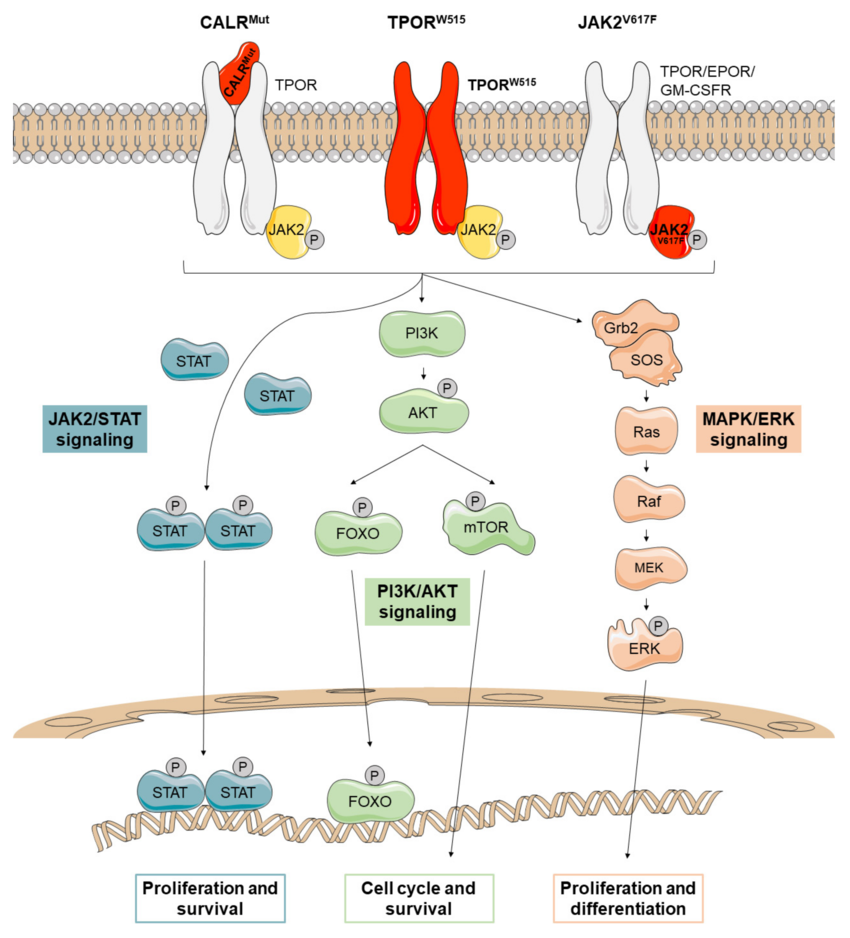
In early 2005, several groups of investigators reported a somatic acquired point mutation in the JAK2 (Janus kinase 2) protein in the blood and bone marrow of patients with BCR/ABL-negative chronic myeloproliferative disorders. The JAK2 gene is located at 9p24 and codes for a tyrosine kinase that plays an important role in signal transduction in hematopoietic cells. The most common somatic mutation occurs within exon 14 at base pair 1849 and results in substitution of phenylalanine for valine, which is designated V617F. A mutation at V617F results in a hyperactive kinase that is believed to allow erythropoietin independent survival of the myeloid stem cell. Less common mutations have been identified in exons 12 to 15.
Using sensitive assays, the JAK2 mutation can be detected in approximately 98-100% of cases of polycythemia vera, 50-70% of patients with essential thrombocythemia, and 40-50% of cases of idiopathic myelofibrosis. The mutation has also been described in rare cases of myelodysplastic syndromes, acute myeloid leukemia, systemic mastocytosis and hypereosinophilic syndrome. It is specific for diagnosis of a clonal myeloid lineage proliferative disorder. The mutation has not been described in BCR/ABL-positive chronic myeloid leukemia, any acute or chronic lymphoid disorders, any healthy persons, or any patient with secondary polycythemia or a reactive blood count elevation.
Testing for JAK2 mutations is very useful in distinguishing clonal myeloproliferative disorders from reactive cellular proliferations. Indications for ordering the assay include the following:
- Evaluation of polycythemia - the test should be ordered in addition to serum erythropoietin level.
- Evaluation of an elevated platelet count, clinically not consistent with reactive thrombocytosis.
- Unusual thrombotic events including abdominal or cerebral thrombosis or arterial events at a young age, which may be a presenting sign of an underlying chronic myeloproliferative disorder.
JAK2 mutation is one of three major diagnostic criteria for the diagnosis of polycythemia vera. It was included in the 2016 revision to the World Health Organization classification of myeloid neoplasms and acute leukemia.
Polycythemia Major Criteria 2016:
- Hemoglobin >16.0 g/dL in women or >16.5 g/dL in men or hematocrit >48% in women or >49% in men or increased red cell mass
- Bone marrow biopsy showing age adjusted hypercellularity with panmyelosis.
- JAK2 V617F or JAK2 exon 12 mutation
Polycythemia Minor criterion
- Subnormal serum erythropoietin level
Diagnosis of polycythemia vera requires all three major criteria or the first two major criteria and the minor criterion. Absence of a JAK2 mutation makes a diagnosis of polycythemia vera his unlikely.
It is important to keep in mind that a positive JAK2 mutation is not specific for a particular sub-type of myeloproliferative disorder, and must be correlated with other clinical and laboratory findings for definitive diagnosis. Furthermore, a negative result does not exclude the presence of a chronic myeloproliferative disorder or other neoplastic disorder.
JAK2 and BCR-ABL PCR testing should be considered complementary in the workup of myeloproliferative disorders. A few cases of dual positivity for both mutations have been reported.
JAK2 mutation is detected by extraction of genomic DNA from blood and amplification by quantitative PCR. Wild type JAK2 is distinguished from the V617F mutation by melting curve analysis. Sample requirement is one lavender-top tube containing at least 3mL of peripheral blood or bone marrow.
References
Baxter EJ, Scott LM, Campbell PJ, et al. Acquired mutation of the tyrosine kinase JAK2 in human myeloproliferative disorders. Lancet. 2005;365(9464):1054-1061.
Kralovics R, et al. A gain-of-function mutation of JAK2 in myeloproliferative disorders. N Engl J Med. 2005;352:1779-1790.
Arber DA, et al The 2016 revision to the World Health Organization classification of myeloid neoplasms and acute leukemia. Blood 2016;127(20):2391-2405



 How to resolve AdBlock issue?