

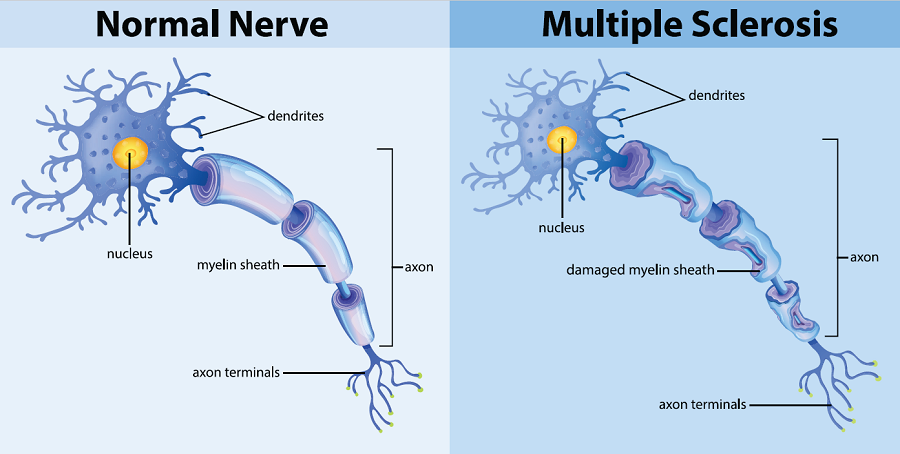
Multiple sclerosis is the most prevalent chronic demyelinating disease of the central nervous system (CNS). Multiple sclerosis lesions can occur throughout the CNS and are most easily recognized in the white matter as focal areas of demyelination, inflammation, and glial reaction.
Typical presentations include monocular vision loss due to optic neuritis, limb weakness or sensory loss due to transverse myelitis, double vision due to brain-stem dysfunction, or ataxia due to a cerebellar lesion.
The female to male ratio is 4 to 1. Major environmental risk factors include Epstein-Barr virus infections, geographic latitude and birthplace, sunlight exposure, and vitamin D concentration. Genomewide association studies of patients with multiple sclerosis and matched controls have identified more than 200 gene variants that increase the risk of multiple sclerosis.
The 2017 McDonald diagnostic criteria for the diagnosis of multiple sclerosis required imaging studies that showed dissemination in space or dissemination in time for the brain lesions that are characteristic of demyelination.
The 2017 McDonald criteria stated that if a patient has presented with two clinical attacks and has any number of demyelinating lesions on imaging studies, they could be diagnosed with MS. If there had been a single clinical attack and there were two or more lesions, the criteria still required performing a second MRI to demonstrate dissemination in time. If a patient had only one lesion, additional imaging was needed to show dissemination in space and time.
In patients who had one clinical attack, the 2017 McDonald diagnostic criteria allowed positive CSF oligoclonal band (OCB) tests to replace the criteria for dissemination in time or space. The criteria for positive oligoclonal bands were very specific. OCB should be performed by isoelectric focusing (IEF). CSF and serum should be run together. Two or more unique CSF bands must be present to be interpreted as positive. Two studies from Mayo Medical Laboratories reported that OCB had a sensitivity of 74% and 94% and specificity of 88.6% and 72.5%.
The complete process for detection of OCB by IEF takes about four hours and is performed manually. Potential technical problems include poor sample application, bubbles in the agarose gel, uneven band migration, nonspecific protein binding, under-staining, over-staining, and inadequate blotting. Interpretation of OCB is rater-dependent.
The 2024 revision of the 2017 McDonald criteria for diagnosing multiple sclerosis allows the kappa-free light chain index (k-FLC) to replace oligoclonal band detection in cerebrospinal fluid analysis. This change addresses the limitations of OCB. K-FLC can more easily be performed in hospital laboratories. K-FLC are measured automatically using a nephelometer. The results are quantifiable and rater-independent. The revised criteria aim to improve MS diagnosis and facilitate earlier access to therapy.
A k-FLC concentration of less than 0.06 mg/dL is considered negative, while a result of 0.10 mg/dL or greater is considered positive for a demyelinating disease. Results in between these two thresholds are borderline and not considered specific for multiple sclerosis.
Specimen requirement is 1 mL of cerebrospinal fluid.
References
Thompson AJ, et al. Diagnosis of multiple sclerosis: 2017 revisions of the McDonald criteria. The Lancet Neurology. 2018;17(2):162-173.
Montalban X, et al, Diagnosis of Multiple Sclerosis: 2024 Revisions of McDonald’s Criteria, Lancet Neurology, 2025;24(10):850-865.
Higgins V, et al. Variation in processes and reporting of cerebrospinal fluid oligoclonal banding and associated tests and calculated indices across Canadian clinical laboratories, Clin Biochem. 2023;116:105–112.
Gurtner KM, et al. CSF free light chain identification of demyelinating disease: comparison with oligoclonal banding and other CSF indexes. Clin Chem Lab Med. 2018;56(7):1071-1080
Saadeh RS, et al. CSF kappa free light chains: Cutoff validation for diagnosing multiple sclerosis. Mayo Clin Proc. 2022;97(4):738-751.
Deisenhammer F, et al, Positive cerebrospinal fluid in the 2024 McDonald criteria for multiple sclerosis, eBioMedicine, 2025;120:105905



 How to resolve AdBlock issue?