

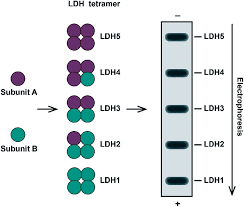
Lactic dehydrogenase (LD) catalyzes the conversion of lactate to pyruvate and is present in high concentrations in the cytoplasm of almost all cells. Since LD is found in every tissue in the body, the diagnostic value of an elevated level without additional laboratory investigation is limited. Diseases of most organs including myocardial infarction, hepatic necrosis, skeletal muscle disease, renal disease, pulmonary infarction, malignancy, megaloblastic anemia, and hemolysis increase serum levels of LD.
Five lactic dehydrogenase (LD) isoenzymes are found in serum. Each isoenzyme is a tetramer, composed of two copies of two protein subunits that are designated H (heart) and M (muscle). LD1 is composed of 4H subunits, LD2 is 3HM, LD3 is 2H2M, LD4 is H3M, and LD5 is 4M.
Although there is some overlap, each of the five LD isoenzymes tends be concentrated in specific tissues and organs.
- LD1 is present primarily in heart muscle, red blood cells, and kidney
- LD2 is present primarily in heart muscle, red blood cells, and kidney
- LD3 is present primarily in lungs
- LD4 is present primarily in white blood cells, lymph nodes, muscle, and liver
- LD5 is present primarily in liver and skeletal muscle
Different tissues have varying concentrations of the isoenzymes so that the LD isoenzyme pattern of the serum may indicate the tissue of origin of elevated serum LD.
- LD1 greater than LD2 is seen in myocardial necrosis, hemolysis, renal infarction and high doses of estrogen.
- LD1 greater than LD2 with increased LD5 is consistent with myocardial necrosis complicated by congestive heart failure or shock.
- Prominent LD2 and LD3 is consistent with pulmonary embolism.
- Elevation of LD3 is seen in lymphoma, pulmonary infarction, splenic infarction, pancreatitis, collagen diseases and viral infections.
- Increased LD3 and LD4 may be seen in thrombocytosis
- Elevations of LD4 and LD5 are associated with necrosis of liver, skin and skeletal muscle.
- Elevated total activity with unremarkable isoenzyme pattern is consistent with multi-system disease such as shock, anoxia, or trauma.
- Bizarre patterns such as an absence of LD2 and 3 with a broad or fused LD4 and 5 may be due to a complex of LD with IgA or IgG.
LD isoenzymes are determined by electrophoresis. Specimen requirement is one red-top or gel barrier tube of blood.
Adult Reference ranges are:
|
LD Isoenzyme |
Percent |
|
1 |
17-32 |
|
2 |
25-40 |
|
3 |
17-27 |
|
4 |
5-13 |
|
5 |
4-20 |
References
Rotenberg Z, et al. The efficiency of lactate dehydrogenase isoenzyme determination for the diagnosis of acute myocardial infarction. Arch Pathol Lab Med. 1988; 112(9):895-897.
Jacobs DS, et al. Clinical significance of the isomorphic pattern of the isoenzymes of serum lactate dehydrogenase. Ann Clin Lab Sci. 1977 Sep-Oct; 7(5):411-421.
Giannoulaki EE, et al. Lactate dehydrogenase isoenzyme pattern in sera of patients with malignant diseases. Clin Chem. 1989 Mar; 35(3):396-399



 How to resolve AdBlock issue?