

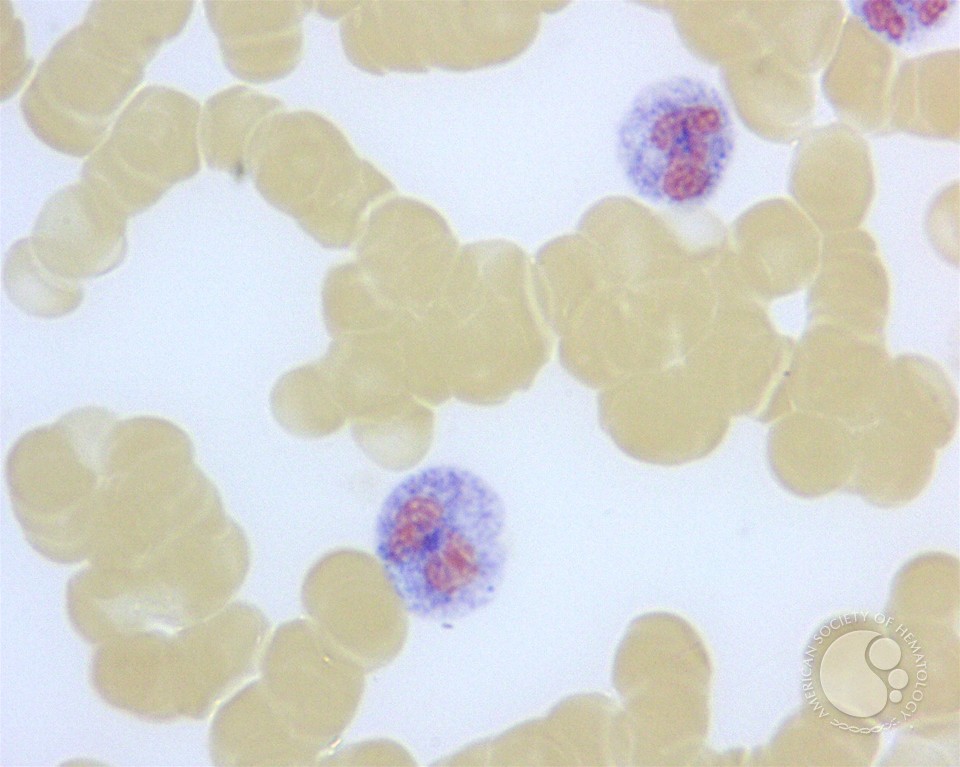
Historically, the diagnostic utility of leukocyte alkaline phosphatase (LAP) activity (measured as the LAP score) was in the differential diagnosis of leukocytosis. The LAP score was usually low in chronic myeloid leukemia (CML). This helped distinguish CML from other myeloproliferative neoplasms with leukocytosis and inflammatory leukemoid reactions, both of which had a normal or increased LAP score. Additionally, it was noted that the LAP score was also low in patients with paroxysmal nocturnal hemoglobinuria (PNH), although this was not used as a diagnostic test for PNH.
In the laboratory, the LAP score was determined using a cytochemical stain on a peripheral blood film followed by a semiquantitative visual estimation of the degree of staining in neutrophils. Thus, the test was inherently limited in its reproducibility and accuracy. Finally, even before the molecular pathogenesis of CML and PNH was fully understood, it was recognized that the LAP score may not always be low in CML and PNH, and can be low in some cases of other myeloproliferative neoplasms and myelodysplastic syndromes.
In 2008, WHO’s Classification of Tumors of Haematopoietic and Lymphoid Tissues eliminated the use of the LAP score. CML was defined by the presence of the BCR/ABL-1 rearrangement, which underlied the pathogenesis of CML and was the basis of treatment of CML using tyrosine kinase inhibitors. If a myeloproliferative neoplasm was positive for the BCR/ABL-1 rearrangement, it was classified as CML, regardless of the LAP score. Just as a low LAP score did not make a diagnosis of CML, a normal or high LAP score did not exclude it.
For all of these reasons, the LAP score has become obsolete.
References
Leukocyte Alkaline Phosphatase in Hematology 4th ed. McGraw-Hill: New York,1990
WHO Classification of Tumors of Haematopoietic and Lymphoid Tissues. IARC: Lyon 2008



 How to resolve AdBlock issue?