

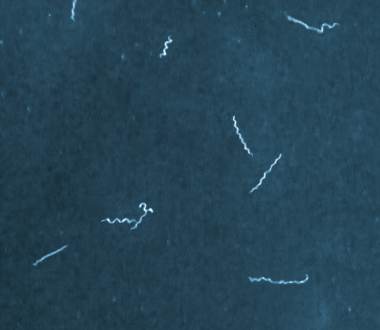
Borrelia mayonii is a less common bacterial cause of Lyme disease in the United States than Borrelia burgdorferi. It was first identified by Dr. Bobbi Pritt at the Mayo Clinic in 2013 and named after William and Charles Mayo, the founders of the Mayo Clinic.
B. mayonii is transmitted through the bite of blacklegged ticks (deer tick, Ixodes scapularis) and has been reported in Minnesota, Wisconsin, and New York. Blacklegged ticks are small; adults are about the size of a sesame seed and nymphs are about the size of a poppy seed. Tick must be attached for at least 24 to 48 hours before it can cause Lyme disease. Blacklegged ticks live on the ground in areas that are wooded or have lots of brush. The ticks search for hosts at or near ground level and grab onto a person or animal as they walk by. Most infections occur between April and September.
Borrelia mayonii infection produces signs and symptoms of traditional Lyme disease caused by Borrelia burdorferi. However, it can cause more serious disease including a diffuse rash involving the face, trunk and extremities and neurological involvement.
The diagnosis of Lyme disease is primarily based on the patient’s clinical presentation and their exposure to black-legged ticks in areas where Lyme disease is endemic. The presence of erythema migrans is considered diagnostic for Lyme disease and no confirmatory laboratory testing is needed. In the absence of erythema migrans, serologic testing is the diagnostic method of choice for Lyme disease. The CDC recommends a 2-tiered serologic testing algorithm for detection of antibodies produced by Borrelia species. Samples that test positive or equivocal with an initial screening assay are reflexed to an immunoblot for detection IgM and IgG antibodies to Borrelia.
However, serology may not be positive until 1 to 2 weeks after onset of symptoms and is not as sensitive for detection of infection with B mayonii. Borrelia mayonii produces higher levels of spirochetemia in whole blood than seen with Borrelia burgdorferi infection. Therefore, detection of Bbsl DNA using polymerase chain reaction (PCR) may be a useful adjunct to serologic testing for detection of acute disease caused by Borrelia mayonii.
References
Pritt BS, et al. Borrelia mayonii sp. nov., a member of the Borrelia burgdorferi sensu lato complex, detected in patients and ticks in the upper midwestern United States. Int J Syst Evol Microbiol 2016;66:4878–80.
Pritt BS, et al. Identification of a novel pathogenic Borrelia species causing Lyme borreliosis with unusually high levels of spirochetemia: a descriptive study. Lancet Infect Dis. 2016;16(5):556-564.
Johnson TL, et al. Isolation of the Lyme disease spirochete Borrelia mayonii from naturally infected rodents in Minnesota. J Med Entomol 2017;54:1088–92.
Hojgaard A, Osikowicz LM, Eisen L, Eisen RJ. Evaluation of a novel multiplex PCR amplicon sequencing assay for detection of human pathogens in Ixodes ticks. Ticks Tick Borne Dis 2020;11:101504.
Centers for Disease Control and Prevention. Recommendations for test performance and interpretation from the Second National Conference on Serologic Diagnosis of Lyme Disease. MMWR Morb Mortal Wkly Rep. 1995 Aug;44(31):590-591.
Nafiz TN, et al. Notes from the Field: Borrelia mayonii Lyme Disease — New York, 2025. MMWR Morb Mortal Wkly Rep 2026;75:271–272.



 How to resolve AdBlock issue?