

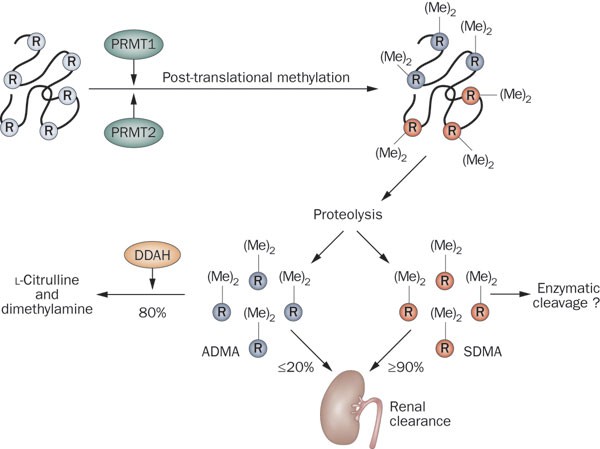
Protein arginine methyltransferases are intracellular enzymes that transfer methyl groups from S-adenosylmethionine to cytoplasmic proteins. When these methylated proteins are degraded by proteolysis, free symmetric dimethylarginine (SDMA) is released. SDMA is almost exclusively eliminated by renal excretion, allowing it to serve as an indicator of glomerular filtration.
SDMA correlates more strongly with measured GFR than creatinine alone. In a head-to-head comparison against iothalamate clearance, SDMA achieved r = −0.84 vs. creatinine r = −0.70, and was equivalent to cystatin C (r = −0.86) and the CKD-EPI eGFR equations. A meta-analysis of 18 studies (n = 2,136) confirmed a strong correlation between SDMA and inulin clearance (R = 0.85).
The major theoretical advantage of SDMA over creatinine is its reduced sensitivity to muscle mass. Approximately 98% of circulating creatinine originates from muscle, making creatinine-based eGFR unreliable in patients with sarcopenia, cachexia, amputations, or spinal cord injuries. Since SDMA is derived from proteolysis of methylated proteins rather than muscle metabolism, it is less affected by these variations in muscle mass. In this regard, SMDA parallels the rationale for using cystatin C in clinical situations where non-GFR determinants of creatinine are suspected.
Despite its superior performance, SDMA has not replaced creatinine and cystatin C as the standard markers of kidney function. Barriers to its widespread adoption into clinical practice include the absence of; standardized laboratory assays, established clinical decision thresholds, and a validated eGFR equation based on SDMA.
References
El Khoury JM, et al. Comparison of Symmetric Dimethylarginine with Creatinine, Cystatin C, and Their eGFR Equations as Markers of Kidney Function. Clin Biochem. 2016.
Kielstein JT, et al. Symmetric dimethylarginine (SDMA) as endogenous marker of renal function--a meta-analysis. Nephrol Dial Transplant. 2006 Sep;21(9):2446-51.



 How to resolve AdBlock issue?