

Malaria is a major tropical disease infecting approximately 500 million people worldwide. In the United States, most cases involve individuals who have traveled to endemic areas. Approximately 2,000 cases of malaria and 7 malaria-related deaths have been reported annually to CDC.
Anopheles mosquitoes capable of transmitting malaria are present across most of the United States. The majority of US residents lack protective immunity against malaria. During 2023, ten cases of locally acquired (autochthonous) malaria occurred in 4 states.
Malaria is caused primarily by 4 species of the protozoa Plasmodium: Plasmodium falciparum, Plasmodium vivax, Plasmodium malariae, and Plasmodium ovale. A fifth Plasmodium species, Plasmodium knowlesi, is more common in Southeast Asia. It is especially important to correctly identify Plasmodium falciparum and Plasmodium knowlesi because they cause life-threatening infections. Plasmodium falciparum has become resistant to many commonly used antimalarial medications including chloroquine. Most local US outbreaks have been caused by Plasmodium vivax.
Malaria is transmitted to humans through bites from infective female mosquitoes of the Anopheles genus. Plasmodium infection can result in a spectrum of disease ranging from asymptomatic parasitemia to severe illness and death. Patients might first experience nonspecific signs and symptoms such as fever, chills, headache, weakness, myalgia, vomiting, and diarrhea. More severe symptoms included altered mental status, circulatory failure, shock, multi-system organ failure, and death.
The standard laboratory method for detection and differentiation of malaria parasites is microscopic examination of Giemsa-stained thick and thin blood films. The sensitivity of thick film microscopy is estimated to be 10 to 30 parasites per microliter of blood. Prolonged exposure to EDTA and prior use of antimalarial drugs may alter parasite morphology and impair species identification. Babesia parasites resemble the ring forms of Plasmodium falciparum and may be misidentified as malaria.
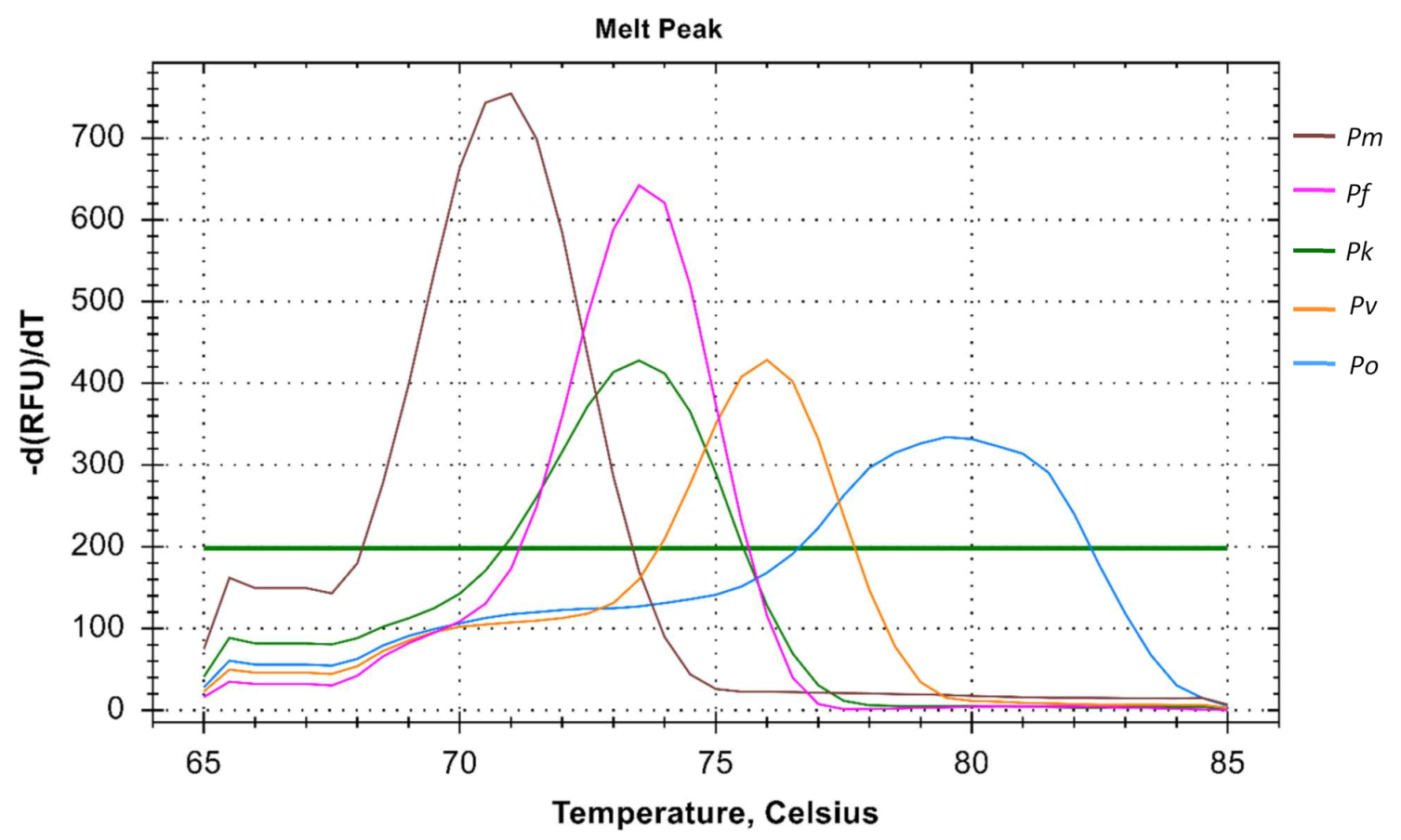
Malaria real-time polymerase chain reaction (PCR) is an alternative method of malaria diagnosis that allows for sensitive and specific detection of Plasmodium DNA from peripheral blood. DNA is extracted from whole blood and a Plasmodium target sequence is amplified by PCR. Clinically significant Plasmodium species are identified by melting curve analysis. In cases with low parasitemia PCR may be more sensitive for detection and more specific for species identification than microscopy. The lower limit of detection (LoD) is 10 to 50 DNA target copies per microliter of whole blood.
PCR can differentiate clinically significant Plasmodium species including Plasmodium falciparum, Plasmodium malariae, and Plasmodium knowlesi, but cannot differentiate Plasmodium vivax from Plasmodium ovale. The latter two species are reported as "Plasmodium vivax/Plasmodium ovale. They can often be distinguished by travel history. Malaria PCR is not indicated for screening of asymptomatic individuals.
Reference range is negative. A positive result indicates the presence of Plasmodium nucleic acid and melting curve analysis indicates the species.
Specimen requirement is a lavender-top tube of blood.
References
Ashley EA, Phyo P, Woodrow CJ, Malaria, Lancet, 2018;391(10130):1608-1621.
CDC. Malaria Surveillance-United States, 2014. MMWR Surveillance Summaries, May 26, 2017:66 (12) 1-24.
Mathison BA, Pritt BS: Update on malaria diagnostics and test utilization. J Clin Microbiol. 2017 Jul;55(7):2009-2017.
Ranadive N, et al. CDC Operational Guidance for Investigating Locally Acquired Mosquito-Transmitted Malaria — United States, 2026. MMWR Recomm Rep 2026;75(No. RR-1):1–14.



 How to resolve AdBlock issue?