

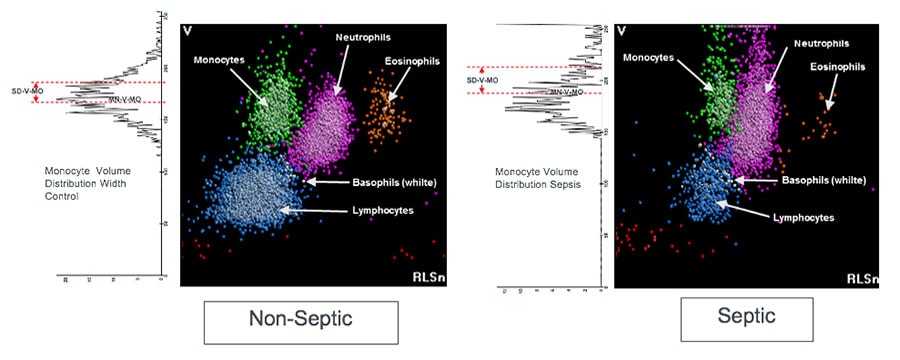
Sepsis is a life-threatening syndrome characterized by dysregulated host response to infection. During sepsis, monocytes become activated and elongated in appearance. Beckman Coulter hematology analyzers can measure monocyte distribution width (MDW). The FDA has approved MDW as an aid in identifying patients with sepsis or at increased risk of developing sepsis within the first 12 hours of hospital admission. Beckman also claimed that an MDW of less than 20 could be used to rule out sepsis.
A study at three academic medical centers found an MDW greater than 20 U could detect sepsis during an ED encounter. MDW had a higher predictive value when combined with the white blood cell count.
Beckman's published data showed that MDW >20 had a 93-94% negative predictive value for sepsis in the ED setting. This sensitivity is too low to reliably rule-out sepsis. Specificity was 70%, which is much too low to be used as to rule-in sepsis.
A systematic review and meta-analysis of 25 observational studies comprising 39,041 patients found that the area under the curve (AUC) was 0.82 for both sepsis-2 and sepsis-3. Sensitivity was 0.79 for sepsis-2 and 0.83 for sepsis-3. Specificity was 0.70 for sepsis-2 and 0.64 for sepsis-3. The aggregate negative predictive value was 94% for sepsis-2 and 96% for sepsis-3. The authors concluded that given its modest sensitivity, MDW could not be relied on to rule-out sepsis in a population with high pretest probability.
In my own experience at a medical center with a large population of patients with hematological diseases, more than 30% of patients in the emergency department had an MDW >20 U. Clinical performance of the MDW has not been determined in patients receiving immune stimulants, patients with alcoholism, or patients with hematologic abnormalities such as blast cells.
At this time, MDW should not be used as a sole test to determine the presence or absence of sepsis.
References
Crouser ED, et al, Improved Early Detection of Sepsis in the ED With a Novel Monocyte Distribution Width Biomarker, Chest, 2017;152(3):518-526.
Crouser ED et al, Monocyte Distribution Width: A Novel Indicator of Sepsis-2 and Sepsis-3 in High-Risk Emergency Department Patients, Crit Care Med, 2019;47(8):1018-1025.
Eisinger GJ et al, Diagnostic Performance of Monocyte Distribution Width for the Detection of Sepsis: A Systematic Review and Meta-Analysis, JACEP Open, 2025;6(2):100073.



 How to resolve AdBlock issue?