

West Nile Virus (WNV) is an arbovirus belonging to the flavivirus family that also includes dengue, yellow fever, St. Louis encephalitis and Japanese encephalitis. WNV is an enveloped virus of about 40-60 nm in diameter with a single-stranded RNA genome of approximately 10,000-11,000 bases. It is an arthropod-borne virus that is transmitted between susceptible hosts by blood-feeding mosquitoes. Birds are the mosquitoes preferred target, and subsequently act as sentinels of the virus’ presence within a geographic area. Birds and mammals can become infected when an infected mosquito bites them to take a blood meal. West Nile virus is mainly transmitted to humans by Culex species mosquitos. Humans, horses, and most other vertebrates are considered to be dead-end hosts since they normally do not participate in the life cycle of the virus. WNV cannot be spread from one human to another by casual contact.
The first North American cases occurred in New York City during the summer of 1999. The virus is endemic in Africa & the Middle East and may have reached this continent by migrant or smuggled birds. Nearly 57,000 cases of West Nile virus have been reported to the CDC from 1999 to 2022. Millions of mild or asymptomatic cases are believed to have occurred and gone unreported. West Nile virus is the most common cause of mosquito-borne disease in the United States.
Warmer temperatures are extending the geographic range of mosquitos in the United States. West Nile virus outbreaks will likely occur in regions of the US where the disease has been relatively rare. The increasing amounts of rainfall in the western US creates more mosquito habitats. Viruses replicate faster and spread more quickly to mosquito salivary glands in warmer temperatures, resulting in higher rates of transmission to humans. Methods to control the spread of the virus to humans involve the individual use of protective clothing and mosquito repellants, public health measures to reduce the mosquito population in areas where the virus is prevalent, and implementation of routine testing of the blood supply to limit transfusion transmitted disease.
Almost all WNV transmission occurs via mosquito bites, but less common routes of transmission include blood component transfusion, organ transplantation, and transplacental, perinatal, breastmilk, percutaneous, and conjunctival exposure. The first case of transmission by blood transfusion was identified in 2002. Nationwide screening of all blood donations with nucleic acid amplification testing started in 2003. Between 2002 and 2023, 14 clusters of WNV transmission by organ transplantation have been identified. A total of 32 recipients were infected.
When an infected mosquito bites a human, viral particles are deposited in the skin. WNV replicates in epidermal keratinocytes and dendritic cells, which migrate to draining lymph nodes. The virus continues to replicate and spreads to the bloodstream and visceral organs. In susceptible people, WNV can invade the central nervous system.
The typical incubation period of WNV disease following a mosquito bite is 2-6 days. The incubation period can be longer for patients who are immunocompromised and patients infected by blood transfusion and organ transplantation. Although most WNV infections are asymptomatic, an estimated 20% develop West Nile fever, which is a self-limited febrile illness that may be accompanied by malaise, anorexia, rash, lymphadenopathy, myalgia, headache, nausea, vomiting or eye pain. Approximately 0.4% to 0.7% of patients progress to neuroinvasive disease including encephalitis, meningitis, and flaccid paralysis. Patients with encephalitis often present with headache, high fever, stiff neck, stupor, disorientation, coma, tremors, convulsions, muscle weakness, and paralysis. Progression is more common in older patients or those with immunodeficiency. West Nile encephalitis is associated with an in-hospital mortality of approximately 20%.
Most severe outcomes have been seen in immunocompromised patients; particularly organ and stem cell transplant recipients, patients receiving immunosuppressive medications and patients with hematologic malignancies, myelodysplasia, and other advanced malignancies. People who are over age 65 or women who are pregnant or immediately postpartum also may be at increased risk.
Cerebrospinal fluid analysis usually reveals an elevated white blood cell count (mean 226 WBC/uL) with a mean neutrophil percentage of 43%. CSF glucose level is usually normal and protein elevated. Patients with encephalitis have higher protein concentrations (mean 101 mg/dL, range 32-295).
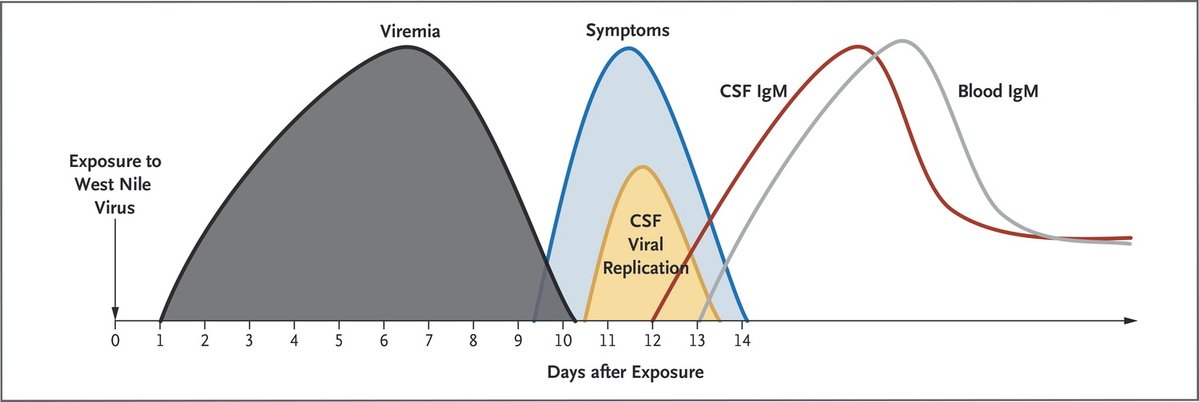
After West Nile virus is acquired from an insect vector, viremia ensues for a period of approximately 10 days, and then the virus becomes detectable in the CSF for 2 to 3 days. Viral replication in the CSF coincides with the onset of clinical symptoms. West Nile virus–specific humoral response develops in the CSF 11 or 12 days after infection, and then antibody becomes detectable in the blood.
The diagnostic test of choice for WNV and other arboviral infections is serologic analysis of serum or CSF for IgM and IgG antibodies. IgM antibody to WNV can be detected as early as 4 days after onset of illness and may persist for several weeks. Since IgM antibody does not cross the blood-brain barrier, its presence in CSF strongly suggests central nervous system infection. IgG antibody to WNV may be detectable one week after symptom onset. Patients who have been vaccinated against, or infected with, related flaviviruses (yellow fever, dengue) may also have positive WNV antibody tests.
Because viral replication in the CSF occurs for a short duration, polymerase chain reaction (PCR) for West Nile virus is often negative by the time the patient presents for clinical evaluation.
Specimen requirement is one red top tube of blood or 1.0 mL CSF.
References
Lyons JL, et al. Case 34-2017: A 76-Year-Old Man with Fever, Weight Loss, and Weakness. N Engl J Med 2017;377:1878-1886.
Gould CV et al. West Nile virus: A Review, JAMA. 2025;334(7):618-628.



 How to resolve AdBlock issue?