

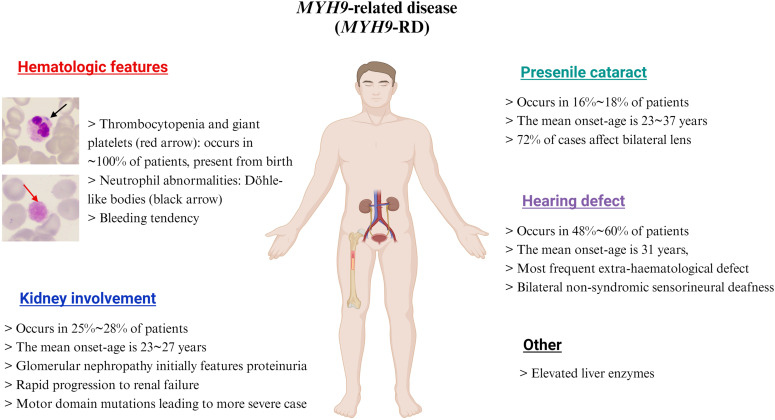
MYH9 related disorder (MYH9-RD) is a general term that encompasses several syndromes that were originally believed to be unrelated including May-Hegglin anomaly, Epstein syndrome, Fechtner syndrome, and Sebastian syndrome. All of these disorders are caused by mutations in the MYH9 gene and share overlapping clinical features such as increased numbers of large platelets, thrombocytopenia and bleeding tendency. The platelet count usually ranges between 30,000 and 100,000/uL. Mean platelet volume (MPV) is often >12.4 fL.Neutrophils may include grey-blue Dohle body-like inclusions. Other clinical features include early onset of deafness, cataracts, and renal disease.
The MYH9 gene encodes for myosin heavy chain 9 protein. Mutations impair cellular motility and production of platelets by megakaryocytes. This syndrome is inherited as an autosomal dominant disorder. A single copy of the mutant gene causes this syndrome because the mutant protein binds to and inactivates the normal copy of the MYH9 protein that is encoded by the normal allele.
MYH9-RD must be distinguished from ITP, toxic neutrophilic change, Bernard Soulier and GATA1-related X-linked cytopenia. Immunofluorescence studies on peripheral blood smears can confirm the presence of MHY9 protein aggregates within neutrophils. Alternatively, next-generation DNA sequencing can be performed to detect single nucleotide and copy number variants in the MYH9 gene.
References
Iqbal NT, Li W, Pay attention to neutrophil inclusions in pediatric patients with thrombocytopenia, Blood, 2019;134:907.
Shen K, Chen T, Xiao M, MYH9-related inherited thrombocytopenia: the genetic spectrum, underlying mechanisms, clinical phenotypes, diagnosis, and management approaches, Res Pract Thromb Haem, 2024;8(6):102552.
Gomez K, et al: Clinical and laboratory diagnosis of heritable platelet disorders in adults and children: a British Society for Haematology Guideline. Brit J Haematol, 2021;195(1):46-72.
Bury L, et al: Next-generation sequencing for the diagnosis of MYH9-RD: Predicting pathogenic variants. Hum Mutat. 2020;41(1):277-290.



 How to resolve AdBlock issue?