

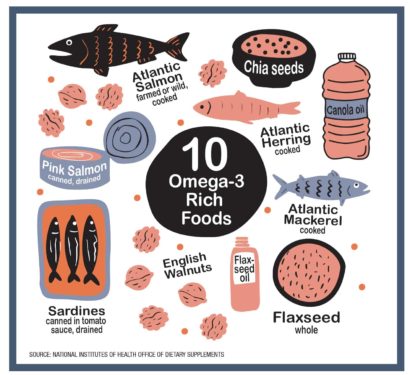
Omega-3 fatty acids are among the most extensively studied nutrients for potential health benefits. There are 2 major classes of omega-3 fatty acids. The first is alpha-linoleic acid, an essential fatty acid derived from plants such as flaxseed, walnut, soybean and canola oils. The second class includes long chain omega-3 fatty acids such as eicosapentaenoic acid (EPA) and docosahexaenoic acid (DHA), which are primarily derived from fatty fist. Alpha-linolenic acid can be converted to EPA and DHA, but this conversion is inefficient.
Omega-3 fatty acids are the newest nutritional agents to be officially sanctioned by the American Heart Association (AHA) for reducing risk of death from CHD. The AHA recommends that all patients with known CHD take about 1 g of EPA+DHA (the principal omega-3 fatty acids in fish oils) per day and that patients without known disease consume at least two (preferably oily) fish meals per week. This translates into about 500 mg of EPA+DHA per day.
Several randomized clinical trials have examined the effects of fish oil supplementation on cardiovascular disease morbidity and mortality, most often in a secondary prevention setting. The findings from these studies have been inconsistent. The most recent trials did not find benefits of fish oil supplementation on CVD outcomes. The Korean Meta-analysis Study Group included 14 random control trials including 20,485 patients with a history of CVD who consumed a mean of 1.7 g of fish oil per day. The follow-up period ranged from 1 to 4.7 years. Supplementation with omega-3 fatty acids did not reduce the risk of overall cardiovascular events, all cause mortality or sudden cardiac death.
To date, there is no conclusive evidence to recommend fish oil supplementation for primary or secondary prevention of cardiovascular disease. However, consuming at least two servings of fatty fish per week is still recommended as a source of omega-3 fatty acids and as a replacement for less healthy protein sources such as red meat.
Blood levels of omega-3 fatty acids can be measured. The Omega-3 Index determines the percent of total red blood cell fatty acids made up by EPA and DHA. Individual differences in metabolism, smoking habits and other dietary variables will affect each person’s Omega-3 Index™. New steady-state levels of the Omega-3 Index™ are achieved 4-6 months after increasing the omega-3 intake.
An Omega-3 Index of 8% to 10% has been associated with the lowest risk for death from CHD, while an Index of under 4% indicates high risk.
References
Kris-Etherton P, et al, Fish consumption, fish oil, omega-3 fatty acids, and cardiovascular disease, Circulation 2002;106:2747-57
Kwak SM,et al, Korean Meta-analysis Study Group. Efficacy of omega-3 fatty acid supplements (eicosapentaenoic acid and docosahexaenoic acid) in the secondary prevention of cardiovascular disease: a meta-analysis of randomized, double-blind, placebo-controlled trials. Arch Intern Med. 2012;172:686-94.
Halim SA et al, Review: Omega-3 fatty acid supplements provide no protective benefit in cardiovascular disease, Ann Intern Med 2012;172:686-94.
Siscovick DS et al, Dietary Intake and Cell Membrane Levels of Long-Chain n-3 Polyunsaturated FattyAcids and the Risk of PrimaryCardiacArrest, JAMA 1995; 274:1363-1367.
Albert CM, et al, Blood Levels of Long-Chain n–3 Fatty Acids and the Risk of Sudden Death, New Engl J Med, 2002; 346:1113-1118



 How to resolve AdBlock issue?