

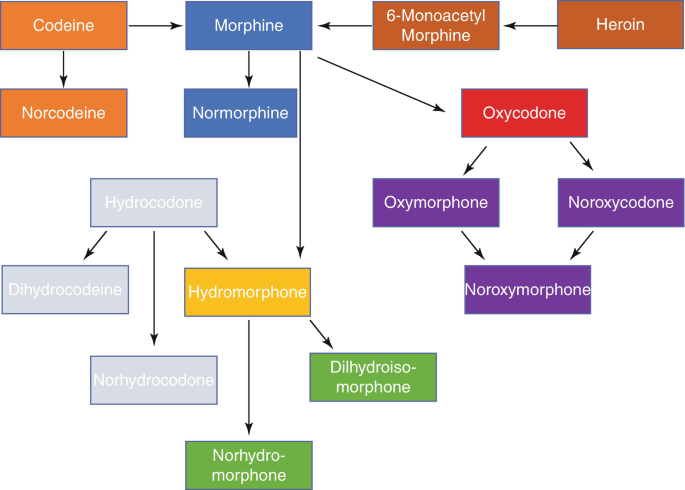
Opioids are a large class of medications commonly used to relieve acute and chronic pain or help manage opioid abuse and dependence.
The types of opioids are:
- Natural opioids (opiates)
- Morphine
- Codeine
- Thebaine
- Semisynthetic opioids
- Heroin
- Hydromorphone
- Hydrocodone
- Fully synthetic opioids
- Methadone
- Fentanyl
- Tramadol
- Pethidine
- Levorphanol
- Dextropropoxyphene
- Opioid antagonists & agonist/antagonist
- Buprenorphine
- Naloxone
Opioids are readily absorbed from the gastrointestinal tract, nasal mucosa, lungs, and after subcutaneous or intramuscular injection. Opioids are primarily excreted from the kidney in both free and conjugated forms. The detection window in urine for most opioids is 1 to 3 days. Some opioids, such as methadone, have even longer detection times.
The American Society of Interventional Pain Physicians guideline states that urine drug testing should be implemented at initiation and during chronic pain management therapy. CDC issued recommendations for prescribing opioid medications for chronic pain in March 2016 that include urine drug testing before starting opioid therapy and at least annually. The purpose of urine drug testing is to verify adherence to prescribed medications, identify undisclosed drugs, and discourage drug misuse, abuse, and diversion.
Urine is typically the preferred matrix for pain management drug testing, as it has a longer window of drug detection than blood, has an adequate specimen volume for drug screening and confirmation, and drug markers (either parent drug or metabolites) are present in high concentrations. It is also less invasive and doesn’t require a phlebotomist for collection. Disadvantages include a high risk of adulteration of the sample by the patient to avoid detection of non-compliance with the therapeutic regimen. Observed specimen collection is generally not performed and is disliked by patients and collectors. Specialized bathroom facilities may be needed, and specimen collectors should be of the same gender as patients. For these reasons, there is much interest in alternative matrices such as oral fluid or hair for drug testing of pain management patients.
Traditionally, urine drug testing for pain management patients has relied on immunoassays. Urine opiate immunoassays incorporate an antibody directed against morphine that has limited cross-reactivity other opioids used in pain management. These immunoassays can typically detect the metabolite of heroin, 6-acetyl morphine, but not methadone, tramadol, fentanyl, or tapentadol. Urine immunoassays also have a detection threshold of 300 ng/mL, which is too high to detect the usual concentrations of oxycodone, oxymorphone or hydromorphone.
While immunoassays are easy to use and provide fast turnaround time, they can produce false positive and false negative results. FDA-approved immunoassays for drug testing were originally designed for workplace drug testing programs. They detect a class of compounds and use higher drug detection cutoffs. Many times, these cutoffs are not clinically appropriate for adherence monitoring of pain management patients. For these reasons, some laboratories use LC-MS/MS and GC-MS for pain management.
Interpretation Guidelines
|
Drug Class |
Brand Name |
Expected Metabolites |
Noncompliant results |
Comments |
Detection Window |
|
Oxycodone
|
Oxycontin Percocet Percodan Roxicodone Endocet |
Oxycodone Oxymorphone |
Negative or any metabolites not listed |
Oxycodone & oxymorphone detected. Hydrocodone is a pharmaceutical contaminant of oxycodone and may be present. |
1– 3 days |
|
Hydrocodone |
Lortab, Lorcet Vicodan Hycodan Tussionex Norco |
Hydrocodone Hydromorphone Dihydrocodeine |
Negative or any metabolites not listed |
Hydrocodone is metabolized to hydrodromorphone & dihydrocodeine |
1 –3 days |
|
Hydromorphone |
Dilaudid Exalgo |
Hydromorphone Hydromorphone-3-glucuronide |
Negative or any metabolites not listed |
|
1-3 days |
|
Oxymorphone |
Numorphan Opana |
Oxymorphone Oxymorphone-3-glucuronide 6-hydroxy-oxymorphone |
Negative or any metabolites not listed |
|
|
|
Codeine
|
Tylenol #3 |
Codeine Codeine-6-beta-glucuronide Norcodeine Morphine Normorphine Morphine 6 glucuronide Hydrocodone |
Negative or any metabolites not listed |
Codeine is metabolized to morphine so both may be present |
1 –3 days |
|
Methadone |
Dolophine Methadose Amidone |
Methadone EDPP EMDP |
Methadone only without metabolite, Negative or any metabolites not listed |
Patients occasionally pour liquid methadone into their urine in order to test positive. However, the methadone metabolite will be absent. |
2- 3 days |
|
Morphine |
MS Contin Duramorph Avinza Kadian |
Morphine, normorphine, morphine 6 glucuronide hydromorphone |
Negative or any metabolites not listed |
Detection of morphine can be due to morphine use, heroin use, or poppy seed consumption. MS Contin patients usually develop very high urine morphine levels. Codeine is a pharmaceutical contaminant of morphine. |
2 –3 days |
|
Heroin (illegal in US) |
Does not apply |
Heroin Morphine Morphine-6-glucuronide Normorphine 6-Monoacetylmorphine |
6-acetyl- morphine is diagnostic for heroin abuse |
Heroin may be contaminated with acetylcodeine so codeine may be detected. Only morphine may be detected after 8 hours |
12–24 hours |
|
Fentanyl |
Duragesic Fentora Sublimaze Actiq |
Fentanyl Norfentanyl Despropfentanyl |
Negative or any metabolites not listed |
Special GC/MS test is required for detection |
1-2 days |
|
Propoxyphene |
Darvon Darvocet |
Propoxyphene Norpropoxyphene |
Negative or any metabolites not listed |
|
2 days |
|
Meperidine |
Demerol Mepergan Pethidine |
Meperidine Normperidine |
Negative or any metabolites not listed |
|
2-3 days |
|
Naloxone |
Narcan |
Naloxone Naloxone-3-beta-glucuronide |
Negative or any metabolites not listed |
|
|
|
Buprenorphine |
Buprenex Suboxone |
Norbuprenorphine Norbuprenorphine glucuronide |
Negative or any metabolites not listed |
|
|
References
Nagpal G, etal. Interpretation of Urine Drug Screens: Metabolites and Impurities. JAMA 2017;318:1704-5.
Incenze MA, Reassessing the Role of Routine Urine Drug Screening in Opioid Use Disorder Treatment, JAMA, published online August 2, 2021,
American Society of Addiction Medicine, Consensus statement: appropriate use of drug testing in clinical addiction medicine, J Addict Med,2017;11:1-56.
Langman LJ, Jannetto PJ,, Using Clinical Laboratory Tests to Monitor Drug Therapy in Pain Management Patients, AACC Academy Laboratory Medicine Practice Guidelines, 2017



 How to resolve AdBlock issue?