

The ongoing epidemic of obesity has increased the incidence of type 2 diabetes in women of childbearing age. For this reason, the American Diabetes Association (ADA) has recommended that pregnant women with risk factors for diabetes should be screened for type 2 diabetes at the first prenatal visit using standard diagnostic criteria (HbA1c ≥6.5, fasting glucose >126 mg/dL, or casual glucose >200 mg/dL). Women with diabetes found at this visit should be diagnosed with overt, not gestational, diabetes.
Gestational diabetes is defined as carbohydrate intolerance of varying degrees of severity with onset during pregnancy. The main purpose of identifying gestational diabetes is to detect women at risk of adverse perinatal outcomes. Gestational diabetes affects ~14% of pregnant women. After a pregnancy with GDM, a woman has an increased risk of developing type 2 diabetes mellitus within 10 years postpartum.
Fetal macrosomia affects 40% of the offspring of women with GDM. Macrosomia is associated with increased risk of birth injuries as a result of the large size of the fetus. Infants of women with GDM are at higher risk of developing obesity, impaired glucose tolerance or diabetes mellitus at an early age. Keeping 1-hour postprandial blood glucose levels between 120 and 140 mg/dL minimizes the risk of macrosomia.
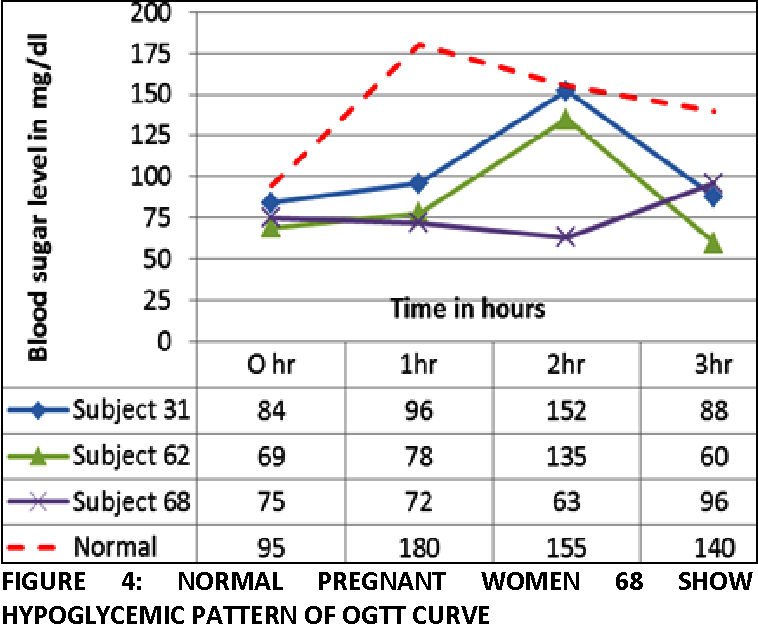
The Committee on Obstetric Practice of the American College of Obstetricians and Gynecologists recommends that all pregnant women should be screened for GDM using a two-step strategy. Patients are first screened with patient history, clinical risk factors, or a 50-gram one-hour loading test. If a 1-hour plasma glucose is 130 mg/dL or higher, the diagnosis of GDM should be confirmed by performing a 100-gram three-hour oral glucose tolerance test. According to ACOG, either the plasma glucose cutoffs established by Carpentar and Coustan (C&C) or the National Diabetes Data Group (NDDG) can be used for interpretation.
Gestational diabetes is diagnosed if any two of the following cut points are met or exceeded:
|
Sample |
C&C (mg/dL) |
NDDG (mg/dL) |
|
Fasting |
95 |
105 |
|
1 Hour |
180 |
190 |
|
2 Hours |
155 |
165 |
|
3 Hours |
140 |
145 |
Alternatively, the 50-gram screening test can be omitted and a 75-gram, 1-hour oral glucose tolerance test can be performed. GDM is diagnosed if any one of the following thresholds are met or exceeded.
|
Sample |
Plasma Glucose |
|
Fasting |
92 mg/dL or greater |
|
1 Hour |
180 mg/dL or greater |
|
2 Hours |
153 mg/dL or greater |
A 2021 study from Kaiser Permanente compared the two strategies. A total of 23,792 pregnant women were randomly assigned to one-step or two step screening. The single step screen detected twice as many GDM cases as the two-step screen, but there were no significant differences in the risk of developing perinatal and maternal complications.
Neither the ADA nor the WHO has specific recommendations for measuring fasting glucose before administering glucola. There is no evidence that it is harmful to give glucola to someone with increased fasting glucose, but it seems prudent to avoid doing so. Some laboratories perform a fingerstick glucose measurement before administering glucola and do not perform the OGTT if the fasting glucose level is >200 mg/dL.
Glucola is a highly concentrated hyperosmolar glucose solution can cause gastric irritation, delayed emptying, and gastrointestinal osmotic imbalance, leading to nausea and vomiting. Other types of oral tolerance tests have been proposed and are better tolerated but appear to be less sensitive and have not been validated in large studies. These approaches typically use candy, a predefined meal, or commercial soft drinks instead of a standard glucose monomer or polymer solution. None have been endorsed by the American Diabetes Association or the American College of Obstetricians and Gynecologists. If the patient vomits the glucose solution, periodic random fasting and two-hour postprandial blood glucose testing is recommended.
Capillary blood should not be used for screening unless the precision of the glucose meter is known, it has been correlated with simultaneously drawn venous plasma samples and has met federal standards for laboratory testing.
Specimen requirement is one gray top (potassium oxalate-sodium fluoride) tube of blood.
References
American College of Obstetricians and Gynecologists Practice Bulletin, Gestational Diabetes Mellitus, Obstet Gynecol, 2013;122(2):406-416.
US Preventive Services Task Force, Screening for Gestational Diabetes, J Amer Med Assoc, 2021;326(6):531-538.
Hillier TA et al. A Pragmatic, Randomized Clinical Trial of Gestational Diabetes Screening, N Engl J Med 2021;384:895-904.



 How to resolve AdBlock issue?