

The standard approach to positive blood cultures has not changed for many years. The Gram stain is quite useful in guiding choice of empiric anti-microbial therapy for Gram positive vs. Gram negative organisms. Blood culture Gram stain results are considered a critical value and are communicated to a caregiver immediately, so that appropriate anti-microbial therapy can be established. However, the final identification for most Gram positive cocci in clusters is coagulase-negative staphylococci, which are potentially blood culture contaminants for which antibiotics are unnecessary. Coagulase-negative staph accounts for 70% of all staphylococcal isolates from SLHS blood cultures. Furthermore, the Gram stain does not differentiate between Gram negative enteric organisms vs. Pseudomonas species, which in many cases necessitates very broad-spectrum anti-microbial therapy until the organism is fully identified. The standard time for identification of an organism from a positive blood culture is 1-2 days.
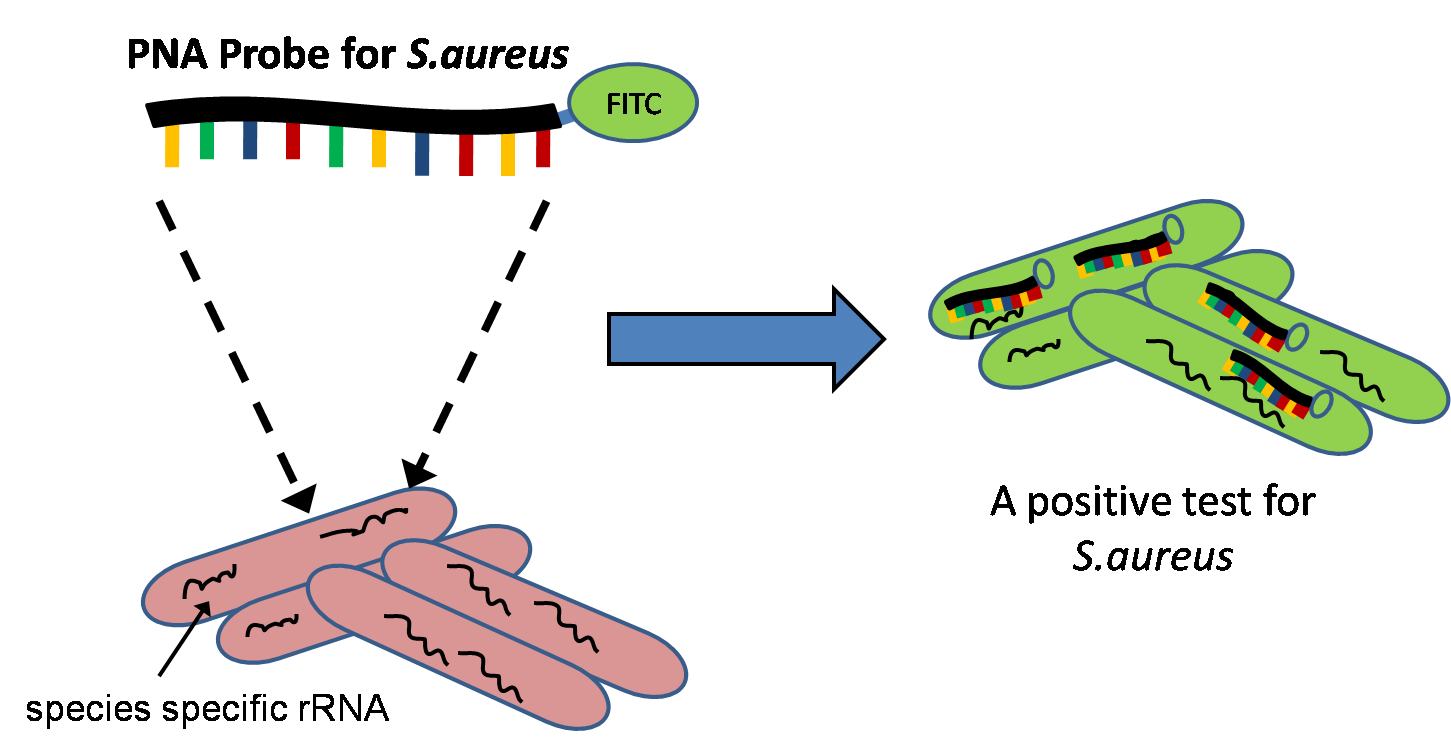
PNA-FISH is a FDA approved commercially available method for the detection of bacteria and yeast species directly from positive blood culture bottles. PNA is a synthetic Peptide Nucleic Acid made up of oligonucleotide bases with a peptide backbone. The PNA probe is fluorescently labeled and binds to species-specific 16S ribosomal RNA. PNA FISH, provides more complete information than the Gram stain on the same day a blood culture becomes positive. PNA-FISH has been used clinically to detect Gram positive bacteria, Gram negative bacteria, and Candida.
Once a blood culture turns positive, a Gram stain is performed and based on the results the appropriate PNA FISH test is selected. A drop from the positive blood culture is fixed onto a microscope slide. A PNA probe is added and allowed to hybridize to the rRNA within the target microbes. After excess probe is removed by washing with buffer, the slides are visualized with a fluorescence microscope.
PNA FISH results are reported on positive blood cultures in addition to the Gram stain result. PNA FISH testing facilitates more appropriately targeted anti-microbial therapy, as well as avoidance of unnecessary antimicrobials. Some published studies have also indicated cost savings due to decreased length of stay and improved patient outcomes.
References
Harris DM, Hata DJ. Rapid identification of bacteria and Candida using PNA-FISH from blood and peritoneal fluid cultures: a retrospective clinical study. Ann Clin Microbiol Antimicrob. 2013 Jan 7;12:2.
Hall L, Le Febre KM, Deml SM, Wohlfiel SL, Wengenack NL. 2012. Evaluation of the Yeast Traffic Light PNA FISH Probes for Identification of Candida Species from Positive Blood Cultures. J Clin Microbiol 50:.https://doi.org/10.1128/jcm.06148-11
Morgan MA, Ten Years of Experience with Peptide Nucleic Acid Fluorescent in Situ Hybridization in the Clinical Microbiology Laboratory, Clin Microbiol Newsletter, 2013;35(10):79-83.



 How to resolve AdBlock issue?