

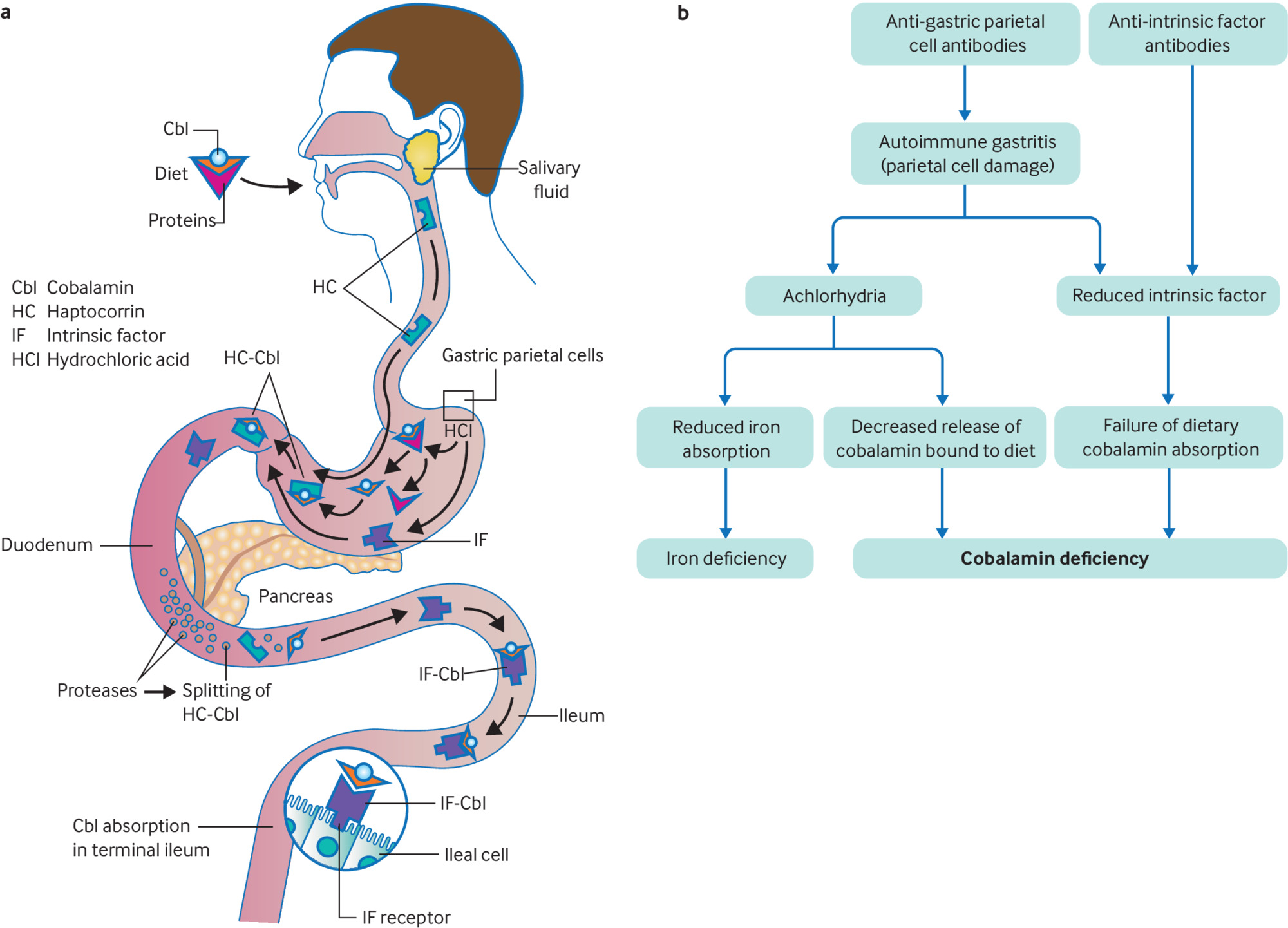
Pernicious anemia is an autoimmune disease that is characterized by the severe gastric mucosal atrophy. Autoantibodies damage parietal cells in the gastric mucosa, leading to decreased secretion of intrinsic factor (IF) and gastric acid. IF is a glycoprotein synthesized and secreted by parietal cells. It binds vitamin B12 in the stomach and facilitates its transport to the terminal ileum for absorption. The IF-B12 complex binds to cubam receptors in the terminal ileum and is taken up into cells by endocytosis. B12 binds to transcobalamin, is released into the bloodstream, and transported to transcobalamin cell receptors. After cellular uptake and intracellular release, B12 is converted to adenosylcobalamin and methylcobalamin. These compounds serve as cofactors for two B12-dependent enzymatic reactions.
The two enzymes are methionine synthase and methylmalonyl-CoA mutase. Cobalamin serves as a cofactor for methionine synthesis through the transfer of a methyl group to homocysteine. The conversion of homocysteine to methionine forms demethylated tetrahydrofolate which is required for DNA synthesis. Vitamin B12 deficiency prevents the proper functioning of these coenzymes, leading to an accumulation of their substrates in plasma. Specifically, adenosylcobalamin deficiency results in an accumulation of methylmalonic acid (MMA), and methylcobalamin deficiency in an accumulation of homocysteine. Additionally, the formation of S-adenosylmethionine (SAM) and methionine diminish. SAM is the methyl donor to key substrates, such as nucleic acids, proteins, phospholipids, and neurotransmitters. B12 deficiency also impairs hemopoiesis due to the pivotal role of vitamin B12 in DNA synthesis.B12 deficiency causes megaloblastic changes in myeloid and erythroid cells.
Metabolism of methionine to S-adenosyl methionine is essential for myelin synthesis and nerve transmission. Lack of cobalamin leads to either the destruction of myelin sheaths or the incorporation of abnormal fatty acids into myelin sheaths, impairing neural function.
Pernicious anemia develops slowly, with a progression time to apparent clinical B12 deficiency of 2 to 5 year. Classical symptoms of vitamin B12 deficiency include macrocytic anemia, glossitis, peripheral neuropathy, weakness, hyperreflexia, ataxia, and other neurological manifestations. It is common, however, to encounter patients with vitamin B12 deficiency who have atypical clinical or laboratory features. For example, many patients present with neurological defects without macrocytic anemia.
A complete blood cell count (CBC) typically shows anemia, macrocytosis (mean corpuscular volume ≥100 fl), and pancytopenia. However, about one-third of patients with B12 deficiency may not have macrocytosis. Normocytic anemia can be seen if there is concomitant iron deficiency anemia, which is a complication of achlorhydria. A peripheral blood smear may show macro-ovalocytes, hypersegmented neutrophils, and anisopoikilocytosis.
An isolated serum cobalamin level has poor sensitivity and specificity for reliably detecting B12 deficiency. B12 deficiency is defined by a serum cobalamin level of less than 200 pg/mL. However, B12 levels may be falsely elevated in up to 35% of patients. A falsely low serum vitamin B12 level may be seen in the absence of true deficiency.
Several laboratory tests can assist in the diagnosis of B12 deficiency and pernicious anemia. Elevated methylmalonic acid (MMA) and/or fasting homocysteine are indicators of B12 deficiency in patients without evidence of impaired renal function.
MMA a substrate that requires cobalamin for its metabolism, is elevated in states of true functional vitamin B12 deficiency. It is useful for confirming a suspected diagnosis of B12 deficiency in patients who have a normal or low-normal serum B12 level (200-300 ng/L).
Homocysteine levels are increased in B12 deficiency but are not as specific as MMA. Homocysteine levels may also be increased in folate deficiency, pyridoxine deficiency, and hypothyroidism.
Intrinsic factor blocking antibodies are detectable in the serum of 40 to 60% of patients with pernicious anemia, and are highly specific for the diagnosis. Specificity is almost 100%. A positive result for this assay establishes a diagnosis of pernicious anemia, but a negative result does not rule it out.
Anti-parietal cell antibodies are present in 90% of patients with pernicious anemia, but they are less specific than anti-IF antibodies. Testing for both antibodies significantly increases their diagnostic performance for pernicious anemia (73% sensitivity and 100% specificity).
The British Committee for Standards in Hematology recommends all patients with anemia, neuropathy, or glossitis, who are suspected of having pernicious anemia, be tested for anti-IF antibodies regardless of cobalamin levels. Secondly, the committee recommends anti-IF antibody testing in patients found to have a low serum cobalamin level in the absence of anemia and who do not have food malabsorption or other causes of deficiency to clarify whether they have an early or latent presentation of pernicious anemia. Thirdly, they do not recommend testing for anti-parietal cell antibodies.
See also articles entitled: “Intrinsic Factor Blocking Antibody” and “Parietal Cell Antibodies.”
References
Bizzaro N, Antico A. Diagnosis and classification of pernicious anemia. Autoimmun Rev. 2014;13(4-5):565-568.
Toh BH, et al. Pernicious Anemia, New Engl J Med, 1997;337:1441-1448.
Devalia V, Hamilton MS, Moloy AM, British Committee for Standards in Haematology. Guidelines for the diagnosis and treatment of cobalamin and folate disorders. Br J Haematol, 2014;166(4):496-513.
Ammouri W, et al, Pernicious Anaemia: Mechanisms, Diagnosis, and Management, EMJ Hematologist US, 2020;1(1):71-80.



 How to resolve AdBlock issue?