

Platelets play a major role in hemostasis. Both thrombocytopenia and thrombocytosis may be associated with impaired hemostasis. Thrombocytopenia may be defined, as a platelet count below 140,000/uL, but spontaneous bleeding usually does not occur with counts above 20,000/uL. Thrombocytopenia may be due to one of several mechanisms. Decreased platelet production occurs in aplastic anemia and bone marrow displacement (such as due to leukemia, lymphoma, or carcinoma). Increased peripheral platelet destruction may be secondary to a platelet autoantibody (immune thrombocytopenic purpura), drug-induced immune thrombocytopenia, DIC, or thrombotic thrombocytopenic purpura. Ineffective thrombopoiesis results in thrombocytopenia associated with megaloblastic anemia.
Thrombocytosis (a platelet count > 400,000/uL) may occur secondary to infection, inflammation, malignancy, hemorrhage, surgery, splenectomy or iron deficiency. Thrombocytosis is also commonly associated with abnormal platelet morphology and function.
An automated CBC with differential white blood cell count can determine 32 different hematological parameters. The complete blood count (CBC) includes: hemoglobin, hematocrit, red blood cell (RBC) count, white blood cell (WBC) count, RBC indices, platelet count, mean platelet volume (MPV), and red cell distribution width (RDW).
Hemoglobin, WBC count, RBC count, mean corpuscular volume (MCV), and platelet count are measured electronically by an automated hematology analyzer. Hematocrit, mean corpuscular hemoglobin (MCH), mean corpuscular hemoglobin concentration (MCHC) and RDW are calculated.
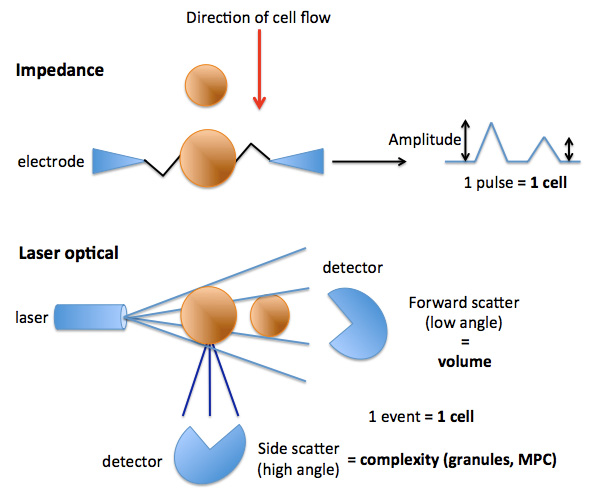
Hematology analyzers utilize either electrical impedance of optical light scatter methods to count platelets. Electrical impedance is coupled with hydrodynamic focusing improve accuracy. Particles between 2 and 20 femoliters (fl) are counted as platelets. Analyzers using impedance are able to provide accurate platelet counts down to 20,000/uL. A major disadvantage of impedance counting is the difficulty in distinguishing large platelets from extremely microcytic or fragmented red cells. Falsely increased platelet couonts occurs when red cell or white cell fragments, microcytic red cells, immune complexes, or cell debris is included in the reported count. Falsely low platelet counts occur in the presence of large platelets or platelet clumping.
Optical light scatter methods utilize flow cytometry principles to count and size a narrow cells as they flow past a beam of laser light. The illumination and light scatter of each cell is measured at two angles of laser light scatter. The number of electrical pulses is proportional to the number of cells and cell volume. A platelet scatter gram map is generated to distinguish platelets, large platelets, red cells, cell fragments, and debris.
An automated cell counter can be programmed to flag the platelet abnormalities such as:
- Platelet abnormal scattergram
- Platelet clumps
- Thrombocytopenia
- Thrombocytosis
If specimens are flagged for review, a clinical laboratory scientist examines a peripheral blood smear to confirm the results.
Reference range is 140,000-400,000/uL. Platelet counts <30,000/uL and >1 million/uL are considered critical values.
Specimen requirement is one lavender top (EDTA) tube of blood.
For additional information, see the articles entitled: Complete Blood Count, Mean Platelet Volume, Platelet Size and Immature Platelet Fraction.
References
Gauer RL, Whitaker DJ, Thrombocytopenia: Evaluation and Management, Am Fam Physician, 2022;106(3):288-298.
Erkurt MA, et al, Thrombocytopenia in Adults: Review Article, J Hematol, 2012;1(2-3):44-53.
Giles C, The Platelet Count and Mean Platelet Volume, Brit J Haem, 1981;48(1):31-37.
Briggs C, et al, Continuing developments with the automated platelet count, Internat J Lab Hematol, 2007;29(2):77-91.



 How to resolve AdBlock issue?