

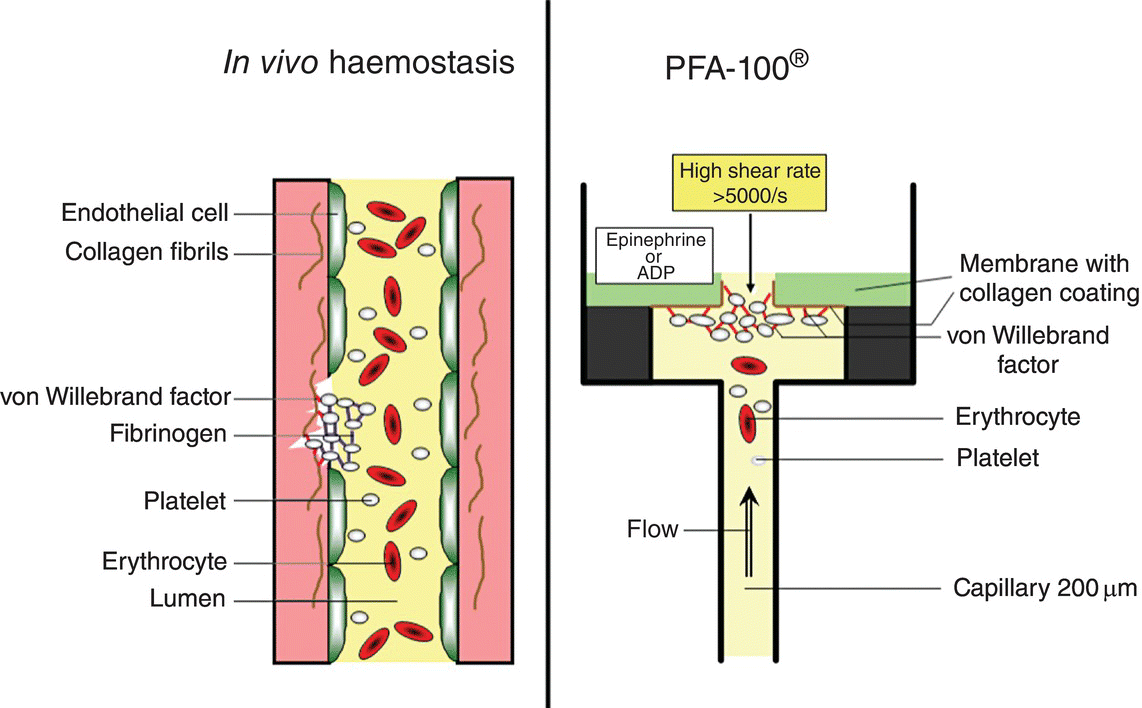
The platelet function screen or PFA-100® test is an in vitro system capable of detecting platelet dysfunction in a citrated whole blood sample under high shear flow conditions. A citrated whole blood sample is aspirated from a reservoir and run through biological membranes with a central aperture. The membranes are coated with collagen to provide an initial matrix for platelet adhesion. In addition to collagen, the membranes are coated epinephrine (COL/EPI) or adenosine diphosphate (COL/ADP), which stimulates platelet aggregation. The time taken for blood to form a platelet plug that occludes the aperture is called the closure time and is an indication of platelet function.
Prolonged closure time (CT) is caused by multiple conditions as summarized in the following table.
|
Cause |
COL/EPI CT |
COL/ADP CT |
|
Drug effect |
Prolonged |
Normal or Prolonged |
|
Mildly low hematocrit |
Prolonged |
Normal |
|
Severely low hematocrit |
Prolonged |
Prolonged |
|
Mild thrombocytopenia |
Prolonged |
Prolonged |
|
Severe thrombocytopenia |
Prolonged |
Prolonged |
|
Mild vWD |
Prolonged |
Normal or Prolonged |
|
Severe vWD |
Prolonged |
Prolonged |
|
Platelet disorder |
Normal or Prolonged |
Normal or Prolonged |
When interpreting the results, a patient’s hematology results much be considered because both anemia and thrombocytopenia may prolong closure time. A hematocrit less than 35% or a platelet count less than 150,000/uL may affect results. In general, the test is not useful in patients with a platelet count less than 100,000 / uL or hematocrit less than 30%. Also, a hematocrit >50% may produce erratic results.
Normal closure times with both COL/EPI and COL/ADP indicate normal platelet function. The COL/EPI membrane is more sensitive to disorders of primary hemostasis, but is less specific. A prolonged closure time with COL/EPI membrane and a normal closure time with COL/ADP may be the result of:
- Thrombocytopenia
- Anemia
- Antiplatelet medication
- Mild platelet dysfunction
Aspirin therapy affects the COL/EPI more than the COL/ADP closure time. A prolonged closure time with COL/EPI and normal result with COL/ADP is characteristic of platelet dysfunction secondary to aspirin or aspirin-like drugs. Although the PFA-100 is sensitive to aspirin, it is insensitive to other antiplatelet medications such as clopidogrel (Plavix) and ticlopidine (Ticlid).
A normal closure time with COL/EPI and prolonged closure time with COL/ADP can be seen in patients with type 1 von Willebrand disease and some platelet aggregation disorders. Platelet function screen is more sensitive than platelet aggregation in detection of vWD and inherited platelet function defects. Prolonged closure times with both COL/EPI and COL/ADP are typical of either vWD or significant hereditary platelet function disorders. PFA-100 is very sensitive to certain vWD subtypes, with nearly 100% sensitivity to types 2A, 2M and 3. However, it is less sensitive in the diagnosis of types 1 and 2B. In this case, additional laboratory tests should be performed including a vWD panel and platelet aggregation. PFA-100 does not detect platelet storage pool disease.
The Platelet Function Screen should not be used for random pre-operative screening; its use should be restricted to those patients with a bleeding history.
Normal ranges for closure times with COL/EPI and COL/ADP are 80-192 and 60-112 seconds respectively.
One 5.0 mL sodium citrate (light blue top) tube is required (3.2% sodium citrate is preferred). The sample must be received by the laboratory within 3 hours of collection.
References
Favaloro, E.J., Clinical utility of the PFA-100. Semin Thromb Hemost, 2008; 34(8):709-33.
Karger, R., et al., Diagnostic performance of the platelet function analyzer (PFA-100) for the detection of disorders of primary haemostasis in patients with a bleeding history-a systematic review and meta-analysis. Platelets, 2007;18(4):249-60.
Hayward CP, et al. Platelet function analyzer (PFA)-100 closure time in the evaluation of platelet disorders and platelet function. J Thromb Haemost, 2006; 4:312-319.



 How to resolve AdBlock issue?