

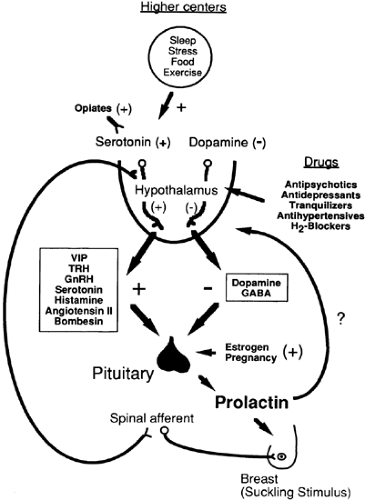
Prolactin is a peptide hormone that is secreted by the anterior pituitary gland and induces lactation. Normally, prolactin is secreted in a pulsatile, sleep-dependent rhythm with highest levels occurring during sleep and lowest levels occurring a few hours after waking. Prolactin secretion by the pituitary gland is under tonic inhibition from the hypothalamus via dopamine. Any lesion of the pituitary stalk prevents tonic inhibition and allows prolactin levels to rise. Prolactin concentrations normally rise with illness and physical stress. If pharmacologic doses of thyrotrophin releasing hormone (TRH) are administered, prolactin concentrations can increase.
Prolactin measurements are most commonly ordered for the evaluation of reproductive disorders such as male and female infertility and in the assessment of global anterior pituitary function. For example, if there is destruction of the hypothalamic-pituitary-portal system by trauma, tumor, inflammation, irradiation or hemorrhage, in the absence of sufficient concentrations of prolactin inhibiting factor, prolactin levels rise.
Hyperprolactinemia can pathologically cause galactorrhea in men and in women in the absence of a recent delivery. Other symptoms include:
Women
- Oligomenorrhea
- Amenorrhea
- Infertility
Men
- Loss of libido
- Impotence
- Infertility
The differential diagnosis of hyperprolactinemia includes the following:
- Hypothalamic diseases (i.e., loss of PRIH secretion)
- Anterior pituitary tumor
- Drug-induced
- Primary hypothyroidism (pathologic TRH-stimulated release of prolactin)
- Chronic renal failure (possibly due to decreased excretion)
- Cirrhosis
- Psychological or physical stress-induced hyperprolactinemia
Hyperprolactinemia, unless drug induced, is most commonly associated with pituitary tumors. Anterior pituitary adenomas that secrete prolactin (i.e. prolactinomas) can occur as isolated conditions or as part of familial cancer syndromes such as multiple endocrine neoplasia (MEN) type 1. Prolactin secreting tumors are the most common secreting tumors of the anterior pituitary. Some prolactin-secreting anterior pituitary tumors can co-secrete growth hormone producing concurrent acromegaly. In reproductive age women, >80% of prolactinomas are microadenomas, (<10 mm) and manifest features of hyperprolactinemia including ovulatory or menstrual dysfunction, hypoestrogenism, galactorrhea, and infertility.
Men and post-menopausal women with prolactinomas usually present with macroadenomas, defined as tumors >10 mm. They usually exhibit the manifestations of a mass effect including visual disturbances or hypopituitarism. Men usually have clinical signs of decreased libido, impotence, and hypogonadism. Galactrorrhea is rare in men.
The best approach to diagnose prolactinoma includes pituitary imaging and prolactin measurement. Prolactin levels greater than 100 ng/ml are diagnostic of prolactinoma. Patients with macroadenomas generally have prolactin levels exceeding 250 ng/mL. Patients with serum prolactin levels of more than 200 pg/mL have a smaller chance of surgical cure.
Secondary causes of hyperprolactinemia should be excluded by a thorough history, physical examination and appropriate laboratory studies (e.g., creatinine, BUN, urinalysis, ALT and TSH).
Elevated prolactin levels are frequently seen in women with the amenorrhea galactorrhea syndrome. Some men with gynecomastia and some women with amenorrhea have elevated prolactin levels. Prolactin levels are usually below 50 ng/mL.
Exercise, nipple manipulation, surgery, hypoglycemia, stress and uremia may transiently increase prolactin levels. Prolactin levels increase gradually during pregnancy to a level approximately 20 times baseline. Some drugs may increase prolactin levels, usually between 20 and 100 ng/mL.
The most common examples are:
- Antidepressants such as amoxapine, imipramine, and amitriptylline
- Antihypertensives such as alpha-methyldopa and reserpine
- Neuroleptics such as perphenzine, fluphenazine, thorazine, promazine, trifluoperazine, haloperidol, and chlorpromazine
- Dopamine receptor blockers such as metoclopramide, sulpride, domperidone, and cimetidine
- Calcium channel blockers such as verapamil
- Estrogens
- Opiates such as morphine.
Prolactin may be present in the circulation in multiple forms. The most common form is the monomeric or normal form, which has a relatively low molecular weight (about 22 kDa) and is sometimes referred to as “little prolactin.” Additionally, a glycosylated variant appears to form oligomers with itself and has an increased effective molecular weight of about 50 kDa (big prolactin). Macroprolactin is a third form in which normal prolactin is complexed to immunoglobulin to form aggregates with an even higher molecular weight of more than 100 kDa. These high molecular weight complexes are not cleared as rapidly by the kidney, resulting in elevated plasma levels.
Macroprolactinemia should be considered, especially if hyperprolactinemia is identified in an individual who lacks any of the typical manifestations of hyperprolactinemia. Between 10 and 20% of samples with elevated prolactin contain macroprolactin. In contrast, about 2% of individuals in an unselected population have an elevated prolactin concentration due to macroprolactin. Current scientific evidence indicates that macroprolactin is biologically inactive.
Laboratory prolactin assays vary in their reactivity to macroprolactin, but all currently available assays will detect macroprolactin to some extent. Studies in which samples containing macroprolactin have been tested by multiple assays have shown that methods can be roughly categorized into low, medium and high reactivity groups
Most hospital laboratories do not test for macroprolactin. Specimens can be sent to a reference laboratory, which may use one of three methods. The best available method for measuring macroprolactin is gel filtration chromatography. The advantages of this method are that it has been validated in many studies and it provides quantitative results.Centrifugal ultrafiltration using a Centricon 100 concentrator with a 100 kDa molecular weight cutoff has also been described. This is a relatively simple method, but it requires long centrifugation times at low temperature (five hours at 15 degrees C). The most common method used to detect macroprolactin is treatment of the patient serum sample with polyethylene glycol (PEG). Addition of PEG to patient serum samples precipitates much of the higher molecular weight forms of prolactin leaving the lower molecular weight forms of prolactin in the serum specimen. The PEG-treated sample or ultrafiltrate may be retested, and the residual prolactin activity or recovery can be calculated. A low recovery after treatment indicates that macroprolactin is likely to be present. PEG treatment has the advantage of being quick and simple to perform, it requires little in the way of extra equipment, and it is well validated in the literature. The disadvantage of PEG precipitation is that it is not quantitative and it interferes with some assays.
Many physicians were taught that prolactin assays are subject to prozone (hook effect) and give falsely low results when prolactin levels are very high. They often ask the laboratory to repeat prolactin testing after dilution. However, modern prolactin immunoassays are not susceptible to the hook effect and dilution is unnecessary.
Prolactin is measured by enzyme immunoassay. The adult reference range is:
|
Gender |
Reference Range |
|
Male |
4-15 ng/mL |
|
Female |
5-23 ng/mL |
Specimen requirement is one red-top gel barrier tube of blood.
References
Casaneuva FF, et al: Guidelines of the Pituitary Society for the diagnosis and management of prolactinomas. Clin Endocrinol. 2006;65:265-273.
Melmed S, et al: Diagnosis and treatment of hyperprolactinemia: an Endocrine Society clinical practice guideline. J Clin Endocrinol Metab. 2011;96(2):273-288.
Sostaric M, et al, Optimizing laboratory defined macroprolactin algorithm, Biochem Med, 2019;29(2):020706.
Ravenot V, et al, Prolactin immunoassay: does the high-dose hook effect still exist? Pituitary, 2022;25(4):653-657.



 How to resolve AdBlock issue?