

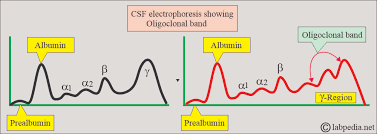
Since cerebrospinal fluid (CSF) is an ultrafiltrate of plasma, it has much lower concentrations of the highest molecular weight proteins such as IgG, IgA and IgM. Elevated CSF IgG levels can either be the result of diffusion of plasma IgG across an altered blood brain barrier or intrathecal synthesis. Patients with multiple sclerosis and other demyelinating disorders often have elevated CSF IgG concentrations due to intrathecal synthesis. One of the best methods to detect intrathecal IgG synthesis has been to examine CSF for the presence of oligoclonal bands after separation of proteins by electrophoresis. IgG in normal CSF migrates as a faint diffuse zone, but in demyelinating diseases, IgG migrates as discrete oligoclonal bands. Oligoclonal bands are produced by a limited number of plasma cell clones, each producing IgG with its own specificity.
During the summer of 2003, the FDA approved a new method for the detection of oligoclonal bands that uses isoelectric focusing plus immunofixation (IEF) instead of electrophoresis. The Consortium of Multiple Sclerosis Centers has endorsed IEF because of its increased sensitivity (>95%). With IEF, oligoclonal bands may be detected while the total CSF IgG concentration is still within the normal range.
Cerebrospinal fluid electrophoresis became an obsolete test.
See article entitled: Oligoclonal Bands in CSF
Reference
Fortini AS, Sanders EL, Weinshenker BG, Katzmann JA. Cerebrospinal fluid oligoclonal bands in the diagnosis of multiple sclerosis. Isoelectric focusing with IgG immunoblotting compared with high-resolution agarose gel electrophoresis and cerebrospinal fluid IgG index. Am J Clin Pathol. 2003;120(5):672-675.



 How to resolve AdBlock issue?