

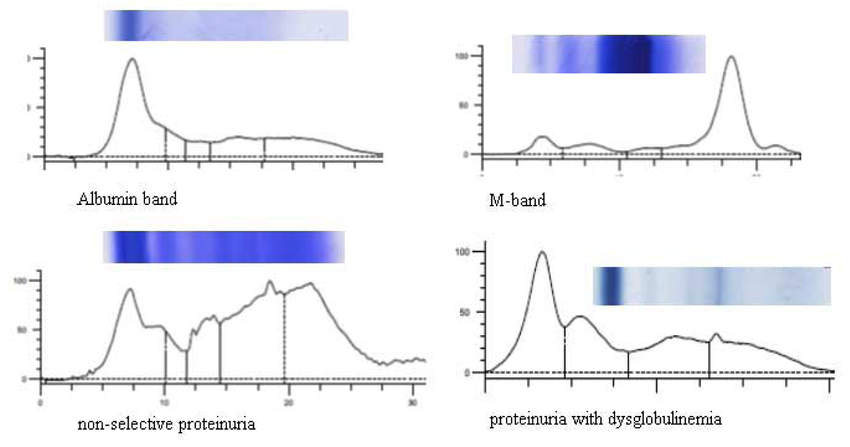
Glomerular filtration produces fluid containing very little protein with molecular weights greater than 40,000 daltons. Proteins with molecular weights less than 15,000 daltons pass freely through the glomerulus but are then almost completely reabsorbed in the proximal tubules. Normal glomerular and tubular function results in excretion of <150 mg of protein per day. Approximately two thirds of the filtered protein (100 mg/day) derived from glomerular filtrate is comprised of albumin, transferrin, low molecular weight proteins and some immunoglobulins. Approximately, one fourth of the total protein load, 20 – 35 mg/day, is albumin. The remainder, such as Tamm Horsfall glycoprotein (uromodulin), is derived from the urinary tract itself.
Renal injury may result in proteinuria. Urine protein electrophoresis separates the proteins according to charge and allows classification of the type of renal injury. Protein patterns are interpreted by a clinical pathologist and reported as glomerular, tubular, or mixed patterns. Glomerular proteinuria occurs when the glomerulus begins to lose its ability to retain large proteins (>65,000 kD) in the plasma. The most common causes are minimal change disease, glomerulonephritis, and diabetic nephropathy. Heavy glomerular proteinuria is often associated with the nephrotic syndrome. The urine contains increased levels of albumin and other proteins of similar size such as alpha-1-antitrypsin, alpha-1-acid glycoprotein and transferrin. The electrophoretic pattern typically shows approximately 70% albumin and 30% transferrin.
Tubular proteinuria occurs when the renal tubules cannot reabsorb low molecular weight proteins. Tubular proteinuria is associated with drug toxicity (aminoglycosides, cephalosporins, and cyclosporine), pyelonephritis, interstitial nephritis, renal vascular disease, and transplant rejection. This protein pattern reveals a small amount of albumin, two protein bands in the alpha 2 region (alpha 2 microglobulin, retinol binding protein), and one band in the beta 2 region (beta 2 microglobulin). Each peak often comprises approximately 15% of the total protein.
Mixed glomerular/tubular proteinuria occurs when both glomerular and tubular functions are compromised. This pattern is typically seen in chronic renal failure. The urine protein pattern often resembles serum with increased amounts of both large proteins (albumin, transferrin, alpha-1 antitrypsin) and low molecular weight proteins (retinol binding protein and beta 2 microglobulin). Albumin, alpha-1, alpha-2 and beta globulin bands are increased.
Prerenal proteinuria is caused by conditions unrelated to the kidney. The most common form is overflow proteinuria, which is caused by high plasma protein concentrations that exceed the reabsorptive capacity of the tubules. Urine protein concentration usually exceeds 400 mg/dL. Common examples include multiple myeloma and myoglobinuria.
Today, the main reason for performing urine protein electrophoresis is to find a light chain myeloma producing an excess of free light chains (Bence Jones protein). A band may also represent an intact monoclonal immunoglobulin, especially if the patient has poor renal function.
Urine protein electrophoresis reference range is:
|
Total Protein |
50-150 mg/24 hour |
|
Albumin |
<50% of total |
|
Total globulin |
60- 67% of total |
A normal urine protein pattern consists of albumin and occasionally faint alpha-1 and beta bands.
Specimen requirement is a random urine collected in a container without preservative. Urine samples with less than 15 mg/dL of protein are usually rejected for electrophoresis, because no bands will be detected even after concentration of the urine. Specimen should be refrigerated during and after the collection. Urine is concentrated by filtration prior to electrophoresis.
References
Jenkins MA, Serum and Urine Electrophoresis for Detection and Identification of Monoclonal Proteins, Clinical Biochem Rev, 2009;30(3):119-122.
Jenkins MA. Clinical application of capillary electrophoresis to unconcentrated human urine proteins. Electrophoresis. 1997;18:1842–1846.
Chew STH, et al, Role of urine and serum protein electrophoresis in evaluation of nephrotic-range proteinuria, Amer J Kid Dis, 1999;34(1):135-139.



 How to resolve AdBlock issue?