

Rabies virus is an RNA virus in the Lyssavirus genus that infects mammals. It is transmitted to humans in the saliva of clinically ill mammals following a bite or scratch. Globally, dog bites are the most common source of rabies infection. In the United States, because most dogs are vaccinated against rabies, the primary animal reservoirs are bats, raccoons, skunks, and foxes. The use of flavored bait containing oral rabies vaccine has controlled the spread of rabies from raccoons, skunks, and foxes. Bats are the leading cause of human rabies deaths in the United States. Wildlife rabies is found in all states except Hawaii.
Cases of human rabies cases in the United States are rare, with less than 10 cases reported annually. However, approximately 100,000 Americans receive post-exposure prophylaxis (PEP) following an exposure each year.
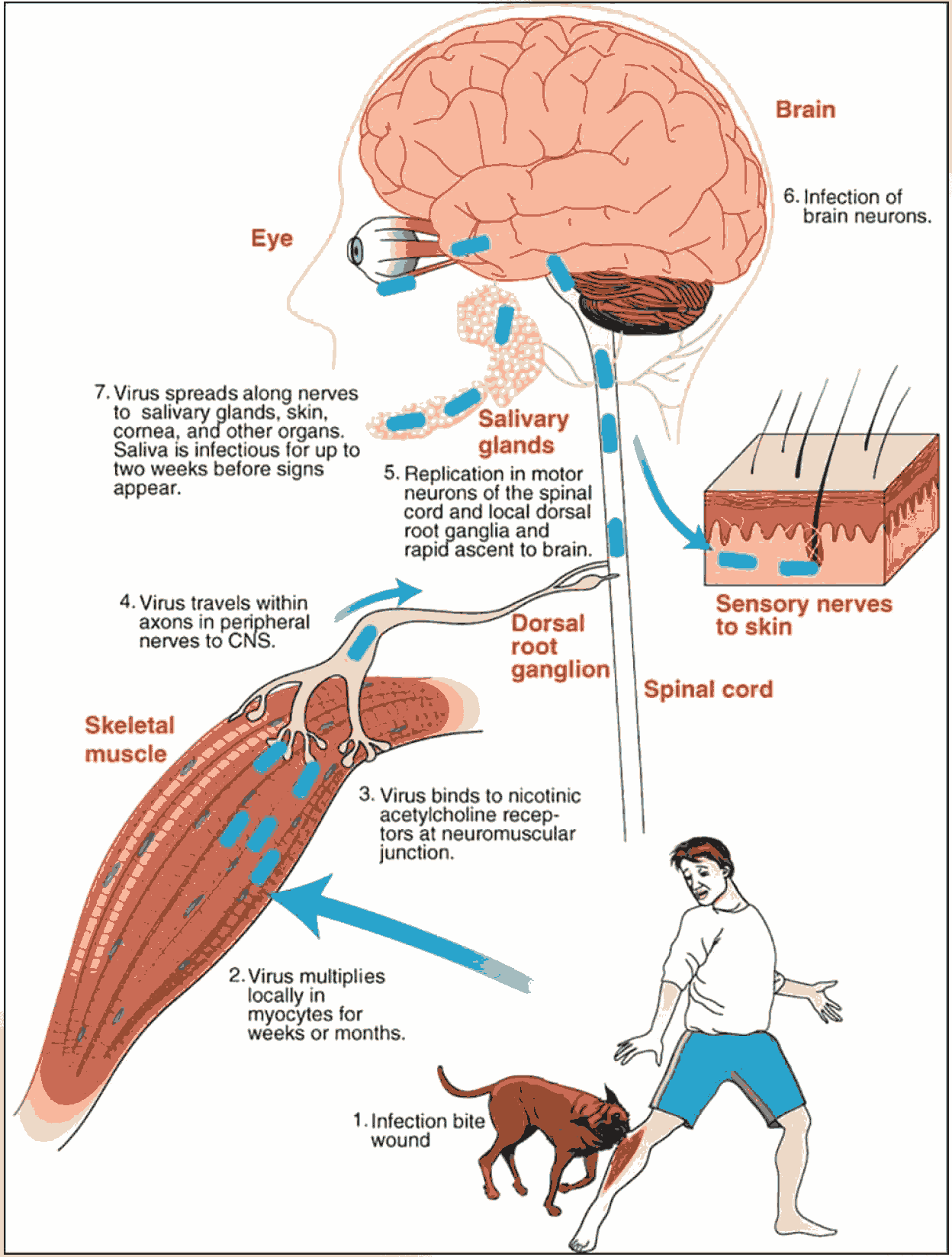
Following a bite, rabies virus multiples locally until it reaches a peripheral nerve synapse. The virus then travels proximally within the axons of peripheral nerves and enters the dorsal root ganglia. Viral replication increases in the motor neurons of the spinal cord and dorsal root ganglia, and brain neurons. The virus then spreads centrifugally by anterograde axonal transport to salivary glands, skin, cornea, and other organs. Infection of the salivary glands causes sialorrhea. Continued viral replication within the brain leads to encephalitis and death.
The first symptoms of rabies resemble flu with fever, headache, and weakness. Patients may notice a prickling sensation at the site of the bite. Severe symptoms begin two weeks later. Common symptoms include anxiety, confusion, agitation, delirium, hallucinations, hydrophobia, hypersalivation, and seizures. These symptoms are caused by encephalitis. There is no treatment once signs or symptoms of the disease begin. Rabies is fatal in 99% of cases within 20 days after the onset of symptoms.
Rabies is preventable if viral exposure is promptly followed by wound cleaning, administration of human rabies immune globulin (HRIG), and rabies vaccination. Passive administration of HRIG provides an immediate supply of virus neutralizing antibodies that has a half-life of approximately 21 days. HRIG is intended to provide protective immunity until a patient begins to respond to rabies vaccine. Three cell culture rabies vaccines are licensed in the United States. An active antibody response requires approximately 7 to10 days to develop. Rabies virus neutralizing antibodies generally persist for several years.
Rapid Fluorescent Focus Inhibition Test (RFFIT) can be used to assess the immune response after vaccination. A serological titer greater than or equal to 0.5 international units per milliliter is considered evidence of an adequate immune response. This test is usually not needed unless the person is immunosuppressed, there were significant deviations from the prophylaxis schedule, or the patient was vaccinated outside the United States with a vaccine of questionable quality.
CDC recommends using standard precautions when providing care to persons suspected of having clinical rabies, including wearing gowns, goggles, masks, and gloves, particularly during procedures that might result in splashes or sprays from body fluids. Enhanced precautions such as droplet and contact precautions are not considered necessary for prevention of health care–associated rabies virus exposures ()
Several laboratory tests are available for detection of rabies virus. Rabies virus antigens can be detected in a skin biopsy by a direct fluorescent antibody test or immunohistochemistry. Rabies virus antigen is detected using specific anti-rabies monoclonal or polyclonal antibodies.
The LN34 test uses reverse transcription polymerase chain reaction (RT-PCR) to detects viral RNA in skin biopsies, saliva, cerebrospinal fluid, and serum.
Two serological assays are considered acceptable for detecting rabies virus neutralizing antibodies: Rapid Fluorescent Focus Inhibition Test (RFFIT) and Fluorescent Antibody Virus Neutralization (FAVN) test. RFIT can detect rabies virus IgG and IgM antibodies in serum and cerebrospinal fluid. FAVN measures the ability of rabies specific antibodies to neutralize rabies virus and prevent the virus from infecting cells.
Detection of neutralizing antibodies in cerebrospinal fluid or the serum of an unvaccinated individual is considered a positive test for rabies virus infection. These assays cannot differentiate between an antibody response to vaccination or as a result of infection.
References
Noah DL, Drenzek CL, Smith JS, et al. Epidemiology of human rabies in the United States, 1980 to 1996. Ann Intern Med 1998;128:922--30.
De Serres G, Dallaire F, Côte, Skowronski DM. Bat rabies in the United States and Canada from 1950 through 2007: human cases with and without bat contact. Clin Infect Dis 2008;46:1329--37.
Pieracci EG, Pearson CM, Wallace RM, et al. Vital Signs: Trends in Human Rabies Deaths and Exposures — United States, 1938–2018. MMWR Morb Mortal Wkly Rep 2019;68:524–528. DOI: http://dx.doi.org/10.15585/mmwr.mm6823e1external icon
CDC. Recommendations for Application of Standard Precautions for the Care of All Patients in All Healthcare Settings. https://www.cdc.gov/infectioncontrol/guidelines/isolation/appendix/standard-precautions.html



 How to resolve AdBlock issue?