

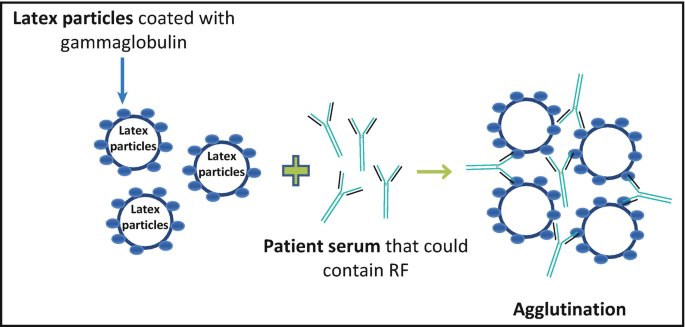
Rheumatoid factors (RF) are autoantibodies that bind the Fc portion of other immunoglobulin molecules. They are typically of the IgM or IgG class, but occasionally may be IgA or IgE. RF form immune complexes with their target immunoglobulin within the circulation or joint fluid. These complexes may reach high concentrations and mediate tissue injury.
Approximately 3% of the general population has low level RF. The incidence increases with age, up to 20% in persons over 65 years old. Only 5% of healthy individuals with a positive RF test will eventually develop rheumatoid arthritis. In higher risk populations, such as first degree relatives of multi-case families, a positive RF test is associated with a much greater risk of developing rheumatoid arthritis. The higher the RF level, the greater the risk of disease. A long latent period of four or more years may occur between detection of RF and development of disease.
Approximately 75 to 80% of patients with rheumatoid arthritis have RF in their sera. Seropositive rheumatoid arthritis patients tend to have more severe disease than seronegative patients and high RF titers are often associated with multiple subcutaneous nodules, necrotizing vasculitis, and poorer long term prognosis. Treatment usually does not alter RF titers; however, they may decrease with gold therapy. Elevated RF titers may not be seen in the serum for the first several months in early RA and may be found in the joint fluid before it is seen in the serum.
Up to 25% of patients with rheumatoid arthritis have negative rheumatoid factor tests. Therefore, a negative test does not rule out the diagnosis of rheumatoid arthritis in a patient who otherwise meets clinical criteria. Female patients and patients with elderly onset rheumatoid arthritis are more likely to be seronegative.
RF is present in only 30% of children with juvenile rheumatoid arthritis. Other joint diseases such as ankylosing spondylitis, Reiters syndrome, Lyme disease, and psoriatic arthritis do not have elevated RF titers.
A positive RF test is not specific for rheumatoid arthritis. High titered RF is present in the majority of patients with Sjogren's syndrome and essential mixed cryoglobulinemia. It also occurs in other connective tissue diseases. RF is present in low titers in a variety of chronic infections and inflammatory disorders, including subacute bacterial endocarditis, tuberculosis, liver disease, and idiopathic pulmonary fibrosis. Most of these conditions are associated with hypergammaglobulinemia and intense stimulation of the immune system. The specificity of RF for rheumatoid arthritis increases when the RF test is repeatedly positive and present in high titer.
Some laboratories measure IgA and IgM RF. IgA RF are less sensitive than IgM RF for the diagnosis of rheumatoid arthritis, but is associated with more severe erosive joint disease.
RF are measured using immunoturbidimetry. Reference range for serum IgM RF is 0-5 IU/mL. Reference range for serum IgA RF is 0-20 CU.
Specimen requirement is one red-top gel barrier tube of blood.
References
Derksen VFAM, Huizinga TWJ, van der Woude D. The role of autoantibodies in the pathophysiology of rheumatoid arthritis. Semin Immunopathol. 2017;39(4):437-446.
Sieghart D, et al. Determination of autoantibody isotypes increases the sensitivity of serodiagnostics in rheumatoid arthritis. Front Immunol. 2018;9:876
Van Hoovels L, Vander Cruyssen B, Sieghart D, et al. IgA rheumatoid factor in rheumatoid arthritis. Clin Chem Lab Med. 2022;60(10):1617-1626



 How to resolve AdBlock issue?