

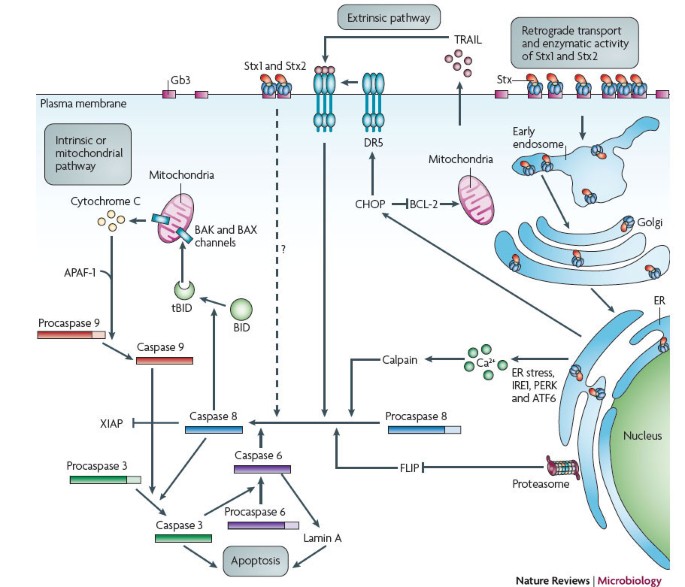
Community acquired diarrhea outbreaks are most often caused by enteric pathogens such as Salmonella, Shigella, Campylobacter, and Shiga toxin-producing E. coli (STEC). Although most strains of E. coli are harmless, E. coli O157: H7 has integrated the gene that produces Shiga toxin, possibly by means of a virus which transferred the gene from Shigella to E. coli.
E. coli are serotyped on basis of their somatic (O) and flagellar (H) antigens. E coli O157:H7 is so named because it possesses the 157th somatic antigen ever identified and the 7th flagellar antigen. The E. coli 0157:H7 serotype and the “non-O157” serogroups i) O26, O45, O103, O111, O121, O145 in the USA and ii) O26, O103, O111, and O145 in the EU, are the major pathogenic STEC serogroups linked to severe human infections
The primary virulence factor of STEC are the Stx toxins. They are named based on their similarity to Shiga toxins produced by Shigella dystenteriae type 1. There are 2 major stx types (stx1 and stx2). An E. coli strain may carry one stx toxin or both. Endothelial cells in the intestine, kidney and brain are the major targets of the toxin.
Additional virulence genes are associated with severe human illness. The eae gene codes for intimin, that damages intestinal cells. Historically, Enterohemorrhagic E. Coli possessed both Stx and eae genes. However, new EHEC serotypes have emerged, such as E. Coli O80:H2, O91:21, O104:H4, AND O113:H21. These serotypes lack the eae gene but are still associated with hemorrhagic colitis.
All STEC strains are pathogenic in humans, capable of causing at least diarrhea. Depending on the presence of certain stx subtypes and the presence/absence of the eae gene, all STEC subtypes may be associated with severe outcomes. These include hemolytic uremic syndrome (HUS), bloody diarrhea (BD), kidney failure, hospitalization, and death. Stx2a is associated with the highest rates of HUS, BD, and hospitalization.
The probability of infection upon any STEC exposure is high since the infective dose can be as low as 1-100 bacteria. Risk factors for developing severe disease include young age (<5 years), immunosuppression, and underlying disease.
STEC infections can occur throughout the year, but are most common during summer months. STEC transmission occurs through consumption of a wide variety of contaminated water and foods, including undercooked ground beef, unpasteurized juice, raw milk, and raw produce such as lettuce, spinach and alfalfa sprouts. Most of these outbreaks are due to fecal contamination from ruminants, such as cattle, sheep, and goats. Transmission can also occur by person to person contact in settings with close contact and substandard hygiene, such as child care and institutionalized care settings.
The onset of illness usually occurs between 3 and 7 days after exposure. STEC infection causes abdominal pain and acute, often bloody, diarrhea secondary to hemorrhagic colitis. Approximately 8% of persons with STEC infection develop hemolytic uremic syndrome (HUS),
The laboratory detects STEC with bacterial culture on sorbitol-containing MaConkey selective media and toxin detection by enzyme immunoassay (EIA). Most 0157 E. coli are sorbitol nonfermenters and produce colorless colonies.
Shiga toxin antigen can be detected by enzyme-linked immunosorbent assays. Compared to culture, they have a sensitivity of 90%. EIA detects both types of toxin STx1 and STx2, produced by both E. coli 0157:H7 and non-O157 strains. EIA requires overnight broth cultures of fecal specimens for maximum sensitivity.
Polymerase chain reaction can detect the stx gene directly from fecal specimens. PCR detects stx subtypes stx1, stx2, stx2c, and stx2d. A positive result indicates the likely presence of Shiga toxin-producing Escherichia coli in the specimen.
The BioFire FilmArray Gastrointestinal Profile utilizes PCR to detect 22 common GI pathogens including viruses, bacteria, and parasites that cause infectious diarrhea. It can detect STEC stx1 and stx2, including E. Coli O157.
Specimen requirement is a fresh fecal sample preserved in transport medium.
References
Melton-Celsa AR, Shiga Toxin (Stx) Classificiation, Structure, and Function, Microbiol Spectr. 2014;2(4): https://doi.org/10.1128/microbiolspec.ehec-0024-2013
Gould LH, et al. Recommendations for diagnosis of shiga toxin--producing Escherichia coli infections by clinical laboratories. MMWR Recomm Rep. 2009;58(RR-12):1-14.
Gavin PJ, Thompson RJ. Diagnosis of enterohemorrhagic Escherichia coli infection by detection of Shiga toxins. Clin Microbiol Newslet. 2004; 26:49-54.



 How to resolve AdBlock issue?