

Hemoglobin S is an abnormal hemoglobin created by a point mutation at the sixth position on the beta globin chain that results in replacement of glutamic acid by valine. This alteration of beta globin causes sickling of red cells under conditions of reduced oxygen concentration.
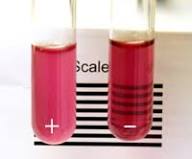
The hemoglobin solubility test (Sickledex, Streck Inc) is a rapid method to detect hemoglobin S in a patient’s blood sample. Blood is mixed with a reagent containing saponin, 2.3 molar potassium phosphate buffer, and sodium hydrosulfite. Saponin is a detergent that lyses red blood cell membranes and releases hemoglobin. Sodium hydrosulfite is a reducing agent that deoxygenates hemoglobin. Deoxygenated hemoglobin S is insoluble in concentrated phosphate buffer and precipitates, while deoxygenated hemoglobin A remains soluble. A clinical laboratory scientist tries to observe black lines on a card placed behind the sample. In a negative screen the black lines are visible because the specimen is clear, but In a positive screen the lines are not visible due to turbidity.
A positive screen indicates the presence of hemoglobin S or another sickling hemoglobin, usually at a concentration of at least 20%. A positive test may be associated with either sickle cell anemia or sickle cell trait, in which hemoglobin S is usually 30-45%. Positive results can also be seen in cases of hemoglobin C, hemoglobin Harlem, and hemoglobin C Georgetown.
False positive reactions can occur in patients with high plasma protein levels, such as occurs in multiple myeloma. Other causes of false positive reactions include erythrocytosis, leukocytosis and hyperlipidemia.
False negative results may occur if the percentage of hemoglobin S is below 20%, if the concentration of fetal hemoglobin in high, or if the total hemoglobin concentration is less than 6 g/dL. Recent transfusion can also give a false negative result.
This test is not recommended for infants less than 6 months of age because they have a high concentration of hemoglobin F. Some hemoglobin variants, such as D-Punjab and O-Arab, that can result in clinically significant sickle cell disorders when paired with hemoglobin S in offspring, are not detected by sickle solubility testing.
Results are reported as positive or negative. Reference value is negative.
Specimen requirement is one lavender-top (EDTA) tube.
Reference
Hematology: Clinical Principles and Applications, Rodak et al., 4th ed. 2012, p. 376



 How to resolve AdBlock issue?