

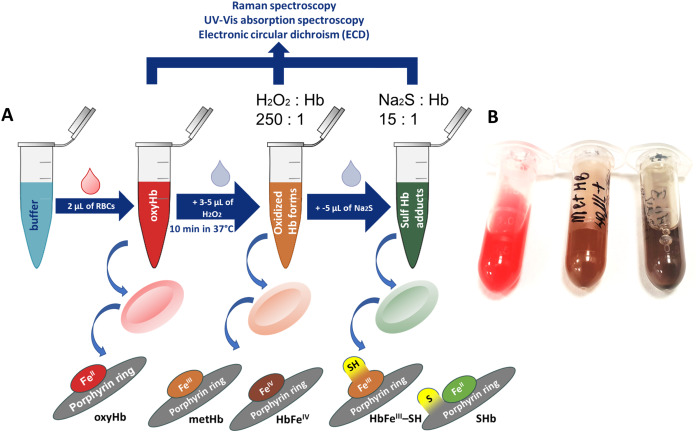
Sulfhemoglobinemia causes cyanosis because oxygen cannot bind to sulfhemoglobin. Sulfhemoglobinemia is most often associated with exposure to chemicals such as trinitrotoluene or zinc ethylene bisdithiocarbamate (a fungicide). Sulfhemoglobinemia can also occur after ingestion of drugs such as sulfasalazine, sumatriptan, furosemide, metoclopramide, and flutamide. It has also been precipitated by hydrogen sulfide producing bacteria such as Morganella morganii.
Symptoms include a blue-green discoloration of the skin and mucous membranes. This discoloration occurs when sulfhemoglobin concentration exceeds 0.5% of total hemoglobin. Sulfhemoglobinemia persists until the erythrocytes containing it are destroyed. Therefore, the blood level of sulfhemoglobin declines gradually over a period of weeks.
Patients with sulfhemoglobinemia often also have methemoglobinemia. There is no specific treatment for sulfhemoglobinemia. Therapy is directed at reversing the methemoglobinemia, if present.
Sulfhemoglobin is detected by co-oximetry. The normal absorption spectrum of oxyhemoglobin has very little optical density above 600 nm, while sulfhemoglobin absorbs light in the range of 600 nm to 620 nm. Methemoglobin absorbs light at 630 nm. A co-oximeter cannot clearly distinguish sulfhemoglobin from methemoglobin. The co-oximeter result may represent a combination of methemoglobin and sulfhemoglobin.
The presence of methemoglobin can be confirmed by the Evelyn Malloy test. The absorbance peak of methemoglobin is abolished with the addition of potassium cyanide, which converts methemoglobin to cyanmethemoglobin. The decrease in optical density is proportional to methemoglobin concentration. Unlike methemoglobin, the sulfhemoglobin peak is not affected by treatment with cyanide.
Reference range for sulfhemoglobin is 0.0-0.4% of total hemoglobin.
Specimen requirement is one lavender top (EDTA) tube of blood. Sulfhemoglobin is stable and does not change in stored or shipped specimens.
References
Finch CA, Methemoglobinemia and sulfhemoglobinemia. N Engl J Med. 1948;239:470–478.
Sulfhemoglobinemia presenting as pulse oximetry desaturation. Aravindhan N, Chisholm DG. Anesthesiology. 2000;93:883–884.
Demedts P, et al. Pitfalls in discriminating sulfhemoglobin from methemoglobin. Clin Chem. 1997;431098- 1099.
Van Veldhuizen PJ,Wyatt A, Metoclopramide-induced sulfhemoglobinemia. Am J Gastroenterol. 1995;901010-1011



 How to resolve AdBlock issue?