

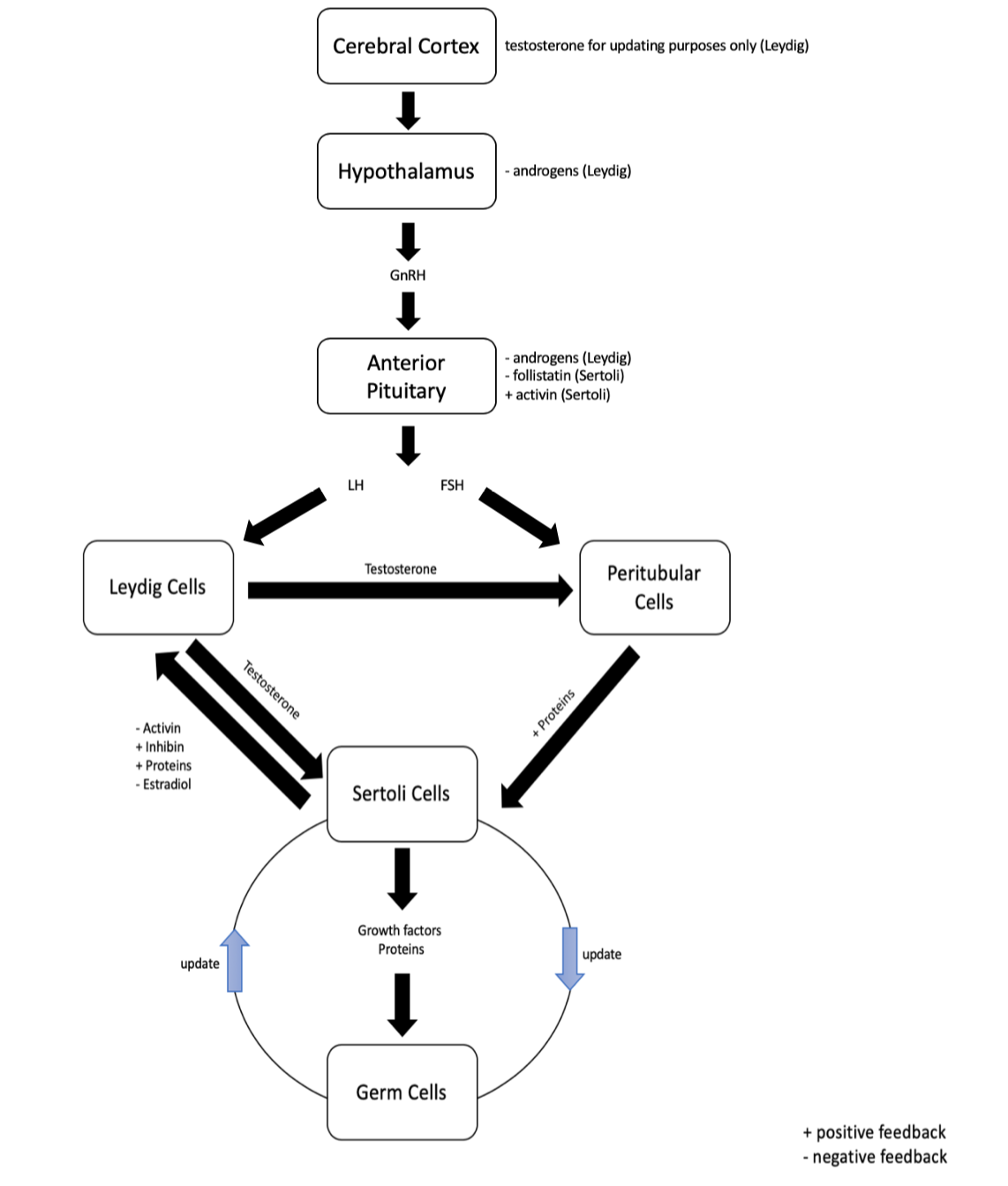
Testosterone is the primary androgen produced by the Leydig cells of the testes and is responsible for sexual differentiation and male secondary sex characteristics. Young men exhibit a diurnal pattern of testosterone secretion, with a peak at about 08:00 and a nadir at about 20:00. Levels increase after exercise. In women, levels are 5 to 10% of male levels.
Testosterone is a systemic hormone that affects many organs.Target organs include male sexual organs, muscle, fat, bone, skin, liver, kidney, brain and bone marrow. Testosterone can have a direct effect or be converted to dihydrotestosterone (DHT) by the 5-alpha-reductase enzyme, which is present mainly in liver, skin, prostate, and external genitalia.
Testosterone secretion is regulated by luteinizing hormone (LH), which acts on the Leydig cells of the testes to stimulate synthesis and secretion of testosterone. LH is secreted by the pituitary gland under the control of hypothalamic peptide gonadotropic releasing hormone (GnRH). Testosterone, DHT and estradiol exert negative feedback on GnRH secretion. Lowering testosterone levels results in increasing LH secretion in an attempt to correct the testosterone deficit. Conversely, raising testosterone levels inhibits LH secretion and reduces endogenous production of testosterone.
Testosterone circulates in the blood 98% bound to protein. In men, approximately 40% is bound with high affinity to sex hormone binding globulin (SHBG) and approximately 60% is bound weakly to albumin. The testosterone fraction that is bound to albumin dissociates freely in the capillary bed, becoming available for tissue uptake. Only 2 to 3% of testosterone exists in the free state. All non-SHBG bound testosterone is considered to be bioavailable.
Measurement of serum testosterone concentration is useful in the evaluation of hypogonadism, infertility, impotence and replacement therapy monitoring in males and hirsutism and virilization in females. Testosterone levels may also be helpful in the evaluation of ambiguous genitalia and precocious puberty in children.
Testosterone dependent changes of puberty can begin from age 10 to 14. In early puberty, testosterone levels initially increase during the night and return to prepubertal levels by morning. As puberty progresses, testosterone levels eventually remain elevated throughout the day. Measurement of an early morning testosterone level is indicated as part of the work-up for precocious puberty, which is defined as the onset of pubertal changes before age 9, and in the work-up of delayed puberty, which is the lack of pubertal changes by age 14. Testosterone is usually increased in precocious puberty.
In adult men, serum testosterone is decreased in both testicular and pituitary failure. The manifestations of hypogonadism are loss of libido and reduced volume of ejaculate. Often hypogonadal men may not offer specific complaints, but may present with scant facial, axillary and pubic hair; pale, fine wrinkled skin; eunuchoid body habitus; small or atrophic testes or prostate; and mild normocytic anemia. They may complain of decreased vitality and energy and mood changes including depression. More advanced cases may have decreased muscle mass, increased body fat, decreased bone mineral density and anemia. The diagnosis is confirmed by a low serum testosterone concentration. If LH and FSH are elevated, the problem is primary testicular failure. Testosterone levels may also be decreased in hepatic cirrhosis and severe obesity.
Two conditions are associated with male sexual dysfunction and elevated total testosterone level: hyperthyroidism and the syndromes of androgen resistance. Hyperthyroidism causes an increase in SHBG, which elevates total but not free testosterone. Androgen resistance is associated with a defective androgen receptor or 5-alpha reductase deficiency. Exogenous testosterone or testosterone precursor over-treatment or abuse can also result in elevated serum testosterone levels.
Female hirsutism is caused by excess androgen secretion by either the adrenal glands or ovary. Virilization or rapidly progressive hirsutism suggests a tumor is present and requires prompt investigation.Testosterone is a good indicator of ovarian function, while dehydroepiandrosterone sulfate (DHEA-S) is a good indicator of adrenal function. A serum total testosterone level above 200 ng/dL is indicative of ovarian stromal hyperthecosis (a benign condition) or an adrenal or ovarian tumor. If the total testosterone is less than150 ng/dL then a tumor is unlikely.
The polycystic ovary syndrome is the most common hormonal cause of anovulation and hirsutism. Most women will have slightly elevated testosterone, elevated LH, and normal FSH. The differential diagnosis of polycystic ovary syndrome includes hyperprolactinemia, acromegaly and congenital adrenal hyperplasia.
Testosterone circulates in the blood 98% bound to protein. In men, approximately 40% is bound with high affinity to sex hormone binding globulin (SHBG) and approximately 60% is bound weakly to albumin.The testosterone fraction that is bound to albumin dissociates freely in the capillary bed, becoming available for tissue uptake. Only 2 to 3% of testosterone exists in the free state. All non-SHBG bound testosterone is considered to be bioavailable.
After the age of 40 years, men’s total testosterone levels begin to decline about 0.4% per year. Men with chronic illnesses have testosterone levels that are 10–15% below that of healthy age-matched men. SHBG increases with age, causing bioavailable testosterone to decrease to a greater extent than total testosterone. Gonadotropins usually do not increase above the normal range with aging.
Young men have a circadian rhythm of testosterone, with the zenith occurring in the morning between 0600 and 0800 hours and the nadir in the late afternoon between 1700 and 1800 hours.This circadian rhythm disappears in elderly men. The difference in testosterone levels between young and elderly men is most pronounced when measurements are made in the morning.
Common practice has been to order both total and free testosterone in the evaluation of testosterone deficiency. To meet the growing demand, most laboratories measure free testosterone with an automated androgen analog immunoassay. Unfortunately, an increasing number of studies have demonstrated that these free testosterone assays do not accurately measure free testosterone and are often falsely low. The Endocrine Society recommends against the use of automated free testosterone assays.
The Endocrine Society Clinical Practice Guideline does not recommend screening for androgen deficiency in the general population. The Guideline recommends making a diagnosis of androgen deficiency only in men with consistent symptoms and signs and unequivocally low serum testosterone levels. The initial test should be a total testosterone level measured on a sample collected during the morning. Low levels should be confirmed by repeat testing of total testosterone. Men who have total testosterone levels near the lower limit of normal or who may have a sex hormone binding globulin abnormality can be further investigated using bioavailable testosterone levels.
The American Urological Association considers a testosterone level below 300 ng/dL to be clinically low, whereas the Endocrine Society sets its lower limit of normal at 264 ng/dL. Some physicians do not prescribe testosterone replacement therapy unless a patient has a testosterone level less than 200 ng/dL.
Testosterone is measured by an electrochemiluminescence immunoassay. Reference ranges are age and gender dependent. A typical adult male reference range is 240-950 ng/dL. A typical adult female reference range is 8-60 ng/dL.
Specimen requirement is one plain red top tube of blood.
References
Bhasin S, et al. Testosterone therapy in adult men with androgen deficiency syndromes: an endocrine society clinical practice guideline. J Clin Endocrinol Metab, 2006;91:1995-2010.
Bhasin S, et al, Testosterone Therapy in Men with Androgen Deficiency Syndromes: An Endocrine Society Clinical Practice Guideline, J Clin Endocrinol Metab, 2010;95(6):2536–2559.
Sargis RM, Davis AM, Evaluation and Treatment of Male Hypogonadism, J Amer Med Assoc, 2018, published online March 17, 2018.
Travison TG, et al, Harmonized Reference Ranges for Circulating Testosterone Levels in Men of Four Cohort Studies in the USA and Europe, J Clin Endocrinol Metab, 2017; DOI: 10.1210/jc.2016-2935.
Vesper HW, et al. Serum Total Testosterone Concentrations in the US Household Population from the NHANES 2011-2012 Study Population. Clin Chem. 2015;61:1495-504



 How to resolve AdBlock issue?